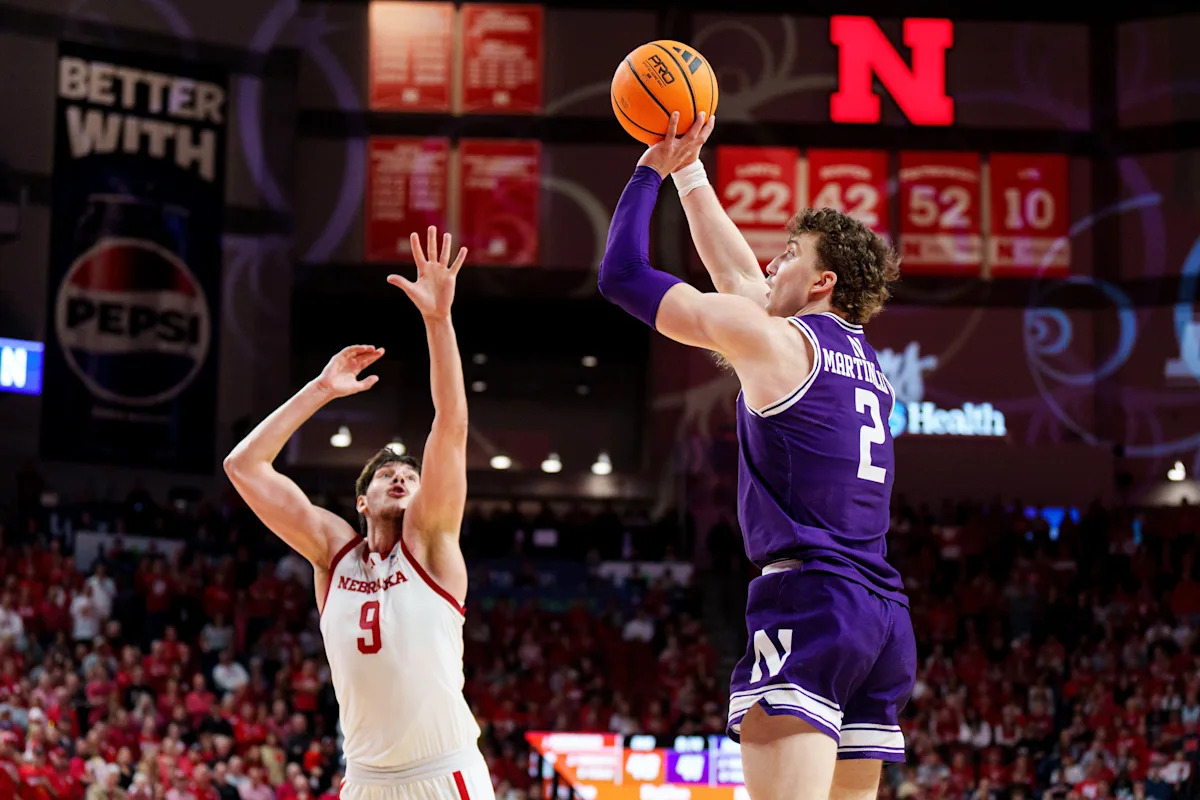
Tre Singleton drove into the lane and converted an and-one for the ’Cats to NU a 20-12 lead with 6:11 remaining in the first half. The Cornhuskers already had eight turnovers and Northwestern, despite missing a handful of wide-open looks and committing a few giveaways of its own, held an eight-point advantage. For a stretch, the ’Cats dictated the pace and forced Nebraska into uncomfortable possessions. That cushion vanished quickly.
The next 13 minutes saw Northwestern and Nebraska locked a tight back-and-forth battle, and Northwestern clung to a 38-35 lead with 13:16 to play. Even with the edge, many NU fans likely sensed what might come given the season’s pattern. That feeling proved accurate. In the game’s final 13 minutes, the Cornhuskers outscored Northwestern 33-11, pulling away for a 68-49 win in a game that felt far more competitive than the final margin suggested.
Advertisement
“Well, I wish the game was 28 minutes,” head coach Chris Collins said. “You know, for two games in a row, Michigan and Nebraska, we played 28 minutes of really good basketball and then 12 minutes of really poor basketball.”
Second-half collapses have defined much of Northwestern’s season. Tournament hopes might look very different had NU managed to close out even a fraction of its narrow losses against Michigan, Nebraska on the road, Illinois at home, Minnesota, Ohio State, Virginia, Butler and Michigan State, to name a few.
The explanation has been consistent. Defense and shooting continue to undermine progress. Defensively, Northwestern allowed just 35 points through the first 27 minutes before surrendering 33 in the final 13. The ’Cats repeatedly left Pryce Sandfort open as he caught fire, and the junior forward finished with 29 points and six threes. He is the one Nebraska player NU could not afford to lose track of, yet he consistently found space on the perimeter.
“We’re starting three true freshmen and they’re learning,” Collins said. “You know that and there’s no substitute for, I’m not sure there’s any other teams in the league starting three true freshmen.”
Advertisement
That youth is partially to blame for the late game defensive struggles. The freshmen are still adjusting to the defensive system and the demands of playing a full 40 minutes at this level. Collins is betting that the development of Singleton, Jake West and Tyler Kropp will pay dividends in the coming years. At times, though, Northwestern simply loses focus defensively, and it has proven costly.
Shooting has been just as problematic. The ’Cats went 3-for-15 from beyond the arc and are shooting 31.1% from three on the season, a figure that makes it difficult to win in the Big Ten. Beating Nebraska often requires converting perimeter looks when the defense collapses.
As Collins explained, “The other night you watched the game, I think Purdue shot 46 threes. That’s what their defense gives up because you get them in rotation, you have the ability, you got to make shots and we just weren’t able to do that.”
Three-point shooting remains one of the team’s biggest flaws. Collins acknowledged as much, saying, “We’re just not a very good shooting team. So that hurts us. You know, when we get them in rotation, we don’t have very confident shooters right now, which makes it hard.”
Advertisement
It is surprising, though, that Collins has not turned to two of his better perimeter shooters in Max Green and K.J. Windham. Green has struggled defensively, which may explain his absence, but it is notable that he was starting just a few games ago and is now completely out of the rotation. Rotation decisions have fluctuated throughout the season, with players serving as key contributors one night and disappearing the next. It’s a conversation for another time.
Windham’s lack of playing time in recent months is harder to explain. He is shooting 34.3% from three and has graded out as a positive defender this year. In his most recent appearance against Illinois, he knocked down a three, played aggressively and looked comfortable. When Collins openly acknowledges the team’s shooting limitations, it is fair to question why two capable shooters are not seeing the floor.
The rotation questions are part of the equation. The broader issues have remained consistent: defensive lapses, inexperience, shooting inconsistencies and rebounding. Northwestern was outrebounded 40-24 by a Nebraska team that is not known for dominating the glass, a gap that compounded the second-half breakdown.
The remainder of the season now becomes a test of growth. The ’Cats will continue developing their young core and searching for late-game poise in the weeks ahead.
Opportunities have been there. Finishing them has not. What remains now is proving that something was learned.
