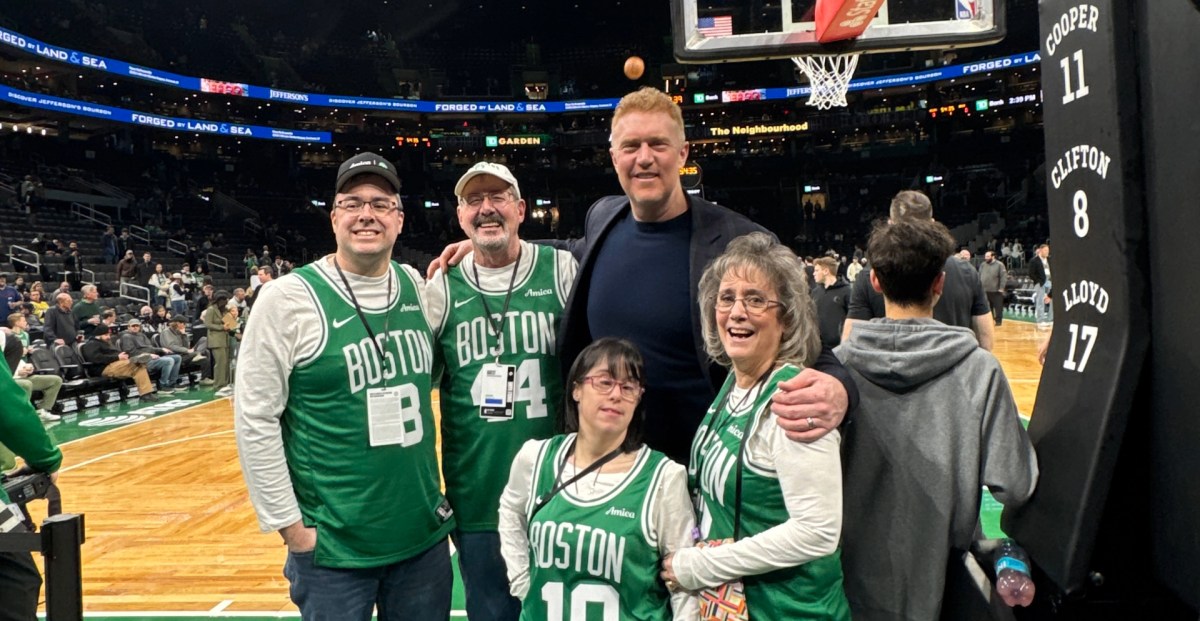
Michael Bullock has admired the Boston Celtics for as long as he can remember. His father, James Bullock, introduced him to the team at birth (literally), and rather than revere their 18 championships, Michael has learned far more from his favorite team.
“My dad has a strong attachment to the Celtics,” Michael told CelticsBlog. “He played most of his adult life and loved watching the Celtics on TV. He has followed them most of his life. The first Celtics game we watched together was at the hospital when I was born. He even attended a pregame demonstration of basketball skills in 1969 at the old Boston Garden, where Red Auerbach, Bill Russell, and Sam Jones demonstrated skills.”
Growing up in East Providence, Rhode Island, sports were a constant in the Bullock household and it wasn’t just basketball. The Bullock family’s passion for New England sports ran deep, but for Michael, it was never about the flashy highlights that would end up on ESPN the next morning. Instead, it was about the core principles that sports teach about life — lessons that often get lost amongst fans, athletes, and coaches — that inspired him more than anything else.
In 1996, before graduating from high school, Michael dedicated himself to participating in the Special Olympics.
“I first got involved with Special Olympics Rhode Island after watching my twin sister (Jessica) compete,” he said. “I like seeing all the athletes with special needs competing and having a lot of fun, so I thought I would join. I always liked basketball and track, and track and field was another sport that I played, so I could be part of the team.”
It’s a journey that has spanned 30 years for Michael, during which he has been involved in nearly everything imaginable. From basketball to bowling to track and field, he’s always remained committed to his belief in promoting inclusion. He has run the 100-meter, the 200-meter, and the 4×100 relay. However, it is on the basketball court above all else that Michael finds the greatest joy, relishing something he holds especially near: the importance of teamwork.
While most fans with a devotion as strong as Michael and his family’s to the Celtics dream of setting foot on the iconic parquet under the bright lights, Michael set his sights on something different. He wanted to light the way for inclusion and awareness, so that those like him, his sister, and the thousands he has met over decades through Special Olympics Rhode Island could follow his example and reach the same heights his lifelong mantra has taken him.
“You can do anything if you put your mind to it,” Michael said. “I do it by attending Athlete Leadership University as a facilitator and working on the podcast called ‘Beyond The Medal.’”
In recognition of Michael’s dedication to spreading his message, Amica and the Celtics honored him through their collaborative Beyond the Patch initiative. He and his family were invited to Boston for the Feb. 1 home game against the Milwaukee Bucks, enjoying a VIP experience that included behind-the-scenes access, exclusive meet-and-greets, and courtside seats to the team’s 107-79 victory at TD Garden.
The invitation initially left Michael in disbelief, James recalled.
“Michael was thrilled when he found out that we would be getting courtside seats and access at the Celtics game,” James told CelticsBlog. “He is a big fan of all Boston sports and could not believe that he would get a chance to see his favorite Celtics players up close.”
The game was especially memorable as it coincided with Pioneer’s Day at the Garden, marking the first time the Celtics and Bucks honored the 75th anniversary of the NBA’s first Black players — Chuck Cooper, Earl Lloyd, and Nat “Sweetwater” Clifton. Both teams wore commemorative jerseys featuring 1950, the year Cooper, Lloyd, and Clifton broke the league’s color barrier, along with an NBA Pioneer’s Classic patch. On the court, Jaylen Brown delivered the pregame address and led all scorers with 30 points, while Anfernee Simons, in his final game in a Celtics uniform, added 27 off the bench.
Midway through the game, Michael and his family were featured on the Garden’s jumbotron, introduced to the crowd, and greeted with a round of applause from the more than 19,000 fans in attendance.
As a father, the experience was truly unforgettable for James. It was surreal watching his son honored for his 30 years of participation in the Special Olympics, all in one night filled with moments and memories that the entire family could share and carry with them forever.
“There were so many wonderful moments, it’s hard to know where to start,” James said. “Getting to meet Derek White and have him sign our jerseys. Being on the floor to see the players warm up, getting to have lunch at the Legends room with Leon Powe, and the great courtside seats we had. But I would have to say that the two best moments were when Mike and his twin sister Jessica got to bring the game ball to center court, and when they showed the AMICA video on the big screen, and everyone cheered for Michael. That was one of the proudest and happiest moments of our lives.”
Founded in 1968 in Chicago, Illinois, the Special Olympics has grown into a global movement. Today, more than 5.5 million athletes with intellectual disabilities from over 172 countries participate worldwide, with numbers continuing to rise. The 2015 Special Olympics World Summer Games in Los Angeles drew an estimated 500,000 spectators and featured roughly 6,500 athletes and 3,000 coaches, making it the largest sports and humanitarian event in the world that year.
Those numbers don’t capture the profound impact the event has on millions worldwide — an effect no statistic could fully measure.
James has watched as SORI has helped foster Michael’s self-confidence and social growth, shaping him into someone who takes initiative and celebrates those around him. Through leadership roles and participation in competitions, Michael has developed skills that extend far beyond athletics. He’s seen firsthand how these experiences have transformed the Michael he knew growing up.
“When he was younger, Michael’s autism made it difficult for him to try or experience new things,” James said. “He was very shy and reluctant to engage. Being part of Special Olympics is a big part of his social development, both athletically and socially. Besides the athletic side of Special Olympics, he has taken part in a variety of Special Olympic programs that promote athlete leadership, public speaking, etc. He even became part of the local cable television show that the Special Olympics of Rhode Island produced.
“There’s a yearly fundraiser, ‘The Torch Run Plunge,’ where people jump into the freezing ocean to raise funds. There was a special law enforcement group that decided to do a super plunge, plunging every hour on the hour for 24 straight hours. When Michael saw this group, he turned to us and said, ‘These people are doing this for all of us Special Olympics athletes. I would like to do this as well, to show everyone that Special Olympics athletes are capable.’ Last year, that group raised over $1,000,000 in total fundraising. We were SO proud of him.”
The past three decades haven’t only shaped Michael — they’ve reshaped James as well. Watching his son grow through competition and the deeper lessons sports instill has steadily shifted James’ perspective for the better. The impact of the Special Olympics on Michael and his family cannot be overstated, nor can what the movement teaches those who witness it, even from the sidelines.
Last year alone, more than 1,000 athletes took part in the Special Olympics Rhode Island Summer Games.
“Watching Michael compete in Special Olympics has only enhanced my belief in how perseverance, sportsmanship, and teamwork can improve/shape the life of a special needs athlete,” James said. “Whenever Michael is on the podium to accept his medal, he always congratulates the other athletes on the podium. It has helped shape him into the caring adult he has become. My wife and I coached the East Providence team for Special Olympics of Rhode Island for 23 years. In every practice and game we saw, the Special Olympics had a positive effect on all the athletes in our group, in one way or another. The friendships and confidence that come from being on a team are immeasurable.”
