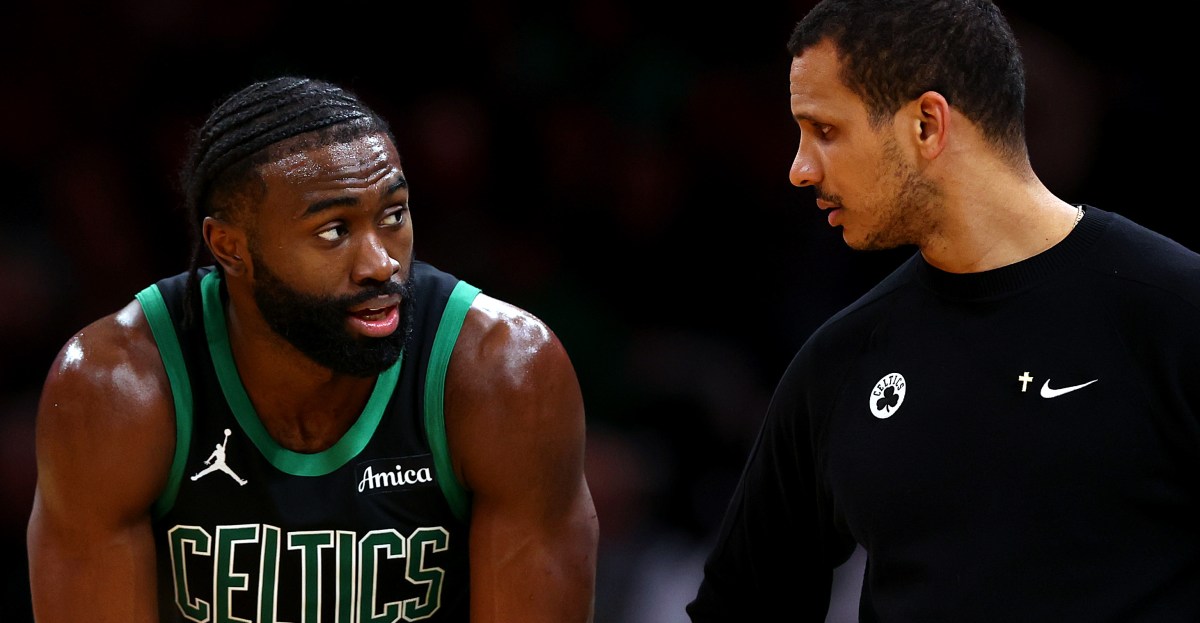
After 54 games, the Boston Celtics have the third-best Net Rating in the NBA, and I still cannot wrap my mind around it. How is it possible that a team that lost its best player and its most important rim protectors, built a roster with young players and minimum contracts, and still kept winning at a high level? How can it be both? It shouldn’t — but it is.
What is even more intriguing is that the Celtics’ overachieving season is built on smaller statistical paradoxes that help us better understand how they’ve been able to win so many games.
The Celtics’ overall Net Rating, per cleaningtheglass.com (that removes garbage time), is +7.3 so far this season, ranking them third between the Detroit Pistons (+8.6) and the San Antonio Spurs (+6.2). Yet, depending on who is on the court, the Celtics’ Net Rating varies from +3.0 to +20.3.
To give it some context, the Denver Nuggets’ overall Net Rating is +3.8, and they are considered by many analysts to be the second-best team in the West after the Thunder. So, at their worst, the Celtics are still a very competitive team. But the paradox lies in the players’ on-court Net Ratings.
Looking at the numbers in the chart below, it is pretty clear that the Celtics’ overall performance is at its worst when the Celtics’ best player is on the court — which shouldn’t be the case. But it is.

So how can this be possible? Well, the numbers show that the Celtics’ offensive level is pretty stable with or without Jaylen Brown on the court: a 120.6 offensive rating with him and 121.6 without him. Boston isn’t as aggressive on the offensive boards when he is playing, leading to fewer second chances. However, when he is on the court, both shooting efficiency and free-throw rate improve.
Defensively, however, the Celtics are allowing a 116.7 offensive rating to their opponents with JB on the floor. Yet, once he sits, the defense steps up and the opponents’ offensive rating drops to 107.3 points allowed per 100 possessions. That is a better defensive rating than the OKC Thunder this year.
When JB is on the bench, the Celtics become far better at forcing turnovers and at limiting opponents’ free-throw attempts. There is also a significant drop in opponents’ shooting efficiency when he is sitting. From my understanding, this is caused by three factors.

First, his backups are absolute madmen on defense. Hugo Gonzalez, Baylor Scheierman, and Jordan Walsh have shown that they are here to play hard and defend at all costs. Second, Jaylen Brown mostly plays against opposing starters — but for what it’s written, this is also the case for Derrick White, and we don’t see the same pattern in his numbers. And third, the offensive load that Jaylen Brown has to carry influences his impact negatively on the other end, leading to more lapses in the Celtics’ defense.
Can the Celtics keep performing like one of the best teams in the league without their best players? So far, the Celtics have posted a +14.3 Net Rating without Jaylen Brown (and Jayson Tatum) — but how long can it last? The numbers also show how much this Celtics team needs Derrick White on the court, despite his offensive struggles this season.

The numbers above clearly show that as long as Derrick White is playing, the Celtics can compete at the highest level. Knowing that Jayson Tatum is coming back, these paradoxical numbers give hope that this group might be talented enough to make a deep playoff run, considering how good they can be even without their two stars on the court.
The rim is better protected without rim protectors
With the departures of Luke Kornet and Kristaps Porzingis, the defense was supposed to perform at a lower level, especially when it came to rim protection. Yet, while the defense is slightly worse than last year (from 5th to 8th in defensive ranking per cleaningtheglass.com), it isn’t because of rim protection. In fact, it has somehow improved when looking at both volume and efficiency numbers. Once again, it is quite paradoxical.
Opponents’ rim accuracy didn’t rise as we might have expected. The Celtics remain in the top 10 at limiting efficiency at the rim, thanks to Jordan Walsh, Neemias Queta, and Derrick White. As the Celtics lost their three best inside defenders, others rose to the occasion and helped the team protect the paint.

Not only were the Celtics able to remain elite at limiting efficiency at the rim, they are now the best team in the league at reducing the volume of shots allowed there. Opponents are taking only 24% of their shots at the rim against Boston, while the league average sits at 31%. So, if the Celtics have remained elite at rim protection without their best rim protectors, why isn’t the defense as good as last year?
Well, size still matters. The Celtics have struggled to contain opponents’ offensive rebounding, dropping from 7th to 16th in defensive rebound rate. Also, the increased aggressiveness from the wings and the lack of size inside give opponents more opportunities at the free-throw line, as Boston fell from 1st to 13th in opponent free-throw rate.
Efficient scoring without efficient scorers
Per basketball-reference, the league-average offensive efficiency is around 115.5 points per 100 possessions, and the Celtics are five points per 100 possessions above that mark. Logic would suggest that the Celtics’ biggest scorers — let’s say all players with above a 20% usage rate — are also above league-average efficiency.
How could a team be five points per 100 possessions better than league average if its four biggest scorers are at or below league-average efficiency? It shouldn’t — but it is.
It is paradoxical, and it works.
Indeed, Derrick White is 10% below league-average True Shooting, Jaylen Brown is 1% below, while both Anfernee Simons and Payton Pritchard are right at league-average level. Yet, the Celtics have the second-best offense in the NBA. How?
It comes down to two things. First, as one of the best defensive teams in the league, the Celtics generate more possessions than their opponents. Through aggressive defense, controlling the boards, and limiting turnovers on offense, they are less dependent on pure shooting efficiency because they simply take more shots than their opponents.

Second, it comes from the rest of the roster and how the coaching staff optimize them. While the main guys are struggling to reach league-average efficiency, the rest of the team is thriving — and that is because Jaylen Brown and the other creators are generating space for the role players. Luka Garza, Neemias Queta, Josh Minott, Jordan Walsh, and Baylor Scheierman are all at least 5% more efficient than league average.
That is yet another Celtics paradox that circles back to the first one. This team is elite because its role players are able to perform at their highest level.
Because of Joe Mazzulla and his staff. Because of Brad Stevens and his roster construction. Because of Jaylen Brown, Payton Pritchard, and Derrick White — their gravity, their creation, their leadership — they have created an environment where the stars can struggle, and the team still thrives.
That may be the biggest paradox of all.
This version of the Celtics isn’t dominant because everything is perfect. It’s dominant because the system absorbs imperfection. Because when one pillar weakens, another strengthens. Because when the stars are inefficient, the role players become surgical.
But somehow, it does — and that may be the clearest sign yet that this team is far more resilient, and far more dangerous, than we initially believed.
