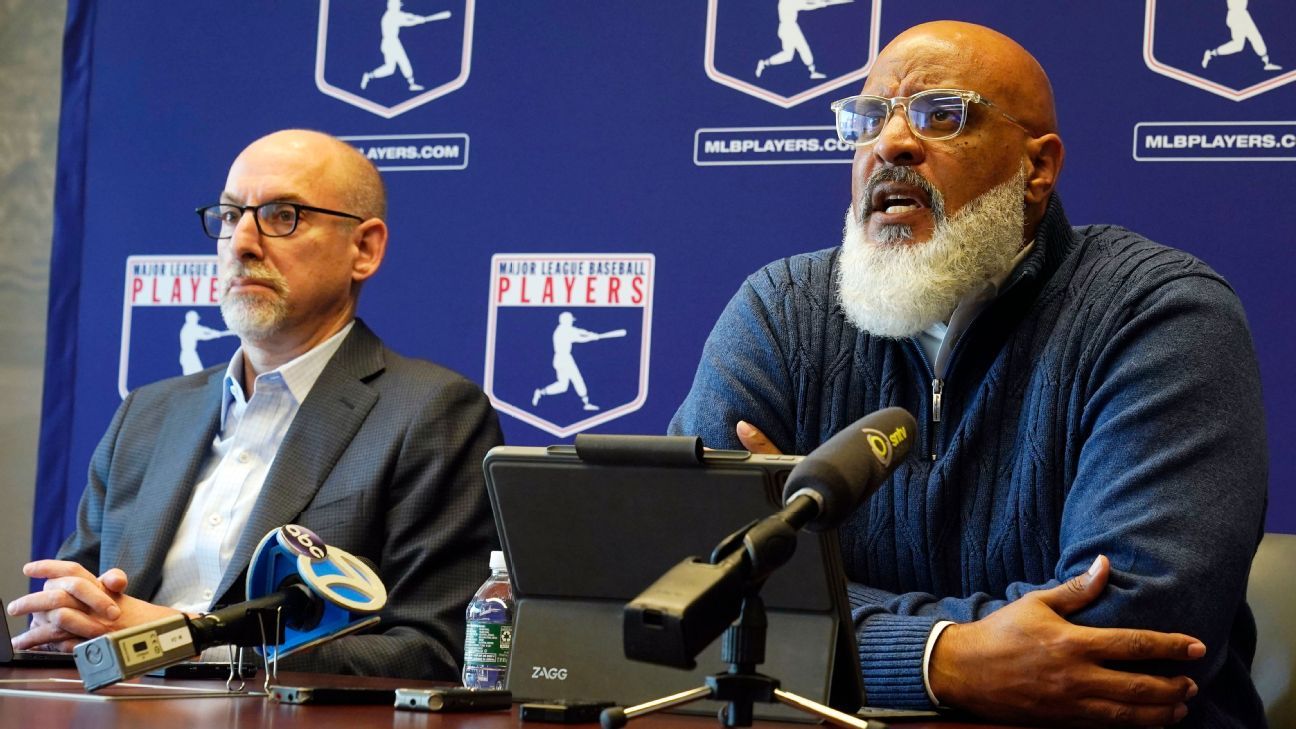
Get past the salaciousness of Tony Clark’s downfall, past the alleged inappropriate relationship with his sister-in-law — who was also an employee of the union he ran — past the federal investigation into his stewardship of the Major League Baseball Players Association, past the detritus of a decade-plus-long tenure that imploded spectacularly Tuesday, and what’s left is opportunity. Amid one of the lowest moments in more than half a century since its formation, the MLBPA can use Clark’s stunning resignation to help save the 2027 season.
Whoever ascends to the MLBPA’s vacated executive director position, which the union expects to fill as early as Wednesday, will inherit an organization facing its greatest challenge in a generation: MLB owners are intent on securing a salary cap upon the expiration of the current collective bargaining agreement Dec. 1. Players are primed to fight it. For the fight to be effective, though, they must acknowledge that the greatest priority is to ensure no games are missed following the league’s expected lockout. And that is where the players themselves must hold their new leadership more accountable than they did their previous one.
In picking a new union leader, players must make clear what they want. It goes beyond “not a cap.” It acknowledges that the game’s payroll disparity alienates fans and needs a wholesale refresh. It embodies core tenets of creativity, thoughtfulness and open-mindedness, meeting hard-line cap zealots with solution-oriented proposals. It makes less-tenured players and those in the left-behind middle class feel every bit as important as $40 million-a-year stars. More than anything, it positions itself to guide the game away from its various doomsday scenarios and toward compromise.
Whether the league and its owners, who are trying to upend a system that no longer suits their needs, will meet the union where it stands is impossible to say. Perhaps MLB, emboldened by public polling that shows strong support for a cap, will stand firm in its position. If the union presents reasonable alternatives to a cap and the league still refuses to budge, whatever goodwill MLB has built up by saying it cares about competitive balance will vanish.
It’s a tricky balance for the new executive director — with more than a dozen players familiar with the union’s discussions telling ESPN the choice is likely to be Bruce Meyer, the deputy executive director and Clark’s former No. 2, at least on an interim basis through these negotiations. Following a meeting Tuesday afternoon in which some player leaders pushed for a vote to confirm Meyer but were rebuffed by those who wanted first to speak with their teammates, the union plans to confer again Wednesday and weigh its options. Meyer has the backing of most of the eight-man executive subcommittee that serves as the ultimate voice of the players. He negotiated the last labor agreement and is expected to do the same for this one. He is the choice of least resistance.
He does come with history. Two springs ago, former MLBPA attorney Harry Marino organized a group to oust Meyer. Dozens of player leaders, in an informal call with Marino, pledged to support Meyer’s removal. Clark, seeing the attempt at Meyer’s job as an indirect challenge to his own, mobilized allies to help save Meyer, who sent players a letter of more than 2,000 words outlining his achievements. In it, he referenced the 2022 negotiations, in which a 99-day lockout ended when the subcommittee voted 8-0 against MLB’s final offer but was outvoted 26-4 by a rank and file that wanted no part of missing games for the first time since 1995.
“Some players emerged from bargaining disappointed that we did not accomplish more and in particular that we did not miss games to see if more [gains] could be made,” Meyer wrote. “To be clear, I sympathized and still do with these players and this position.”
Nothing in the 2022 negotiations warranted games being lost. It was a near-status-quo deal — a solid one for players, in many respects, but far from the fundamental change to the economic system that MLB seeks today. Certainly Meyer can argue that such a posture is simply meeting owners where they are — that a number of them, sources told ESPN, have said privately that they’re so invested in gaining a salary cap that they feel the 2027 season is a worthy sacrifice to achieve their end.
Any position that depends on sidelining baseball is short-sighted, ill-conceived and exceptionally problematic, and if the players want to maintain any sort of moral high ground, they can’t entertain the notion that the game going dormant benefits anyone. There are plenty of ways to maintain a cap-free game, but they are dependent on the union’s willingness to propose clever paths that satisfy large- and small-market teams, a thorny proposition, yet one in which the union undeniably finds itself.
Owners believe the union is weak, and in some regards, they are correct. The anonymous whistleblower complaint sent to the National Labor Relations Board in November 2024 that accused Clark of a variety of improprieties was initially dismissed by the MLBPA as “entirely without merit.” Between the nepotism that indirectly led to his ouster and the continued federal investigation into other elements of the complaint, its merit grows by the day and speaks to an organization with deeply flawed processes and unreliable checks and balances. It was widely known that Clark had hired his sister-in-law to run the massive new Arizona-based office that current and former union employees derided as “wasteful” and “unnecessary.” No one stopped it.
Despite the failed attempts to expel Meyer in 2024, players emerged from the rebellion intent on the union undertaking a full audit of its finances to highlight any wasteful or inappropriate spending. Instead, Clark commissioned a financial review — a far less in-depth look at the MLBPA’s books — that left players convinced the union’s unwillingness to embrace full transparency meant it was hiding something. It left the Eastern District of New York, which has empaneled a grand jury in its investigation of Clark and the union, wondering the same.
How cynical were the rank and file about Clark? Multiple Cleveland Guardians players, sources said, were planning to discuss whether he would be willing to take a pay cut from his $3.76 million salary before the union abruptly canceled its scheduled meeting with the team Tuesday.
That level of interest, though, is where the union evolves from a group that is often checked out or bored with the intricacies of labor relations into a powerful, intimidating group of 1,200. The MLBPA didn’t earn the reputation as the strongest union in the country during its heyday in the 1970s and 1980s by accident. It set goals, gamed out how to achieve them and banded together. As much as executive subcommittee members Tuesday preached solidarity, that is a characteristic better shown than spoken.
And where that solidarity begins is from the bottom up. A strong labor union guides its leaders, not the other way around. It can have honest conversations about whether, even in an uncapped system, exceptional top-of-the-scale salaries give teams excuses not to spend on the middle class and whether there are remedies. It can say that, yes, the Los Angeles Dodgers and New York Mets are great for players but that that greatness comes with a price that ultimately might hinder the union more than it helps.
Meyer’s leadership style is, as an ally of his said Tuesday, “furious indignation.” He is a fighter first, a born litigator, and while he has rubbed enough players the wrong way to find himself on the precipice of losing his job, they do not doubt his willingness to take on owners. They also know times of great import call for nuance and institutional knowledge, and whoever takes the reins needs to solicit the bright ideas of agents; lean on past union luminaries such as Donald Fehr and Gene Orza for guidance; and recognize that the union staff, for all of the institutional problems that exist, is competent and capable and would thrive in an environment that encourages it to find holistic solutions for complex problems.
There is hope in that, in an MLBPA that, even as MLB lashes at it with cap proposals, doesn’t forget its purpose by getting lost in its opponent’s. The Tony Clark era, home to questionable decision-making, ended with an unresolved federal investigation and a disgraced executive director. The next incarnation of the MLBPA must be something better. It’s not just the union that needs it. The whole game does.
