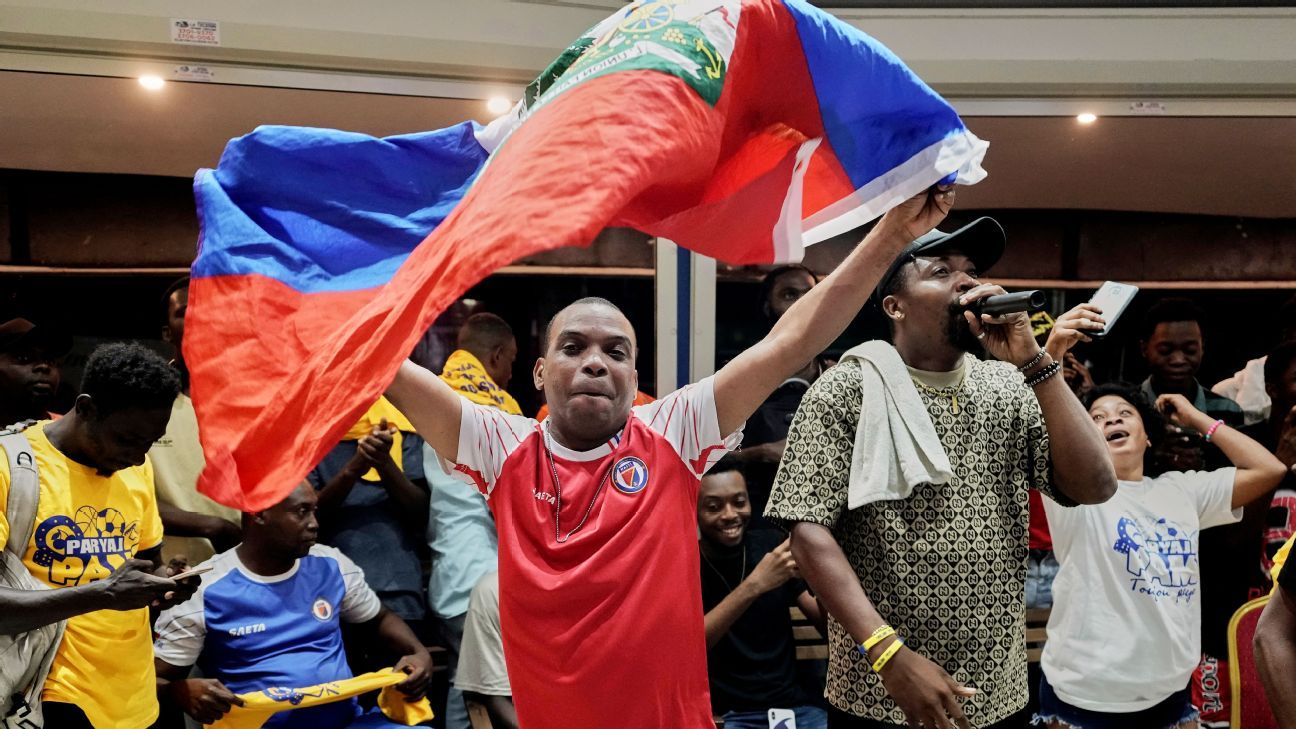
When the Haitian men’s soccer team qualified for the 2026 FIFA World Cup, its first time since 1974, it did so without being able to play in its home stadium or train inside the beleaguered country.
“Which makes this achievement even more remarkable. We’re very proud of this,” said Regine Etienne, Haiti’s acting consular general in Boston. “Their journey demonstrates that there is still hope for Haiti, and that determination and talent can triumph despite adversity.”
Making the World Cup can have that kind of power for a small or troubled country. The Haitian flag will fly with those of some the world’s most powerful nations. Haiti’s citizens, however, will not be able to travel to the United States to cheer them on, a reality that stings for Haitians at home and in the diaspora. Haitians, like citizens from Senegal, Ivory Coast and Iran, face almost a complete travel ban under Trump Administration policy. Despite pleas from those countries, there is no indication President Donald Trump will relent, or that FIFA will pressure the U.S. to make an exception for those who want to travel to the World Cup.
As of Jan. 1, the Trump administration expanded its visa-issuance suspensions to nationals from 39 countries, citing national security and public safety concerns and saying the identified countries could not properly vet their citizens. Four of the countries on the banned list — Haiti, Senegal, Ivory Coast and Iran — have qualified for the World Cup, hosted this year by the U.S., Canada and Mexico.
Under the policy, known formally as Presidential Proclamation 10998, players, team officials and immediate family members from the four countries will be granted visas. While the policy allows for some other exceptions — including those that “would serve the U.S. national interest” — a State Department spokesman said in an email that those would be “quite rare.”
“A visa is a privilege. Visas are not a right,” the spokesperson said in an emailed statement “Under President Trump, the Department of State is administering visa operations in a way that prioritizes the safety of the American people and our national interests, strengthens screening and vetting, and enforces the law.”
The Haitian government “is actively exploring all possible options,” Etienne said. But noted that, “a visa is a sovereign prerogative and remains at the discretion of the relevant authorities.”
One hope for the four World Cup countries might be New York City Mayor Zohran Mamdani, a democratic socialist who had what observers found to be a surprisingly cordial Oval Office meeting with the Republican president in November.
Mamdani said in January that he would appeal to Trump for a travel exception for the World Cup. In a recent interview with ESPN, Mamdani would not say whether he had spoken to Trump — “I’ll keep conversations between the president and myself private” — but said he intends to advocate for affected communities in any way he can.
“It is an opportunity to be seen by a world that often overlooks you. And I’ve heard, especially from Haitian New Yorkers, about what it means that their team is going to be a part of this World Cup, that it’s a recognition of an entire people,” Mamdani said, adding that he will “always make the case” that New York is “a city that the world can visit.”
Mamdani, known for his love of soccer, hosted a watch party for the Africa Cup of Nations final between Morocco and Senegal last month, the first of what he says will be numerous events celebrating New York’s immigrant communities.
A White House spokesman would not say whether the president had spoken to Mamdani or would consider a travel ban appeal, saying in an email, “Thanks to President Trump’s leadership, the FIFA World Cup 2026 will be one of the greatest and most spectacular events in the history of mankind, right here in the United States of America. This event will generate billions of dollars of economic impact and bring hundreds of thousands of jobs to our country. The President is focused on making this the greatest World Cup ever while ensuring it is the safest and most secure in history.”
Haiti, Senegal and Iran will play all their group-stage games in the United States. The Ivory Coast, on the other hand, plays its second group stage game in Toronto, where Canada has a strict vetting process but not a blanket ban. It’s also possible that teams could advance to knockout games in Canada or Mexico, a long shot for all but Senegal.
Sheck Wes, a Senegalese-American hip hop artist raised in New York City, said the ban not only prohibits Senegalese tourists from sharing their passion with World Cup crowds, but also keeps other Americans from seeing a vibrant community that wants to contribute to the event.
“If we’re going back to 1776, back to Benjamin Franklin having to be in Paris and getting help from the French, we’re a country known to ask for help and give help, and this World Cup is a great opportunity for us as a country to be great hosts for these people,” he said.
When the Trump administration announced the bans, it said nationals from the named countries “have been involved with crimes that include murder, terrorism, embezzling public funds, human smuggling, human trafficking, and other criminal activity.”
“Widely unreliable foreign civil documents and lack of authoritative criminal information” make it difficult for the U.S. to vet applicants, the administration said, adding that the government must “exercise extreme vigilance” in the visa-issuance process.
The policy has been attacked by Democrats and a number of civil and human rights organizations as being discriminatory, with Human Rights First describing the policy as “racist” and “a sweeping act of collective punishment.”
Jonathan Grode, a prominent immigration lawyer in Philadelphia, said the inflexibility on immigration runs counter to the Trump Administration’s own business instincts.
“You have (the Department of) Commerce, who understands the significance and importance of (sports diplomacy), and you have the immigration hawk faction, which, irrespective of the financial gain of the country, or what it means as a world leader, they are not interested in that if it goes against the overall objective of how they want to treat immigration,” he said. “And that is really what’s coming to a head here.”
Asked whether FIFA might push for an exemption to the ban, a spokesman for the organization pointed out that FIFA has worked with the Trump administration to create an expedited visa interview process for anyone holding a World Cup ticket. Who ultimately receives a visa, however, is a different matter: “The U.S. government… determines who gets a visa and who is admitted. FIFA is not involved in host country immigration processes.”
Critics said they think FIFA President Gianni Infantino, who has grown close to Trump and awarded the American president the inaugural FIFA peace prize, should press his friend for an exemption.
“It’s very difficult to process,” said Lionel Lucien, a Haitian-American community leader in Boston, where Haiti will play its World Cup opener. “There are people over there that would love to come and that qualify based on some of the requirements. The blank prohibition of Haiti to come for the World Cup is completely against the FIFA mission. It’s hurtful and disrespectful.”
One retired veteran U.S. diplomat, speaking on the condition of anonymity, said the U.S. has legitimate concerns about vetting people from poor or unstable countries seeking tourist visas. Haiti and Iran faced restrictions in previous administrations: “Tourist visas for them are basically rare, if not impossible, to get, and some of it is just logistics,” the former diplomat said. But, he said, a total ban is an extreme reaction.
“There’s a way to handle it that’s sane and measured and meant to solve the problem, and then another to use this completely for an ideological goal, and door ‘B’ is what they’ve chosen,” the diplomat said.
Senegal may be “a poor country, and there is significant fraud,” the diplomat said, “but to see upwardly-mobile citizens going to see their teams is not crazy to think about.”
Iran has been in its own category since the Islamic Revolution in 1979.
“We’ve never had a functioning consular section there since the ‘Argo’ era,” the diplomat said, referencing the film about the 1979 Iran hostage crisis. “And the vetting is quite justified when an Iranian is not an ex-pat or a dissident, someone we already know.
“They’re not just hostile (to the United States) but they’re not sharing information that lets us trust in their identities and their passports. The difficulty in determining that a person holding an Iranian passport is actually that person-how can you trust that?”
Trump’s announcement of the suspensions also stated that foreign nationals from the named countries have “exploited the historic generosity of the United States” by not adhering to the terms of their visas. According to Department of Homeland Security data, Haitians who have received visas over the past several years have overstayed the terms of their visas at a rate far beyond any other country in the World Cup. But that’s an argument for vetting, the diplomat said, not for a blanket ban.
“For Haiti this is not just about soccer, it’s about dignity and visibility,” said James “Reggie” Colimon, a Haitian American who is director of global affairs and protocol for Boston Mayor Michelle Wu. “Sport is supposed to unite the world, but Haiti can’t participate? We are a country where all are welcome, supposedly, in theory, but what we’re seeing is very different.
“When you single out one nation while welcoming others, it creates a credibility gap. No one will ever dispute security doesn’t matter, but there’s an inconsistency in the way we’re doing things. The World Cup already operates under the highest security.”
