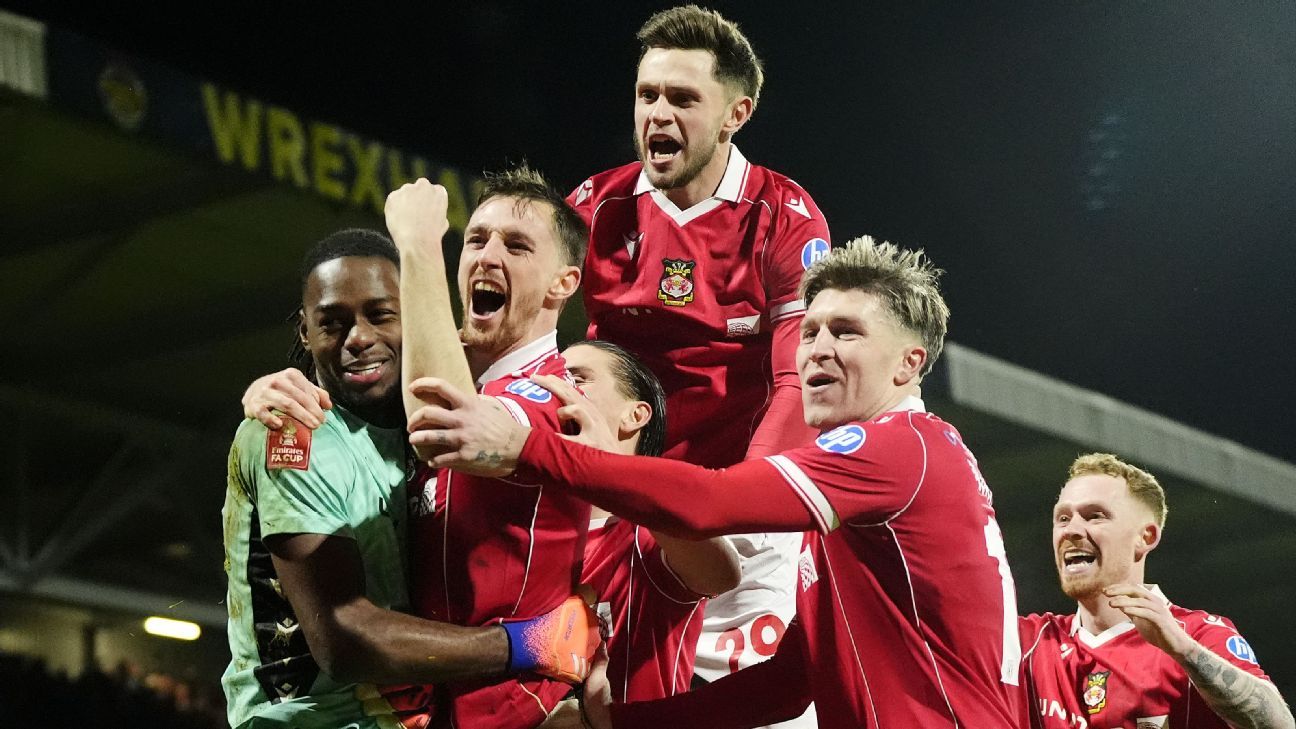
WREXHAM, Wales — Mickey Thomas still holds the distinction of scoring the most famous goal in Wrexham‘s history, even after five years of the Rob Mac and Ryan Reynolds dream factory that has taken the club to the brink of the Premier League.
Nothing yet has topped Thomas’s free-kick goal in a 2-1 FA Cup win against Arsenal in Jan 1992, when Wrexham — who finished bottom of the Football League, in 92nd position, six months earlier — eliminated the reigning league champions at the Racecourse Ground. But Thomas admits his historic goal may soon be eclipsed by even greater moments, following Wrexham’s incredible rise from the fifth-tier National League to the EFL Championship play-off positions since Rob and Ryan completed their £2 million takeover on Feb 9, 2021.
“Wrexham have become a runaway train since Rob and Ryan arrived,” Thomas told ESPN. “I’ve been in football a long time, I’ve seen everything, but the rise has taken my breath away. And the crazy thing about it all is that Wrexham could be playing Arsenal in the Premier League next season.
“When you think about that cup tie in 1992 and everything that has happened to Wrexham since then, the ups and downs, that prospect is absolutely amazing. It would be the greatest football story ever.”
On the day the takeover was confirmed five years ago, after the pair received a greenlight to complete the deal in Nov. 2020, Wrexham secured a 2-1 away win against Altrincham to climb to seventh in the National League. Today, they are 73 places higher in the English football pyramid and will move up to fifth position, three places behind the automatic promotion spots, with a win at home to Millwall on Saturday.
Following three successive promotions, beginning with their elevation from the National League to the EFL in 2023, the Wrexham story may just be weeks away from another incredible chapter.
“Listen, is the structure of this club behind the scenes ready for the Premier League and would there be an immense amount of work to take place [if we get there]?” Wrexham manager Phil Parkinson told ESPN. “Of course, but wouldn’t it be great to have that chance? You’d probably say we weren’t ready for Division One, certainly not the Championship, but I think in football, you just keep evolving as you go along.”
When Wrexham announced their most recent annual financial results in March 2025, which reported a 155% rise in yearly revenue to £26.7 million during their first year back in the EFL after 15 years in the National League, the accounts included a statement of intent from the directors. “The goal of the owners is to grow the team and establish Wrexham AFC as a Premier League club in front of increased attendances and in an improved stadium,” the statement said.
Five years on from day one, the journey from Altrincham to Arsenal is almost complete, with Rob and Ryan zooming towards each of those ambitions at breakneck speed.
Phil Parkinson was Wrexham’s first game-changer. His appointment as manager in July 2021 gave the Rob and Ryan project instant credibility, and offered proof of their determination to revive the club.
Parkinson was an established EFL manager with promotions on his record at Colchester and Bolton. In 2013, he achieved the unthinkable by guiding League Two’s Bradford City to the EFL Cup final, beating Premier League sides Arsenal and Aston Villa on the way. Those results meant he already had “miracle worker” on his resume, but joining Wrexham was a gamble for Parkinson.
“It’s always an element of risk because if you drop into the National League as a manager and it doesn’t go well, where do you go from there?” Parkinson said. “But the more I looked into it and spoke to the owners myself, I realized how serious they were.
“Sometimes when you get a manager’s job, you look at what could be achieved — the potential here is huge. Since coming here, it’s been a roller-coaster really. I don’t think you can describe it any other way. It’s just been incredible to see the club go from the National League to the Championship, but I think what Rob and Ryan have done, in everything they’ve said to anybody, they’ve delivered.”
The headline of Rob and Ryan’s five years at the club is unquestionably the three promotions. No club had ever achieved three straight promotions in the history of English football, dating back to its very first season in 1888, but those successes have coincided with rapid change on and off the pitch.
Since February of 2021, 66 new players have arrived at Stok Cae Ras, at a total cost of £38.8 million, while 76 have left the club for a sum total of nothing as free transfers or loans — including Paul Mullin, the goalscoring hero of the first two promotions, who joined Bradford City last week after spending the first half of this season on loan at Wigan. Ollie Palmer, another key figure in the early promotions, was a £300,000 club record signing from AFC Wimbledon in Jan 2022, but he’s now playing in League Two for Swindon Town.
Wrexham’s squad evolution has seen their transfer outlay rise exponentially. Sam Smith eclipsed Palmer as the record signing when arriving for £2 million from Reading last January, but Smith was then overtaken by Nathan Broadhead when the Wales forward completed a £7.5 million transfer from Ipswich Town last August. Change has become a constant, and on an accelerated scale. Parkinson admits that while it is an essential part of the team’s growth, Wrexham have been determined to ensure that those heroes who played a role in those early promotions are treated with respect.
“It’s been a challenge,” Parkinson said. “We look to sign players that, if we stepped up, would continue with us and we’ve tried to bring that quality in, but then there’s always those players you need to bring better quality in each level, so there are players who have been incredible for us who have moved on. We’ve had to make some tough decisions and let players go — players who have been absolute legends for us at this club.
“But equally, when you step up as quickly as we’ve done, that change has got to happen quicker than we normally expect. That is a tough part of the job, but all you can do in those circumstances is sit down, speak to people respectfully and make sure when they’re leaving that it’s done the right way.
“But you’ve got to keep evolving as a squad because if you stand still, people go past you.”
For those players coming in, though, the attraction of Wrexham — a club on the up with Hollywood glamour sprinkled on top — is clear.
“The immediate attraction was obviously everything on the field, success with promotions, being a winning culture and a team that had stepped up to the Championship for the first time,” George Thomason, a £1.2 million signing from Bolton last summer told ESPN. “But everyone knows the outside noise of the owners and things like that. Just to see the buy-in and the spirit and the culture around the club was something really special.
“I was really delighted when I heard about the interest from Wrexham. They want to keep going right to the top and that’s something that’s very exciting for every footballer.”
The “Welcome to Wrexham” documentary series that has chronicled the team’s rise through the divisions since Season One, first airing in 2022, helped bring worldwide recognition to the club by showcasing the sporting drama as well as the off-field stories of supporters and the local community. But while Wrexham have become a global brand, their stadium remains an outdated lower league venue.
When ESPN met Parkinson and Thomason at the ground, a lack of facilities meant that interviews were staged in a staff kitchen in the bowels of one of the stands and the stadium, which first staged football in 1864, would require a multi-million pound upgrade just to make it fit for the Premier League. While teams only need a minimum capacity of 5,000, with 2,000 seats, to meet minimum Premier League requirements, they must also have high-intensity floodlights for broadcasting purposes, designated areas for cameras and media and secure segregation of supporters.
When Luton Town were promoted to the Premier League in 2023, the club spent £8 million on ground improvements to make their Kenilworth Road stadium — which included an entrance nestled between houses, and a footbridge over a garden — comply with top-flight demands. At Wrexham, work has started on a new 7,500-capacity Kop Stand, which will take the ground’s capacity to 18,000, but it is not due to be ready for months.
“The delivery date is early 2027,” Wrexham CEO Michael Williamson told ESPN. “But the reality is that the completed version of the new stand will probably not be available until the 2027-28 season, so we could be in the Premier League next season with just 10,500 seats.”
Still, when it is completed, the new stand will be in keeping with the glitz and glamour of Wrexham’s Hollywood owners having been designed by Populous, the stadium architects responsible for the Tottenham Hotspur Stadium, the Lusail Stadium, which hosted the 2022 World Cup final, and The Sphere in Las Vegas.
“The connection with The Sphere was definitely a cool selling point for Rob and Ryan,” a source told ESPN. “They are both totally across the detail and even the choice of the Ruabon red brick for the stand was made with them wanting to acknowledge local tradition.” (Ruabon is a small town 10 miles from Wrexham, which is famous for the production of a terracotta-coloured brick from local clay.)
But despite the challenges ahead off the pitch, Wrexham are ready to meet them full on. “There is no roadmap for this,” Williamson said. “To go from the National League all the way to the Premier League in successive promotions is something that no other club in the history of English football has done.
“When we were in League One I said to Rob and Ryan, ‘Hey, let’s try to get the Championship as quickly as possible because otherwise you risk getting stuck in League One.’ They bought into that. We invested in a squad and were able to get that promotion. We were sprinting all of last season off the pitch, and around all the other areas of the organization, and we’re sprinting to be able to survive in the Championship to build to a level where we could survive in a Championship.
“Ultimately, if we get to the Premier League, we are sprinting again to be ready to be Premier League ready.”
So where do Wrexham go from here? Is it a case of when, rather than if, they reach the Premier League?
On the pitch, Parkinson’s team is in the heart of the play-off race, meaning Wrexham are well-placed to achieve their latest dream this season. Off it, the workforce and personnel hired by Rob and Ryan point to the clear ambition of joining English football’s elite. Williamson was recruited as CEO two years ago having previously worked at DC United, Inter Milan and Inter Miami, while chief business and communications officer Rob Faulkner arrived in Dec. 2024 following roles at UEFA, Inter Milan and the European Club Association (ECA).
“I think Rob and Ryan made pretty clear their ambitions from their very first interviews, stating that they wanted to take Wrexham to the Premier League,” Williamson said. “I think at the time everyone kind of laughed at them, but here we are, six places away from being a Premier League club. What we have to look at is how do we make sure that once we arrive there [PL], we can stay there. And that includes growing in a lot of different areas. It means growing in the staffing, so we’ve gone from 40 permanent employees to over 140 in under 20 months.
“It is a sprint, it’s not a marathon. I would like to get to the marathon at some point to be honest, but it is a constant sprint. But the thing that I’ll say about us as a club is that we’ve been sprinting since Rob and Ryan have come in And so we’re pretty good at it.”
Impressively, Wrexham have become a global brand despite never having previously played in the top flight. Prior to the Rob and Ryan takeover, their only real claim to fame was a run to the quarter-finals of the European Cup-Winners’ Cup in 1975-76. But they have become a phenomenon over the past five years, something that former player Thomas admits surprises him every day.
“I played for Manchester United and still work for the club on match-days at Old Trafford, but wherever I go, people only ever want to talk to me about Wrexham,” Thomas said. “I just think people have embraced the story so much that the club is now as big as any Premier League team in the United States.”
Wrexham’s commercial power is also likely to appeal to the Premier League too, with the prospect of Hollywood celebrities soon sitting at the top table.
“Most international fans wouldn’t know the difference between a Fulham, a Bournemouth, even a West Ham maybe,” Omar Chaudhuri, chief intelligence officer of Twenty First Group, London-based commercial brand advisors, told ESPN. “But if you’ve suddenly got a team coming up that has an actual narrative attached to them, you’re drawing viewers to those games that you might not otherwise get in an average season.
“Particularly in the U.S., you’re going to have a big audience there that understands it has suddenly a connection with this team, so whenever Wrexham are on TV, you’re going to have an uplift of viewers and that definitely has value to the league. If you’re a Premier League club owner, you’re going to be welcoming that kind of thing.”
When Rob and Ryan arrived at Wrexham, the club relied on local sponsors and partners not just for commercial revenue, but financial survival. They have since moved on from the likes of Ifor Williams Trailers to global corporations like United Airlines and Meta Quest, securing multi-million pound deals that are only likely to grow if Wrexham make it to the Premier League. Their commercial power now underpins both their present successes and future ambitions.
“There are top six clubs in the Premier League who would love the brand connection that we have in North America,” Williamson said. “So the possibilities are unlimited on what we can continue to do, but the key to the success has been, and will need to continue to be, that we stay rooted to our local community values.
“Some Championship clubs go into the playoffs and suddenly find themselves, ‘Oh wow, we got promoted and we’re in the Premier League and haven’t actually planned to be in the Premier League.’ That’s probably the biggest difference here. Even though we are infrastructure-wise challenged compared to some of the historic Championship clubs, our mentality is that we’re preparing ourselves to arrive there because that’s our expectation.”
It has taken five years to get to this point, but Wrexham might now reach their ultimate destination in less than five months.
