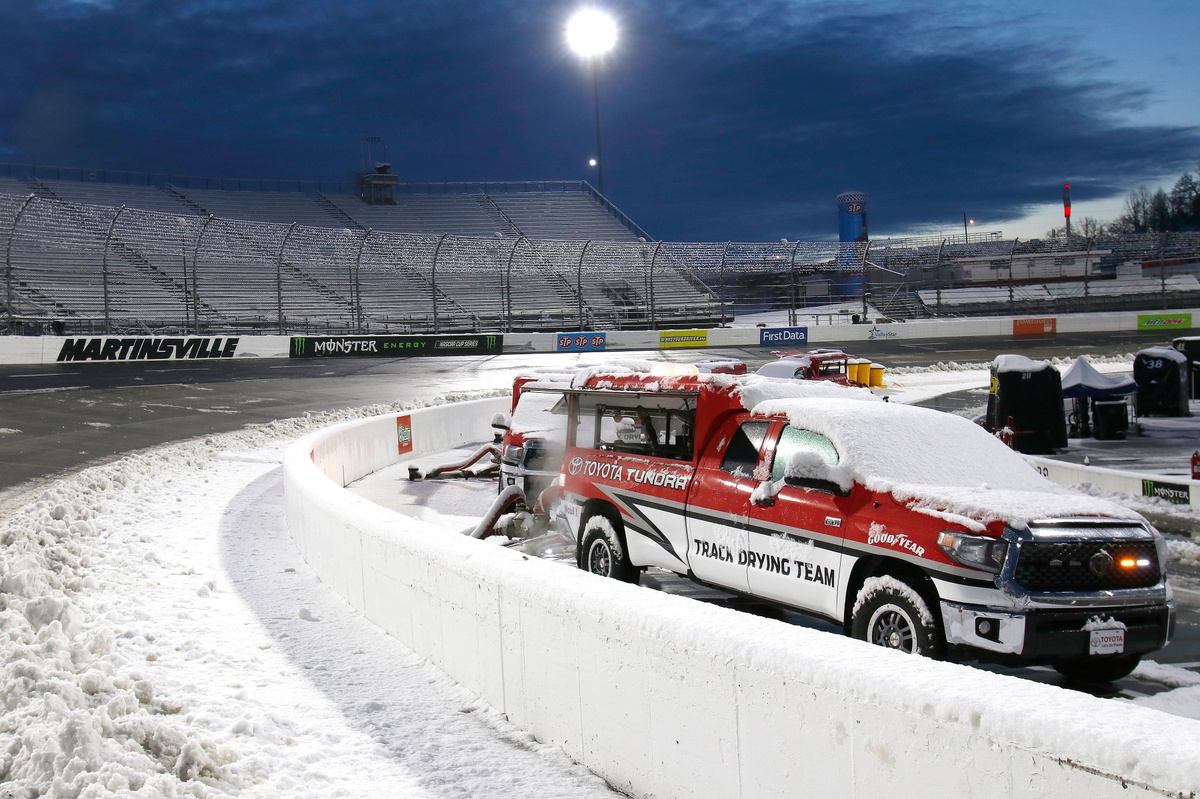
After clearing whatever snow falls in Winston-Salem, North Carolina, over the next 24 hours, temperatures will be lucky to reach 30 degrees Fahrenheit on Sunday when NASCAR plans to race at Bowman Gray. The low will be around 12, and the green flag does not fly until 8pm EST (unless they postpone the entire event until Monday). With some wind expected, the wind chill will bring the feel like temperature even lower — possibly single digits.
So how cold is too cold for NASCAR?
Advertisement
Well, on Sunday, February 25th, 1990, NASCAR prepared to compete in the second round of the season after the 32nd running of the Daytona 500. This race, which took place in Richmond, Virginia, and that race is widely considered to be the coldest Cup Series race on record (or at least in the modern era). It was 31 degrees Fahrenheit at the drop of the green flag and only reached a high of 32 that day. In Celsius, that’s a benchmark of between -0.5 °C and 0 °C, and if you’ve forgotten high school science class — exactly where water freezes.
“It is a bright, beautiful, sunlit day here at Richmond International Raceway. There’s only one problem – it is cold. Frosty the Snowman would want time-and-a-half for this one,” began Ken Squier as he welcomed viewers to the CBS broadcast, a brisk wind keeping things even chillier.
Radiators were taped up completely, CBS reported technical difficulties with their camera equipment on the helicopter due to the low temps, crew members and fans alike were bundled up in several layers as they prepared for several hours out in the elements, and there was real concern about cold tires causing chaos at the start of the race.
Advertisement
NASCAR also allowed for extra time between firing the engines and rolling off pit road, giving the cars a chance to heat up. Teams were worried about crew members sitting idle and their muscles stiffening up between stops, leading to unforced errors.
Due to the concern around cold tires and a lack of grip, teams went to interesting lengths in an effort to keep the tires warm. NASCAR did not permit the use of tire warmers, and so they weren’t amused when the No. 7 team of Alan Kulwicki pointed a heater at a set of tires, unplugging the device. Instead, the team put a tarp over the tires and hoped for the best.
Ricky Rudd started the race from pole position while seven-time NASCAR Cup champion Richard Petty was at the very rear of the field for the start of the race. Dale Earnhardt also had to go back there, but only because he wrecked in practice and was forced into a backup car.
Advertisement
The start was fairly clean, up until Rob Moroso went for a spin on Lap 4, causing a minor melee on the frontstretch. It was a fairly straightforward race from there, with Earnhardt’s attempt at a last-to-first drive taking center stage.
While Rusty Wallace was leading late, Mark Martin opted for a two-tire call on the final pit stop, leading the final 15 laps and capturing the checkered flag. Earnhardt finished second, and Wallace was third.
While that race was quite cold, the skies were clear and they didn’t have to deal with any inclement weather. Some of the other events you’re about to hear about weren’t so fortunate…
Advertisement
Other infamous cold-weather NASCAR races from recent history
Watch: Do you remember? The Bristol ‘Snow-Bowl Derby’
2006 Bristol: This is a race that featured snowball fights, snowmen in the pit lane with lug nut smiles and wearing helmets, and even race-winning snow angels. It’s one of the most memorable snow-impacted NASCAR races. The track was completely covered in snow on race morning with temperatures hitting 34 degrees at the start of the green flag. They actually had to halt the O’Reilly Series race from the previous day due to snow flurries arriving about 30 laps into the event. They eventually got both races in, running every lap. After Kurt Busch won the Cup race, he actually did snow angels on the finish line (even though the snow was gone by that point). And in true Bristol fashion, there was also a post-race altercation as Jeff Gordon shoved Matt Kenseth over some late-race contact.
Advertisement
2008 Atlanta: There was basically a blizzard that hit Atlanta Motor Speedway on March 8th of that year, with high winds creating whiteout conditions keeping things frigid. The grandstands were covered in a thin layer of snow. Qualifying was cancelled due to snow, but the O’Reilly Series race was still able to get going later in the day. Temperatures rose to above 40, but with winds above 30 mph, the wind chill was nearly unbearable for spotters atop the track.
Michael Waltrip signs autographs in the snow
Michael Waltrip signs autographs in the snow
Despite it being early April in Texas, the weather remained chilly on April 7th, the day of the NASCAR O’Reilly Auto Parts Series race. There was no snow, but the temperature reached a brisk 37 degrees for the start of the race, and it was even colder during Cup Series qualifying earlier in the day.
Advertisement
Rain, followed by several inches of snow and ice impacted the March 25 Martinsville race weekend, forcing NASCAR to postpone the event to Monday. The Truck race, which was unable to reach halfway on Saturday before the storm system moved in, joined the Cup Series for a Monday double-header. Crews had to work tirelessly to plow snow from (thankfully) NASCAR’s shortest track before Bowman Gray returned to the schedule. On Monday, the snow as gone but the weather remained chilly, with an air temperature of just 31 degrees at the start of the Truck race that morning.
It was a chilly night race at Martinsville, following a day of rain and some sleet that delayed the start of the Cup race. While the weather cleared, the temperatures remained chilly, and fans were bundled up in the grandstands as NASCAR held a rare night race at the Virginia short track.
The swansong for NASCAR at Auto Club Speedway before the track’s destruction was a memorable one. A mix of snow and rain impacted Saturday action on February 25, forcing the cancellation of Cup qualifying and the postponement of the O’Reilly Series race. The weather improved for the Cup race, in what was the final NASCAR race ever held at the beloved track.
Advertisement
Snow falling

Snow falling
Read Also:

NASCAR postpones Saturday action, makes Bowman Gray Clash one-day event

Watch NASCAR star Joey Logano snow drift a 1924 Model T

Bowman Gray legend Burt Myers to run NASCAR Cup Clash at historic short track
To read more Motorsport.com articles visit our website.
