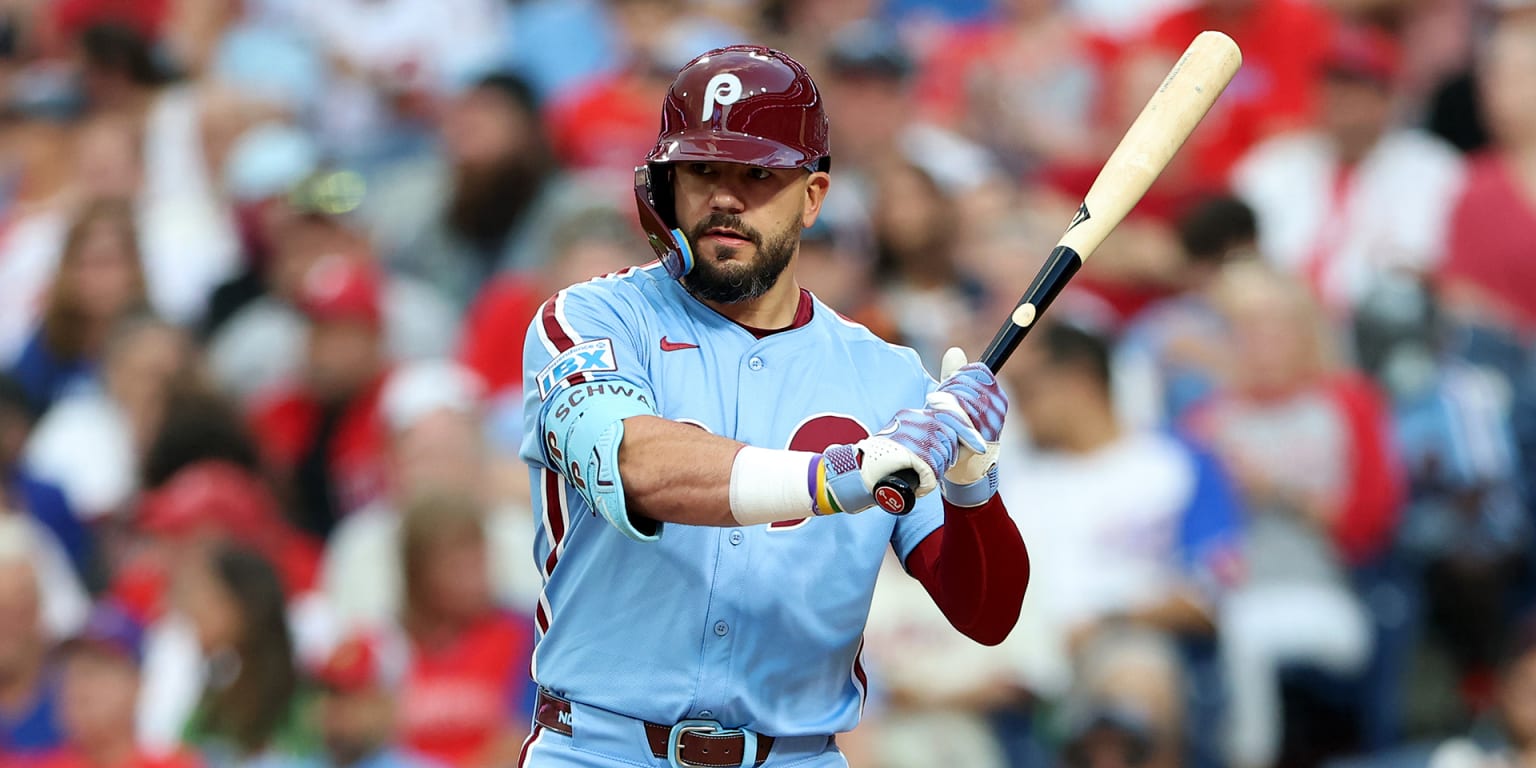
How teams evaluate Kyle Schwarber‘s future value is one of the most fascinating free agent cases of the offseason.
The left-handed slugger is a living, breathing outlier. He is getting better at an age (32) when forecast models suggest he should be approaching, or falling off, a performance cliff.
Coming off a career-best season, his resume is further complicated because he primarily plays a position the majority of MLB teams have devalued. Clubs generally prefer to not invest in a dedicated DH.
“There is a cost as a DH can be where others play when not completely healthy, but then you get that bat,” one AL executive texted of the Schwarber dilemma.
Schwarber was great in 2025. His campaign included 56 home runs and an MLB-best 132 RBIs. But the only hitters to primarily be DHs at the time of signing $100-million-plus deals in MLB history are few in number: J.D. Martinez, Yordan Alvarez — signed to a pre-arbitration extension — and Shohei Ohtani, though one could argue Ohtani doesn’t qualify given his ability to pitch.
There has been much speculation that Schwarber could land a nine-figure deal this winter, and on one hand, that type of investment in an aging, bat-first player could be viewed as too risky.
On the other hand, there are not many bats like Schwarber’s. Just seven qualified hitters have posted a better OPS+ than Schwarber’s 142 mark since the start of 2024, and some of the closest comps to him as a DH have aged very well.
If one believes Schwarber can continue to defy the odds — and count me among those — he could very well be a massive hit for a club, one of the rare players worth a premium investment to fill a DH role.
To understand how unusual Schwarber is, let’s consider some of his underlying skills.
Exit velocity is not supposed to age well. In fact, the vast majority of underlying power traits peak by a player’s mid-20s. Similar to pitching velocity, a batter’s ability to rotate quickly, to produce bat speed and power, generally declines with age.
Schwarber posted a career-best 94.3 mph average exit velocity in 2025 and the second-best max velocity of his career at 117.2 mph.
An underlying component of exit velocity, of power, is bat speed.
In the three years of tracking data to date, Schwarber ranks in the 98th or 99th percentile in average bat speed: 77.1 mph in 2023, 77.5 mph in 2024, and 77.3 mph this past season.
This is not how power is supposed to age.
One front office analyst notes that even if Schwarber begins to suffer some skill degradation, he’s at such an elite level he should remain a plus hitter for years.
“Even if he’s losing half a [mph] every year, he’d still be towards the top of the league and likely be productive,” the analyst said.
He’s not just hitting the ball harder, he’s improving the quality of his contact.
This can be seen in his elite barrel rate tied to a career best in pulled air percentage (31.1%) that ranked fifth in the Majors. He’s improved his ability to pull balls in the air nearly every year since 2020, nearly doubling his mark of that season (16.8%). That is one underlying skill that does improve with age.
I asked Schwarber about his unusual improvement this past season.
“I have to evolve,” Schwarber said. “The game is going to catch up with you. You have to be a really good self evaluator. You have to always get better at something.”
He’s always possessed an elite eye, but he took fewer called strikes in 2025 and struck out at a lower rate (27.2%) than his career average (28.4%). While he’ll never win a batting title, he’s posted back-to-back seasons of .240-plus averages after flirting with the Mendoza Line in 2023.
“Your swing is not the same as when you first come in,” said Schwarber of his evolution. “You look year to year, and my most common change from 2020 is it’s less movement, less movement, less movement. I’m just trying to minimize movements to where I am giving myself a really good opportunity to make a [swing] decision.”
Another point in favor of Schwarber? The history of elite, 30-something DHs.
Since 1990, Schwarber (150 OPS+ in 2025) is one of 10 primary DHs in an age-32 season to post at least a 120 OPS+, meaning 20% better than a league-average hitter. The other nine, sorted by OPS+:
Edgar Martinez, 185 (1995)
Frank Thomas, 163 (2000)
Joc Pederson, 150 (2024)
Harold Baines, 143 (1991)
Marcell Ozuna, 140 (2023)
Chili Davis, 130 (1992)
Kendrys Morales, 127 (2015)
David Ortiz, 124 (2008)
Travis Hafner, 120 (2009)
Four of those players, Martinez, Thomas, Baines and Ortiz, are in the Hall of Fame. They are reminders that outlier talents can beat aging curves.
Of the seven players on that list who are retired, they averaged a 130 OPS+ during their age 33-37 seasons compared to their average career mark of 133. They did not fall off a cliff from a performance standpoint.
They also averaged playing 7.1 more seasons after their age-32 campaign, and all played at least four more years. Perhaps there’s something to less wear and tear reducing age effects at the position. (IL trips dot Schwarber’s resume but he was healthy in 2025, crediting the Phillies’ training staff with an excellent in-season workout regimen.)
Many of the aforementioned names bode well for Schwarber’s future:
Martinez became the first primary DH to reach Cooperstown in 2019. During his age 33-37 seasons, he averaged a 160 OPS+, 149 games played, 29 homers and 109 RBIs over the course of those five seasons.
Ortiz was a four-time All-Star and two-time Silver Slugger during his age 33-37 seasons, which included a 142 OPS+, in line with his career mark (141).
Thomas had injury issues in three of his age 33-37 seasons but he still averaged a 135 OPS+ and 39 homers per 162 games played. He was still the Big Hurt when in the right-handed batter’s box.
While Baines was less of a slam-dunk Hall of Fame selection, he averaged a .293/.376/.483 slash line and a 126 OPS+ during those five mid-30s seasons.
As for the others on the list, it’s more of a mixed bag.
In his age-33 season in 2024 in Atlanta, Ozuna finished fourth in NL MVP voting for a season that included 39 home runs and 104 RBIs. He was not as effective this last season, with a 113 OPS+. … Davis averaged 26 homers, 93 RBIs and a 129 OPS+ in his age-33-37 seasons. … Hafner was still effective on a per-plate-appearance basis (118 OPS+) but retired after his age-36 season following multiple years of injury issues. … Pederson struggled in his age-33 season in 2025, posting a negative WAR and an 81 OPS+.
Most of the names on that exclusive list remained well-above-average hitters into their late 30s, and this was mostly before DHs could take advantage of modern video and scouting data or even go spend a half-inning with a Trajekt hitting machine while their teammates were in the field.
It’s evidence in support of a bull case of Schwarber. He’s perhaps not as risky as his age suggests. He’s a good bet to continue to defy the odds. He might even be a bargain.
