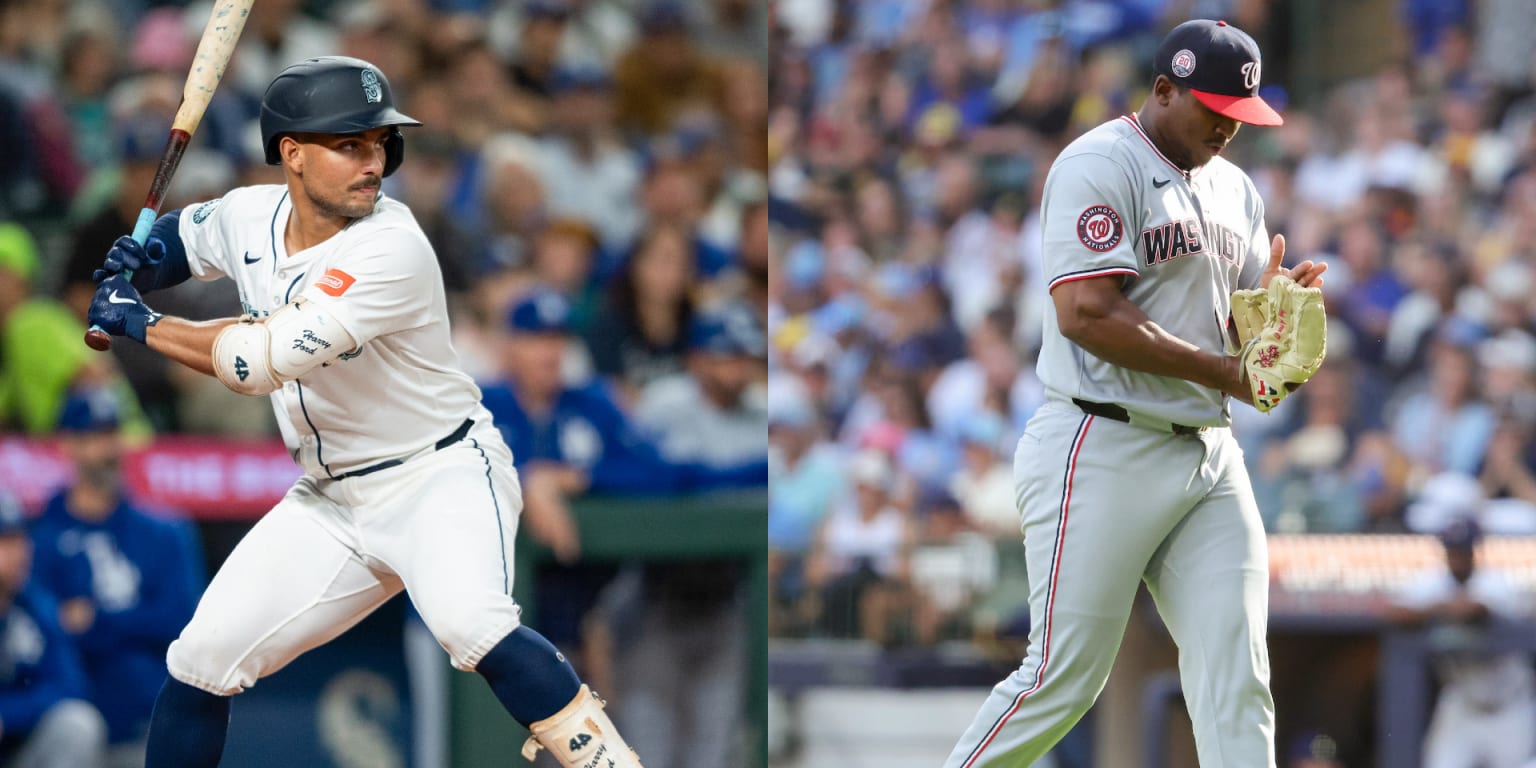
Both in search of an upgrade, the Mariners and Nationals struck a deal on Saturday, sending left-handed reliever Jose A. Ferrer to Seattle in exchange for MLB Pipeline’s No. 42 prospect, catcher Harry Ford (who becomes their No. 2 prospect), and Minor League right-hander Isaac Lyon.
The Mariners had identified bullpen help as a top priority heading into the Winter Meetings, which begin Monday in Orlando, Fla. The decision to seek said upgrade via trade rather than the open market won’t come as much of a surprise, and the 25-year-old Ferrer will be under team control through at least the 2029 season.
On the other side of the deal, the acquisition of Ford is likely an indication of the Nationals’ outlook on current starting catcher Keibert Ruiz, who is entering the fourth year of an eight-year, $50 million extension but has a 72 OPS+ since the beginning of the 2024 season.
Mariners receive: LHP Jose A. Ferrer
Nationals receive: C Harry Ford (No. 42 overall prospect), RHP Isaac Lyon
What it means for the Mariners
Via Mariners beat writer Daniel Kramer
At first glance, it’s a curious decision by Seattle’s front office, given that Ford has long been believed to be a big part of the team’s longer-term plans — and because the club does not have any other catchers on its 40-man roster other than Cal Raleigh now that veteran backup Mitch Garver is a free agent.
Yet the fact that the Mariners were willing to part ways at this stage suggests how much they value Ferrer — and perhaps that they believe they can backfill their backstop depth elsewhere.
What it means for the Nationals
Via Nationals beat writer Jessica Camerato
This marked Paul Toboni’s first trade as Nationals president of baseball operations. The acquisition of Ford adds a catcher who does not become a free agent until 2032 to a Nationals catching dynamic that has faced uncertainty.
Ruiz, who signed an eight-year contract in Spring Training 2023, was sidelined during last season by concussions. The Nationals expect him to be ready for camp, but his availability will have to be determined. Washington also signed backup catcher Riley Adams to a one-year contract to avoid arbitration last month.
While the Nats added a potential long-term catcher, the move leaves a big question mark in the bullpen. Ferrer took over the closer role when Washington sent Kyle Finnegan to Detroit at the Trade Deadline. The Nats could explore righty Cole Henry as a closer in 2026, or they could acquire one this offseason. MORE >>
Prospect perspective
Via MLB Pipeline’s Sam Dykstra
Ford’s name was going to come up in plenty of trade rumors this offseason. We even named him in this newsletter about prospects who could be affected by the Hot Stove and this recent MLB Pipeline Podcast episode about farm systems with the talent to trade. On Saturday, we got our answer. Such is the life of a catcher playing behind Raleigh.
Ford, who is turning 23 in February, should have been competing for more MLB at-bats in 2025, had he not been in the same organization as the 60-homer backstop. The right-handed slugger slashed .283/.408/.460 with a career-high 16 home runs over 97 games at Triple-A Tacoma. He had just a 21 percent chase rate (per Synergy), a number that would have ranked in the 91st percentile of Major League hitters, and that patience at the plate was what drove much of his offensive value with exit velocities running average to slightly above-average when he did swing and make contact. He slowed down a touch both in terms of straight speed and production (his stolen-base total dropped from 35 in 2024 to seven), but his overall athleticism still allows him enough defensive value to be a future starting option in the Major Leagues.
So why would the M’s trade Ford now? Beyond what they’re getting in Ferrer (more on that below), Seattle had eight Top 100 prospects at the time of the deal, but of those eight, Ford was the most clearly blocked. He also lacks the true standout tools of the other hitters ranked above him in Colt Emerson (pure hit tool) and Lazaro Montes (power). Barring a big downturn or major injury by Raleigh, Ford wasn’t going to be a starter any time in the near term, perhaps lessening his value to Seattle.
Meanwhile, he steps into a good situation in D.C. Ruiz (once a Top 100 trade acquisition himself) shouldn’t have the starting catcher role nailed down after failing to produce a bWAR above 1 in either of the last two seasons, meaning Ford will head to West Palm Beach with a real shot at winning the gig out of Spring Training.
Washington is already trying to build an MLB lineup around young talent in James Wood, Dylan Crews, Daylen Lile and (depending on how the rest of the offseason goes) CJ Abrams. Ford heaps more coal on the engine of that youth train.
Diving deep
Via national content editor Andrew Simon
As MLB.com’s Mike Petriello has pointed out, several transactions this offseason have driven home the point that you can no longer simply look at ERA to understand why a team would sign or trade for a certain pitcher. There was the Blue Jays spending big on Dylan Cease (4.55 ERA in 2025) and the Mets on Devin Williams (4.79). There was the Red Sox surrendering notable prospect capital to acquire both Sonny Gray (4.28) and Johan Oviedo (3.57 in nine starts last year, but a 4.24 career mark, including 4.31 in 2023 before missing all of ‘24 due to Tommy John surgery). And now there is the Mariners’ acquisition of Ferrer, with his 4.48 ERA in 2025 and 4.36 over 142 Major League relief appearances.
It isn’t just about that, though. It’s about the underlying performance somewhat obscured by that ERA, and even deeper than that, it’s about the raw material that teams now have reason to believe they can mold into something even better. (It also doesn’t hurt that Ferrer has four remaining seasons of club control before he’s due to reach free agency.). So what do the Mariners likely see here that would lead them to part with as promising a prospect as Ford?
Put all those pieces together, and this deal looks a lot less odd from the Mariners’ side of things. For a team with World Series aspirations, it’s an intriguing, if somewhat risky upside play.
Stat to know
Via MLB.com research staff
How much of a weapon is Ferrer’s changeup? There were 126 pitchers last season who faced at least 100 opponents’ swings against their change. Of those, just four topped Ferrer’s 47% whiff rate, a list that included Royals ace Cole Ragans, NL Rookie of the Year runner-up Cade Horton and Ferrer’s now-ex-teammate MacKenzie Gore. AL Cy Young winner Tarik Skubal ranked just behind him. And among 267 pitchers who threw enough changeups to qualify, Ferrer got the 27th-most vertical drop (relative to pitchers of similar velocity and release point) and eighth-most horizontal break. Williams, whose “Airbender” changeup is a unique offering, is the only other pitcher in that group to get at least 3 more inches of movement compared to average, both vertically and horizontally.
