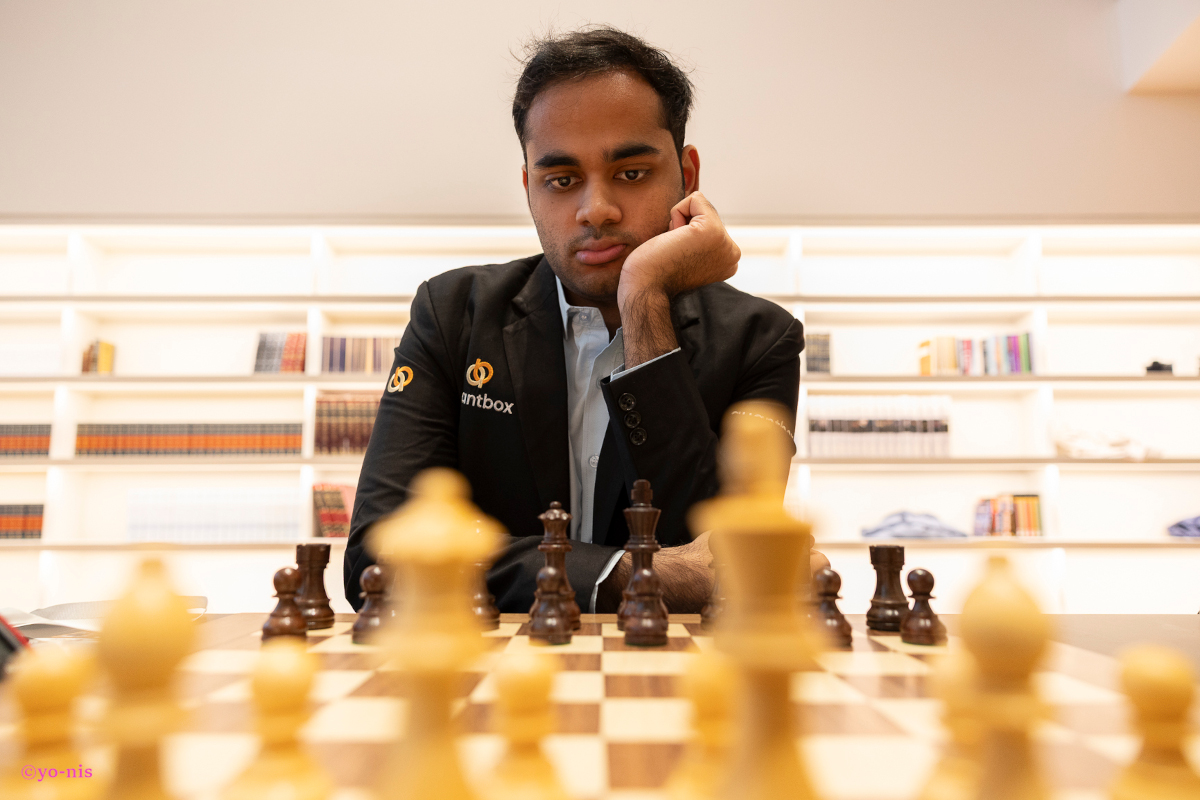
An all-Indian final
The knockout phase of the Jerusalem Masters concluded the second edition of the Jerusalem Chess Festival, bringing together the four highest-scoring players from the preceding round-robin competition: Peter Svidler, Ian Nepomniachtchi, Viswanathan Anand and Arjun Erigaisi.
All matches were scheduled for Wednesday and followed a fixed format – two rapid games played at 15 minutes plus a 5-second increment, with the possibility of two blitz games (3+2) if required, and an Armageddon game should the tie persist.
Peter Svidler, who had dominated the round-robin with an undefeated 8/11, entered the semifinals against world number five Arjun Erigaisi. On the other side of the bracket, Ian Nepomniachtchi faced former world champion Viswanathan Anand.
Despite Svidler’s strong form and Nepomniachtchi’s reputation as a specialist in rapid formats, both matches were decided surprisingly swiftly. Erigaisi and Anand each secured 1½–½ wins, settling matters within the rapid portion.
Data, plans, practice – the new Opening Report In ChessBase there are always attempts to show the typical plans of an opening variation. In the age of engines, chess is much more concrete than previously thought. But amateurs in particular love openings with clear plans, see the London System. In ChessBase ’26, three functions deal with the display of plans. The new opening report examines which piece moves or pawn advances are significant for each important variation. In the reference search you can now see on the board where the pieces usually go. If you start the new Monte Carlo analysis, the board also shows the most common figure paths.
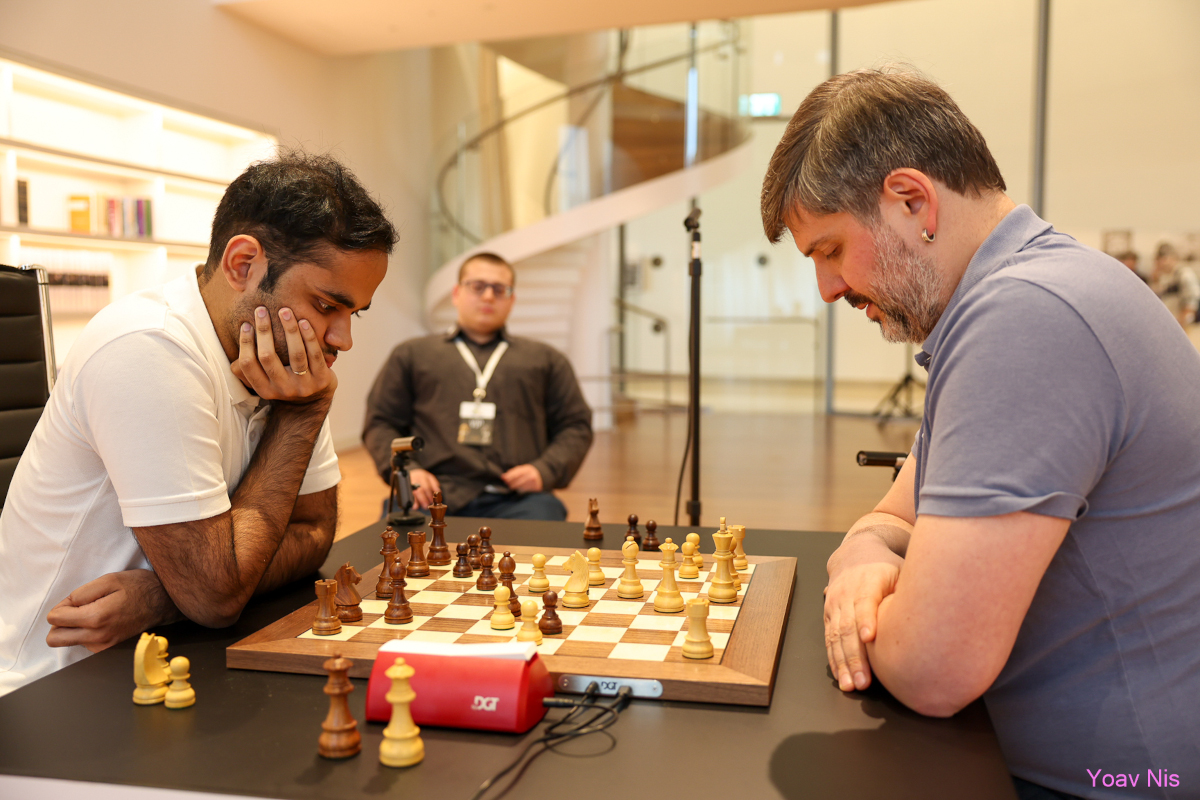
Arjun Erigaisi playing black against Peter Svidler | Photo: Yoav Nis
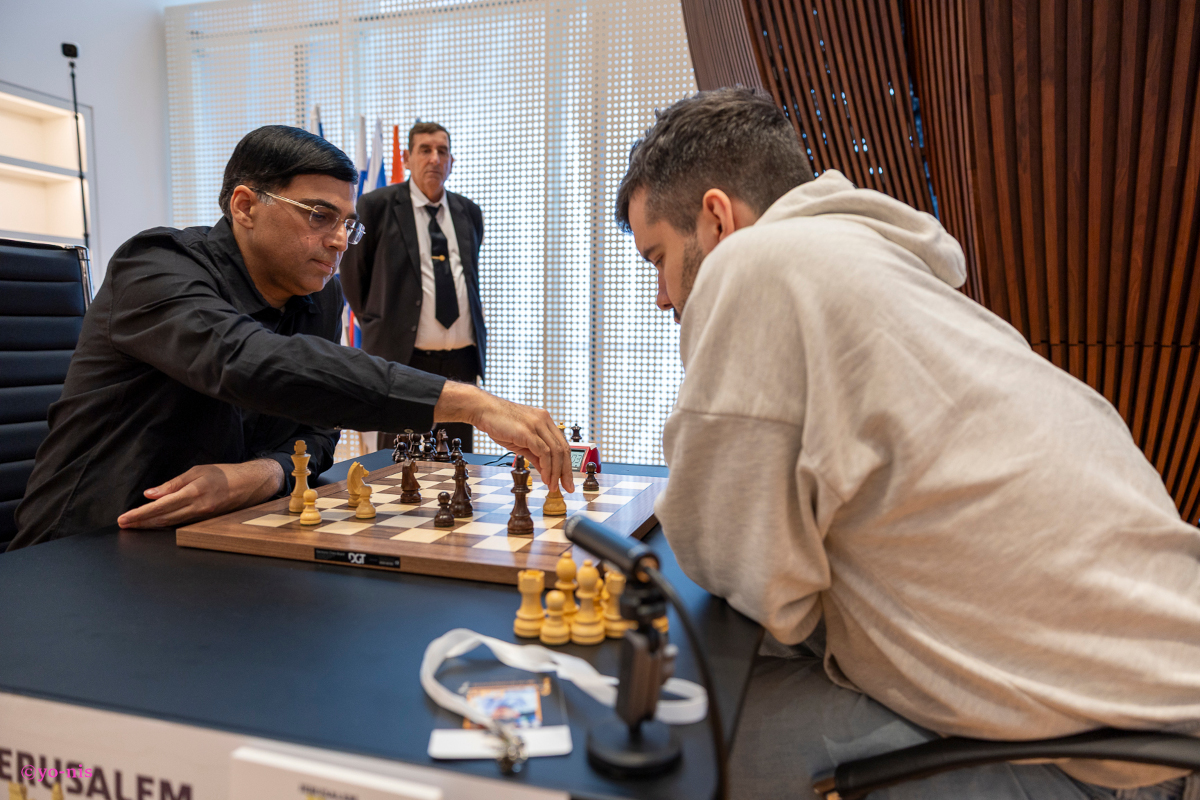
Vishy Anand, at 55 years of age, showed his class in Jerusalem | Photo: Yoav Nis
The final brought the two Indian representatives together. In the first rapid game, both players created promising positions at different stages, yet inaccuracies at key moments prevented either from converting. The second game saw a more controlled approach from both sides, leading to a measured draw. With the match tied, the players moved on to the blitz tiebreaker. Erigaisi struck first, winning with the white pieces. In the return game, he reached a clearly favourable position but opted for a pragmatic draw, which gave him a 2½-1½ match victory and the overall Masters title.
The match for third place mirrored the final in score, but not in trajectory. Svidler and Nepo traded wins with black in the rapid games, before Svidler pulled ahead in the blitz segment – also by scoring in his game with black. By securing a 2½–1½ win, the eight-time Russian champion concluded the event on a positive note.
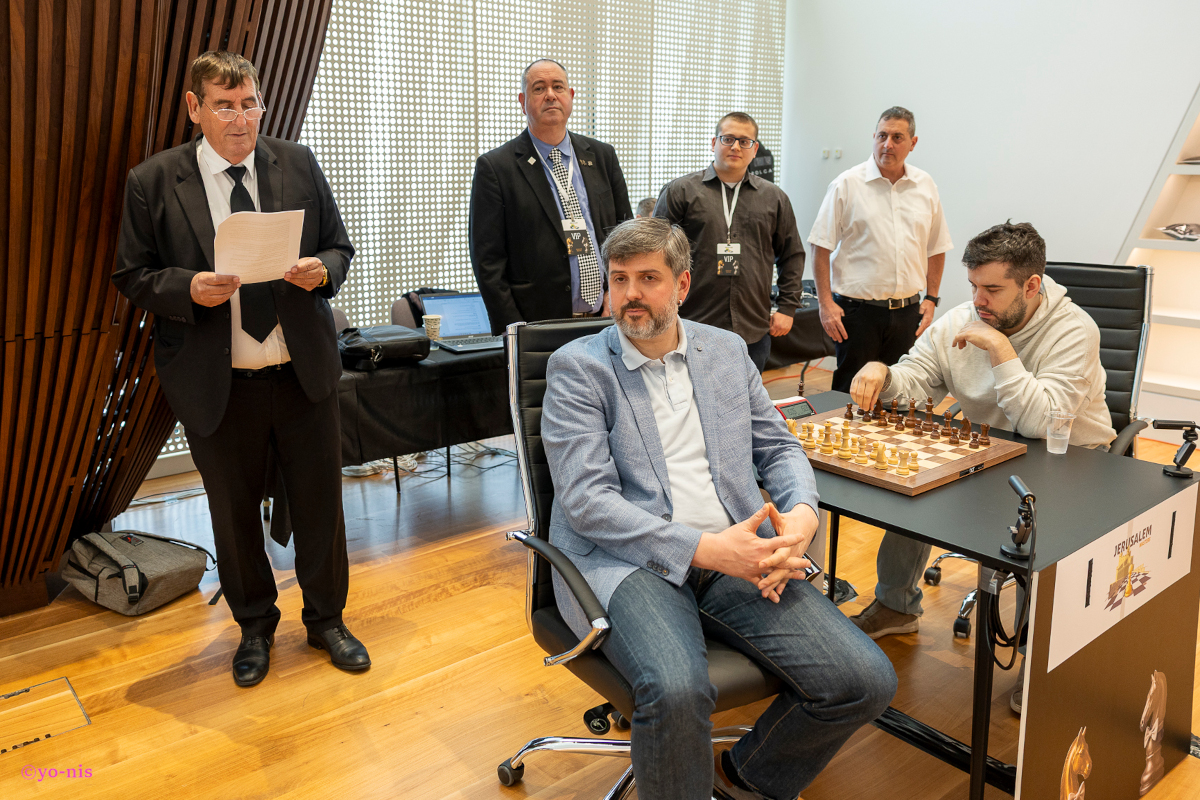
Peter Svidler defeated Ian Nepomniachtchi in the all-Russian match for third place | Photo: Yoav Nis
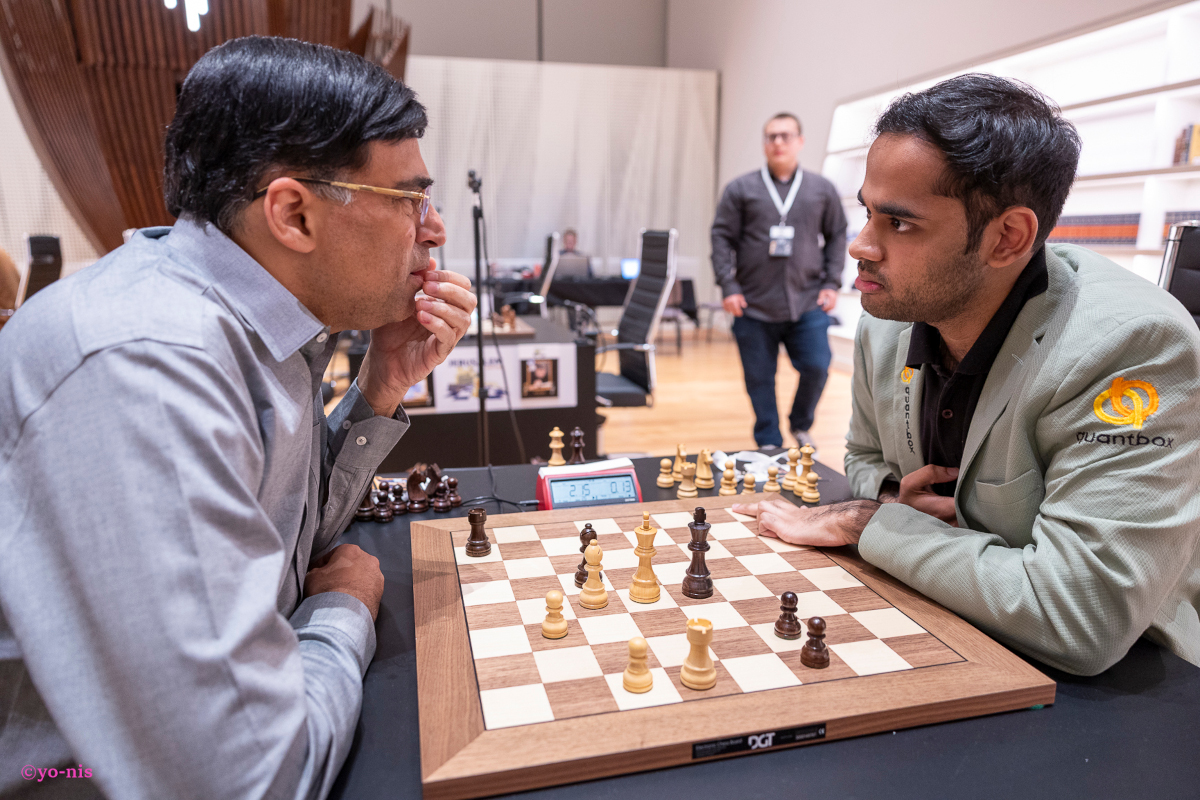
Two generations of Indian superstars – Vishy Anand and Arjun Erigaisi discuss lines from the game that has just finished | Photo: Yoav Nis
Semifinal 1: Erigaisi 1½-½ Svidler
In the first game, it was Svidler who missed a golden chance to take the lead. Playing black, he first found the strong (though not winning) 32…Rxc2, but then failed to find the refutation to Erigaisi’s mistaken 33.Re4
Black now could have got a clear advantage by going for the tricky sequence 33…g5 34.Qe3 Re2 (diagram), a combination difficult to find with less than 2 minutes on the clock even for the strongest players in the world.
This tactical idea works since trades on d4 favour Black – a bishop capture there would fork the king on g1 and the rook on a1. This did not appear on the board, though, as Svidler went for 33…Bf5 – the most natural-looking continuation – which led to an equal position.
In the second game, Erigaisi got the upper hand with black, but it was only until Svidler faltered with 32.Rxb3 that the game was decided in the Indian’s favour.
Svidler could have kept the battle going with 32.Rd1, but after the text move, there followed 32…Bf3, threatening mate on d1, and White found nothing better than to sacrifice the bishop with 33.Bc2 to prevent the checkmate – resignation came after 33…Rxc2 34.Rxe3 Bd5 35.Rd3 Rb2, and Black will capture the pawns on the b-file, winning.
Semifinal 2: Anand 1½-½ Nepomniachtchi
A 42-move, well-played draw was followed by Anand’s deciding victory. In a dynamically balanced position, Nepo faltered with 34…Kg8
Anand found the winning 35.b4, and after 35…Be2, attacking the queen, the former world champion uncorked 36.Qd4, threatening mate on g7 and attacking the knight on c5.
White grabbed the knight after 36…Re7 and resignation followed shortly after.
In the first diagrammed position, Black had a number of moves that would have kept the dynamic balance – e.g. 35…Qe7 or 35…Be4, among others.
Final: Erigaisi 2½-1½ Anand
A topsy-turvy first game, in which Erigaisi missed chances in the middlegame and Anand missed chances in the endgame, was followed by a more controlled, 30-move draw.
In the blitz tiebreaker, Erigaisi reached a favourable (materially balanced) queenless position with a rook and two minor pieces per side.
Black needs to be very careful here, as White has a dangerous passer on the h-file. Anand erred under pressure by playing 30…Re8, when 30…Nc4 31.Bxc4 dxc4 was necessary (though still better for White).
After the text move, Erigaisi found 31.Nxe6, when 31…Rxe6 fails to 32.Kf4, and Black’s pieces will be all but paralysed trying to deal with the threat of h5-h6-h7-h8. Thus, Anand captured with 31…fxe6, and White was clearly for choice after 32.g4 e5 33.g5+
The white pawns on the kingside are too strong. Anand resigned 12 moves later.
In the blitz rematch, Erigaisi agreed to a draw with his legendary compatriot from a position of strength, securing match victory.
Match for third place: Svidler 2½-1½ Nepomniachtchi
This match saw three games ending decisively, and all of them favoured the player with the black pieces. In the deciding blitz encounter, Nepo blundered the game away in one move.
Despite being two pawns up (and both extra pawns are passers), White can only get a draw here, given Black’s strong initiative with the queen and knight tandem on the kingside. The one move that keeps the balance is 38.Qd2, which would likely be followed by a triple repetition with 38…Ne2 39.Kh2 (to prevent mate from g1) Qg3+ 40.Kg1 Qf2 41.Kh2, etcetera.
Instead, Nepo played 38.Ne1, allowing 38…Ne2, which not only threatens checkmate on g1 but also attacks the queen on c3.
White resigned.
Two Super Grandmasters from India explain the ins & outs of Attack, Tactics an Calculations in these two video courses.
