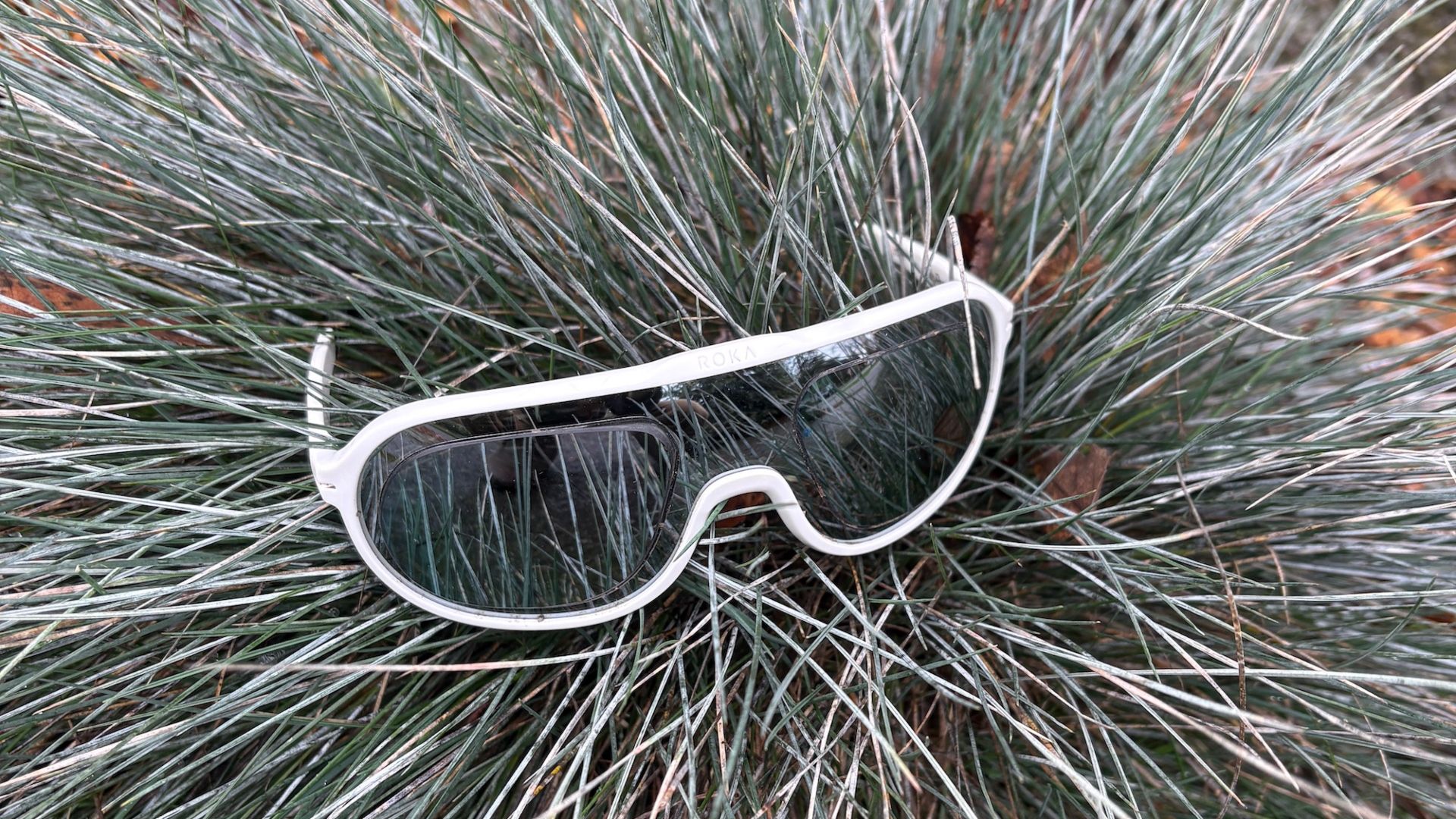
Prescription sport sunglasses exist in a niche within a niche. Finding good ones takes time and effort and often requires spending a small fortune with no guarantee that the final result will work out. Sport sunglasses, as a broad category, have gotten very, very good, but prescription options remain limited. As a result, they seem to be the item that I receive the most questions about from other riders; anyone who needs prescription sunglasses is always on the hunt for something better. I’ve made it a goal to test as many different prescription sunglasses as I can, since I’m in a somewhat unique position of having both poor vision and a platform to review cycling equipment.
Roka first began as a wetsuit brand with a triathlon focus, before pivoting to sunglasses. Now an established player, the company has an extensive catalogue, including the newly launched San Remo model (released alongside a half-frame San Remo Air variant), which blends endurance-sport tech specs with the durability and style of a casual sunglasses design.
Design and Construction
(Image credit: Tyler Boucher)
The San Remo sunglasses are built with an injection-moulded nylon frame embedded with titanium wires in the arms, which are covered in grippy black rubber, as is the nose piece. Roka calls this substance “Geko Grip.”
The frames use a single-piece, shield-style design that is relatively flat compared to many other cycling-specific designs. The model has a 5-base curve, which results in less eye protection than more tightly fitting options, but happily, it means that the design works with stronger prescription lenses as the lenses sit in front of the eyes more squarely.
Roka lists the prescription range for the San Remo frames as follows, with the caveat that “in some cases, specific frame, prescription, and pupillary distance combinations may be rejected by the lab.”
Sphere +3.00 to -4.00
Cylinder up to -2.00
Total power: -5.00

(Image credit: Tyler Boucher)
The listed weight with standard lenses is 27 grams. My custom version weighed slightly more, at 31 grams, which is still extremely light for prescription glasses, and since my prescription is on the strong side, it is reasonable to expect most would weigh less. The lens dimensions are 142 mm x 55 mm, and the overall width is 146 mm. The temple length (along the length of the arms only) is 127 mm long.
As for how the prescription component works, the corrective portion of the lenses is bonded to the inside and outside of the regular lens shield. These additional lenses stick out somewhat, though the exact amount will depend on the specific prescription. This is a similar construction method to other prescription glasses on the market, and allows for the lenses to minimise the amount of distortion caused by adding more lens correction.
Along with the glasses, Roka also provides a hard travel case, a microfiber bag, and multiple different sizes of interchangeable nose pads. The components are manufactured in Italy and assembled in Texas. Pricing for the prescription version starts at $325.
The Ride

(Image credit: Tyler Boucher)
I tested out the San Remo glasses over a few months of regular riding and during my local cyclocross season. The shield-style lens provides a good balance of wind protection and ventilation, and the glasses do an excellent job of staying put.
To place an order, you’ll need two things: a recent prescription from an optician/eye doctor and a PD (pupillary distance) measurement. My prescription is strong enough that many of Roka’s frames won’t work for me, but fortunately, the San Remo was one of the available options. The company’s website also allows you to sort by prescription strength, though it appears that not all the new models are included.
Roka’s ordering process is straightforward, even with the addition of the requisite prescription values. The website has options for different lens materials, as well as a choice for polarised vs. non-polarised lenses.
Testing while racing in the harsh conditions of a PNW cyclocross season demonstrated to me how well these glasses stay in place over rough terrain. The Geko Grip is very grippy, and the arms have enough adjustability to fit each rider’s anatomy and stay out of the way of helmet straps where needed.
I opted for the Dark Arctic Mirror polarised lenses, which allow 10% light transmission, which in hindsight was not a great option for an autumn review. I should have opted for something that lets more light through, given that I live in such a dark climate, but I’ll be all set for next summer.
I was very pleased with how well the glasses did during hard efforts in terms of clearing moisture. Fogging can be a big problem during lower speed, higher intensity ridin,g but as long as I was moving, the glasses stayed fog-free.
The included extra nose pads allow for some fine-tuning for how the glasses sit on your face. The different pieces are similar to one another, however, and I wish that the nose rest had more adjustment built in.
Fitwise, the glasses are slightly wide for my face, but that is often the case with the current trend of Google-style shield glasses. The bold look certainly won’t be everyone’s cup of tea, but it’s nice to have options for glasses that don’t scream “I love cardio,” and the San Remo fits firmly into that category.
Value & Verdict

(Image credit: Tyler Boucher)
After wearing them extensively, I came away very impressed by Roka’s San Remo glasses, both for their light weight and how well they stay in place when things get bumpy. Compared to non-prescription glasses, they’re pricey at around $350, as tested here.
When placed against other corrective sport options, however, they’re a bargain. French company Julbo offers many prescription options with prices starting around $425. Oakley makes prescription glasses, too, and while the ones I’ve tried have impressed, single-vision lenses can cost upwards of $500, plus the cost of the frames themselves. Thus, $350 for made-to-order prescription glasses seems very reasonable.
Depending on where you live and your insurance coverage, you may be eligible for some assistance from your insurance company when purchasing prescription glasses.
