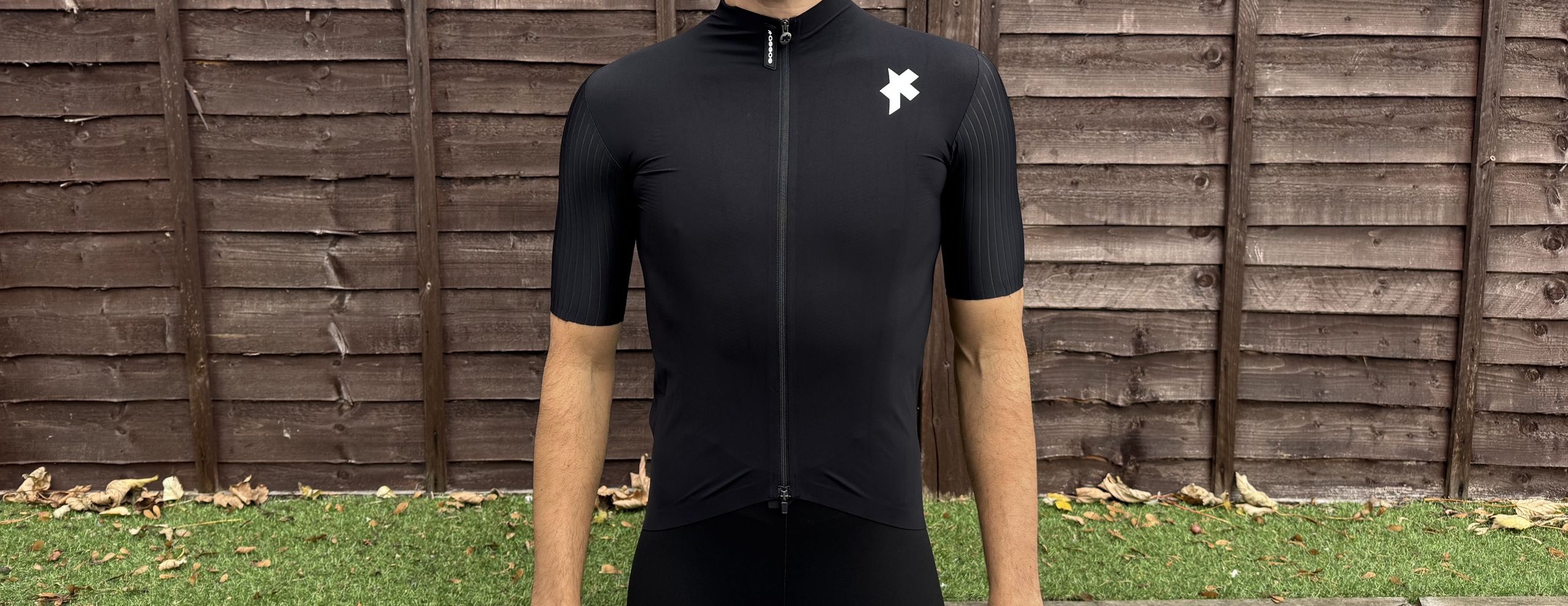
I’ll start off by saying that one of my favourite kit items that I have in my pocket almost year round is a lightweight gilet that’s weather proofed at the front, and breathable at the rear. The best cycling vests work well as a wind breaker, or to ward off showery weather without making me feel excessively toasty. This Equipe RS Shell jersey is very similar in many aspects, save for one key point, it has sleeves.
It looks like a jersey, but acts like a gilet
(Image credit: Future – Andy Turner)
Construction
This is something that Assos has done before with its Equipe RS Alleycat. Sleeves were added that had no protection beyond the elbow, and the reason was to stop the billowing that can occur around the cuff of gilets at the shoulder. This meant less speed, and in the Equipe line, that was not something Assos wanted to compromise on. Enter the RS Shell. Not only does it have sleeves to prevent any billowing, these sleeves also feature an aero texturing the same as the Equipe RSR jersey and well suited to the speeds of amateurs (30-35kph).
The bulk of protection on the Shell Jersey is courtesy of the new DIAMOND Ultra fabric from Assos. This is a proprietary 2L membrane designed to be highly elastic for the brand’s AEPD 11 racingFit designed to offer 360˚stretch and race fit. It is part of what Assos call aeroScience, combining weather protection with uncompromised aerodynamics.

aeroScience so you know it’s focussed on speed and performance
(Image credit: Future – Andy Turner)
This methodology follows on to the sleeves and hems, which are all raw cut. Meanwhile, given the race and high intensity focus, the rear features less protection and a large breathable panel to allow for excessive heat to be expelled. At the front a two-way zip is aimed to enhance this further while also allowing access to pockets underneath the jersey. It is only available in Black, part of the Assos blackSeries, while sizes some in XS-2XL.
The ride
The Assos Equipe RS Shell Jersey S11 is really quite an interesting piece of kit in that it is quite niche. In essence, it’s a race day protection layer. Generally when riding at a fast pace we generate a lot of heat, so when adding weather protection it becomes a case of not getting too hot rather than too cold. Also we are likely travelling at a higher speed so elements are mostly tackled front on, and aerodynamic drag becomes an important factor. Finally, if it’s a race then it is unlikely the intensity will drop much providing no opportunity to cool down. It is those specific scenarios that this shell has been designed for, and as far as testing has gone, it appears to fit this quite well.
Firstly, the fit of the Shell Jersey is comfortably a race fit, it hugs the body and there is no excess material or flapping whatever position you hold on the bike. This is firmly in line with the Equipe moniker. It does this however without being constrictive, thanks mostly to the rear and the sleeves – more on those later.
The Shell is designed to protect you from the elements, and the DIAMOND Ultra fabric does a great job here at beading water droplets off the top layer and preventing the worst of the water ingress. Under very persistent and heavier rain there is a bit of ingress, but that is the case with most PFAS-free water resistant garments. Given the skintight fit of the Shell it was actually a lot more resilient to rain than I expected it to be.
Image 1 of 2


Often though, a problem with waterproof items for high intensity is that they do not breathe. The DIAMOND material itself does appear to be more breathable than a lot of membranes I’ve tested, but the rear is the star of the show here. Assos took the decision to make it mostly mesh, allowing for a huge evacuation of excess heat from the body when going at high intensity. Obviously, it offers zero protection, but the idea is that when travelling at speed the majority of rain and road spray will impact the front facing surfaces which are protected. When riding in a group in the rain this was certainly the case, however with no mudguards there is a lot of rear spray which makes its way partly up the back where protection is limited. As a race garment, the trade-off is warranted, and also means race or event numbers are visible underneath.
A note on the two-way zip as well which boosts breathability thanks to the option to unzip from the top to get cold air in, or from the bottom to allow more heat out. This tailored heat management is fantastic and I wish Assos included it on its jackets rather than just the shells. It also allows for access to pockets underneath the Shell which is ideal for accessing food during events.
Another benefit of the two-way zip is that unzipping from the base means less material flapping. This was another goal of this Shell as it is designed for racing so aeroScience was applied by Assos. Taking from the Alleycat, adding sleeves to the garment reduces the material billowing that can occur around the shoulders. But the Equipe RS Shell takes this further by adding aero texturing to the sleeves to actually boost aerodynamics. It’s an older design material, but one that tends to test well at 30-35kph and is faster than a smooth or texture-less material in most cases. I personally am a massive fan of these features, as it effectively means the Shell is a gilet in function, but with improved speed performance. For racing or events and rides where you don’t want speed to be compromised but still require weather protection, this is ideal.
Image 1 of 2


One gripe however is the lack of pockets. Yes the two-way zip does make access to pockets underneath far easier, but it still requires more effort than just accessing some external pockets on the gilet. To save on the breathability, a style similar to the Q36.5 Dottore Hybrid gilet where two mesh pockets are placed either side of the rear would work well even just for stashing a few gels.
Value & conclusion
At £215/$290/€250 its certainly not cheap. Indeed compared to much of the competition the Assos Shell Jersey is significantly more expensive. The likes of the Castelli Espresso Vest (£125 / $150), Sportful Fiandre Pro Vest (£/$120) are far better value offerings, however they focus mainly on adding insulation rather than specific weatherproofing.
Indeed the most similar option on the market currently appears to be the Q36.5 Dottore Hybrid Vest with a mix of specific weatherproofing up front and more ventilation at the rear, and this is £190 / $260 so still cheaper and does include pockets. Similarly the Rapha Shadow Gilet has similar features at £225 / $300 but is more heavy duty and far more winter training specific.
The key selling point of the Assos Shell Jersey though is the construction to better assist aerodynamics. The problem with a lot of external layers is even if they are more race fit, the gilet construction means some flapping material around the shoulders. Similar to the Castelli Gabba R (£299 / $370) the Rain Shell adds sleeves to improve the fit, reduce flapping, and actually enhance speed. If anything Assos has done this better than Castelli due to using textured materials, but the trade-off is less protective material. The main focus has been protection at the front breathability at the rear.
It fits into a very specific niche, and it performs well there, but it’s hard to qualify it as necessarily good value overall. If you need a protective layer for racing or events where maintaining speed is key, this does do that job very well though, justifying its cost somewhat.

Classic aero ribbed material is used on the sleeves
(Image credit: Future – Andy Turner)
The Assos Equipe RS Shell Jersey S11 is somewhat of an outlier when it comes to products. It has similarities with several other gilets or weatherproof jerseys on the market, but as a race day aerodynamic weatherproof yet breathable shell layer it’s unique. To that end it actually performs exemplarily well, using aero fit and materials to limit flapping, with loads of breathability features for a broad range of use. It’s certainly not ideal for colder weather, but can still be used on top of a warmer insulated jersey. For riders with a specific need for weatherproofing without race performance compromise, the performance justifies the cost, but for most riders it may be perhaps somewhat too specialised for them.
