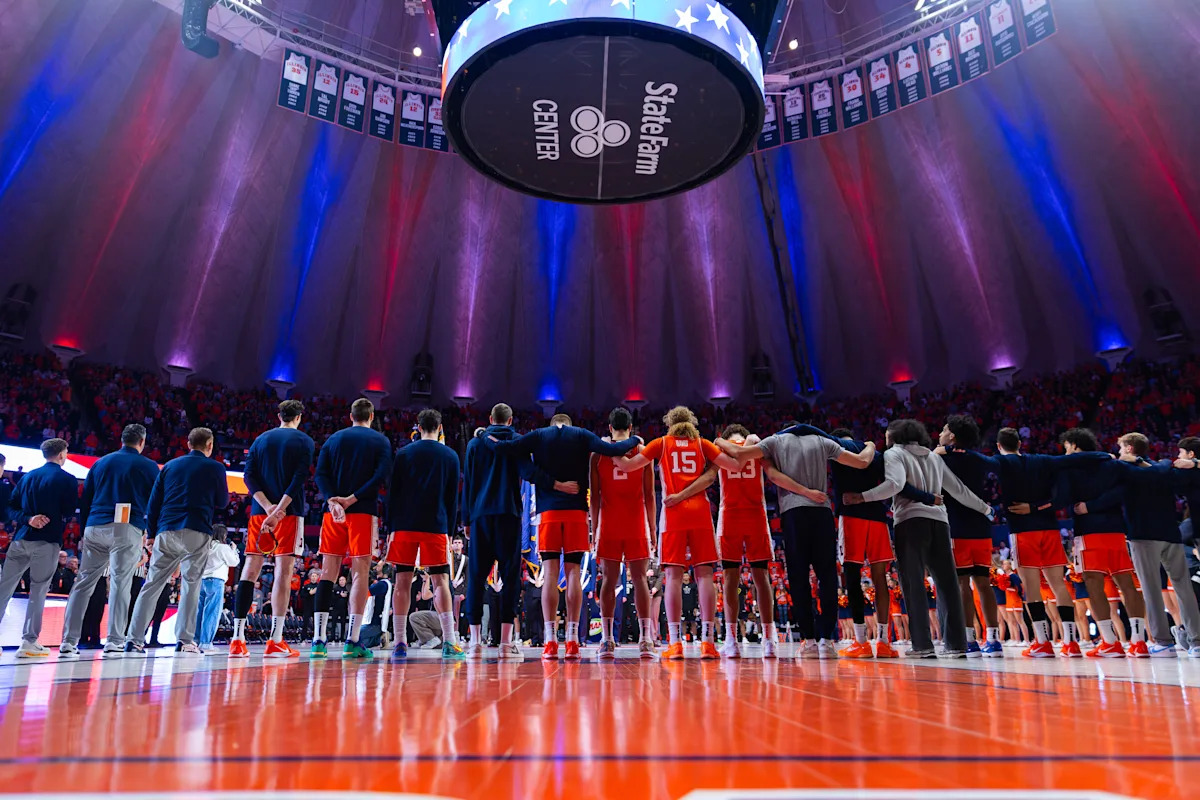
With roughly two-thirds of the season in the books, Illinois basketball finds itself in rare air. At 18=3, this is the program’s best start since the 2005-06 team, and that record alone demands instant respect from the field and the designation of a title-contender.
More importantly, this roster looks like the finished product Brad Underwood envisioned when he assembled it. Roles are defined. Strengths are clear. Weaknesses, while present, are largely understood and, at times, by design. And before Illinois heads into the annual pressure cooker that is March, it’s worth taking a step back to ask the question: What kind of team is this, really?
Advertisement
To answer that, let’s break down what Illinois does exceptionally well and where the cracks still show.
What Illinois Does Well
An Offense Built on Efficiency, Not Flash
Illinois’ offense doesn’t overwhelm you with pace or highlight-reel chaos. Instead, it quietly suffocates teams with efficiency. That starts with a true shooting percentage of 60.7%, which sits in the 93rd percentile nationally.
The Illini also lean heavily into the modern game, with slightly over half (50.2%) of their field goal attempts coming from beyond the arc, ranking in the 96th percentile, but this isn’t a reckless volume, as may have been the case in previous years. Illinois pairs that volume with smart shot selection and spacing.
Advertisement
The shot profile tells the story. Illinois takes significantly more above-the-break threes than the Division I average, about 7.5% more, and still converts them at an above-average clip. At the rim, they finish roughly 70% of their attempts, well above national norms. Corner threes have been another quiet weapon, with Illinois knocking those down at a 40% clip.

Absolute Bullies on the Offensive Glass
Although this is nothing new to Brad Underwood teams, it is still remarkable how well the Illini grab offensive rebounds every year. This year is no exception. They are grabbing an absurd 40% of their own misses, 4th nationally. They’re also pulling down 13.4 offensive rebounds per game, placing them in the 94th percentile.
Advertisement
Those extra possessions add up quickly. Illinois scores nearly 16 points per game on second chances, which again ranks in the 99th percentile. Nearly one-fifth of their total offense comes from second-chance opportunities, a figure that sits in the 96th percentile.
This matters because it gives Illinois insulation. They don’t need to shoot lights-out to score. Missed shots don’t always end possessions, and that physical edge wears teams down over 40 minutes.
Ball Security and Free Points
For a team that plays with size and physicality, Illinois is remarkably clean offensively. They turn the ball over on just 12.1% of possessions (96th percentile) and average fewer than 10 turnovers/game.
Advertisement
When they do create advantages, they capitalize on the free-throw line. Illinois shoots nearly 80% from the stripe. The 9th best mark in the nation. That combination of protecting the ball and converting free points becomes especially valuable late in games and even more so in tournament settings.
Defensive Discipline Without Overextending
Illinois’ defense rebounds extremely well on the defensive end, pulling down over 28 defensive boards per game, and protects the rim with five blocks per contest.
Perhaps most impressively, they rarely foul. Illinois averages just 13 personal fouls per game, ranking in the 99th percentile and 2nd in D1 basketball.
Advertisement
Shot-wise, opponents shoot below league average from virtually every area of the floor. Most attempts allowed come in the paint and from above-the-break threes, but even in those zones, Illinois limits efficiency. It’s a defense designed to force tough shots without gambling.

Where Illinois Does Not Perform Well
Zero Transition Offense
If there’s a glaring weakness in the data, it’s transition scoring. Illinois generates just 6.4% of its points on the fast break, ranking 361st/365 teams nationally. This team lives almost entirely in the half-court.
That’s not inherently fatal, but it does mean Illinois has fewer easy points available when games tighten. Far are the days of Terrance Shannon Jr. throwing down electric dunks on the fastbreak.
Advertisement
A Defense That Doesn’t Create Chaos
Illinois also doesn’t force turnovers. At all. They are the WORST team in all of Division I in opponent turnover rate and the 2nd-worst in steals per game. This is part of the reason they have no transition offense.
The result is simple: opponents get shots up. Illinois wins defensively through shot quality, rebounding, and discipline, not disruption. That lowers variance, but it also limits quick momentum swings.
High Shot Volume Allowed
Because Illinois doesn’t force turnovers, opponents take a lot of shots. Over 63/game, ranking in the 5th percentile. Most of those are twos, and efficiency allowed is manageable, but the sheer volume can keep games closer than they need to be and leave the door open for hot shooting nights.

The Big Picture
Illinois is an efficient, physical, and disciplined basketball team. It plays slowly, values possessions, and controls margins. This is a group built to survive cold shooting nights, win half-court battles, and impose its will over time. The tradeoff is that Illinois doesn’t thrive in chaos. It doesn’t score in transition, doesn’t force turnovers, and doesn’t create many easy points.
Either way, this team knows exactly who it is, and that alone gives it a fighting chance when it matters most.
