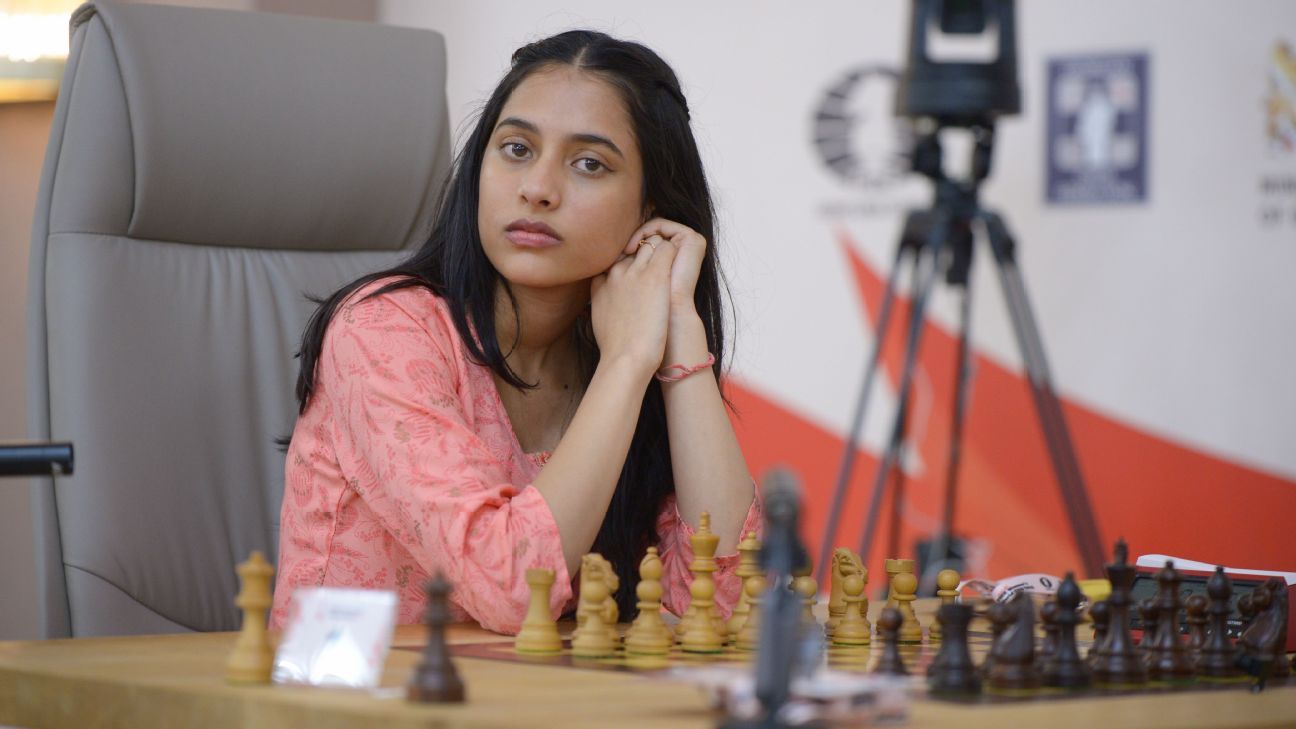
ESPN India’s Player of the Year is usually a hotly-debated endeavour with plenty of arguments, votes being swayed hither-and-tither before crowning a winner. The 2025 edition, however, was different.
A bevy of candidates up on the whiteboard, but all it took was a few seconds. No debates, no fuss, just one name on everyone’s lips – Divya Deshmukh.
For a simple reason – she just keeps winning.
A 19-year-old winning a World Cup in an individual sport like chess is no mean feat, but there was an air of inevitability to Divya’s rise. One of ESPN India’s Emerging Athletes of 2024, Divya’s CV as an 18-year-old was already incredible – three golds at the Chess Olympiad, Asian Chess Champion, World Junior Champion, World Youth Champion.
She added plenty to her list of achievements in 2025, where she defeated world no.1 Hou Yifan en-route an individual bronze and team silver (rapid) and bronze (blitz) at the World Rapid & Blitz Team Chess Championships. And yet, when the World Cup came around in July, Divya was seeded 15th. The official website didn’t even have space for Divya in their hero image featuring the big hitters in women’s chess. Big-hitters like second-seed Zhu Jhiner (whom Divya beat in the fourth round), tenth-seed and former world championship bronze medallist Harika Dronavalli (whom Divya beat in the quarterfinals), former world champion Tan Zhongyi (whom Divya beat in the semifinals), and Indian GOAT Koneru Humpy (whom Divya beat in the final).
One can understand why Divya wasn’t in the pre-tournament running – this was as tough a draw as FIDE could come up with for her.
Which is also why there were no question marks around Divya’s eventual victory, because she did it the hard way – beating the best. Usually someone who refrains from showing emotion, the pent-up relief of surviving a good fight came out at the end, with Divya in tears the moment Humpy shook hands with her to hand her the title.
Speaking to Chessbase India after her win, Divya revealed what was behind those tears, saying “I was feeling a lot at that moment because I was so engrossed in the game that I forgot. When it hit me that ‘I’m actually winning’ (just 2-3 moves before the end) immediately my hands started to shiver. I was tearing up; I needed to wait till the game was over & I didn’t even know why I was crying. I was just crying. I think it was the emotions of the past month and immediately as the game finished, I just burst into tears.”
Those tears also ended up on the shoulders of her mother, Dr. Namrata, who had given up her medical practice to shepherd a young Divya as she rose through the ranks, and in typical maternal fashion asked Divya to calm down in the hall in Batumi after her World Cup win.
Regaining her poise, Divya then handled the spotlight with disconcerting ease for a 19-year-old – the interviews were excellent, the Messi-esque photo with the trophy in bed, the happiness writ large on her face as Nagpur welcomed her back with pomp and humongous crowds (in contrast to the quiet terror on D Gukesh and R Praggnanandhaa’s face in similar welcomes home).
Success sat naturally upon her crown, but it never came easy. Divya even chose the moment of her celebratory rally to pay tribute to her first coach – Rahul Joshi (who passed away aged 40) – a man who’d drawn her to the regular practice in her younger years with the prize of homemade fried chips, who’d guided her at every stage, deciding when the time was right for regional competitions and national competitions… all of which she usually won.
Old photos and interviews surfaced – Diyva and Pragg posing with under-seven national trophies; a precocious 12-year-old Divya – unfazed by a Zoom interview with adults – happily answering questions; and the now-all-but-certain picture for any successful Indian chess player: young Divya with Viswanathan Anand.
It all seems pre-destined in a way.
The World Cup win gave her the title of Grandmaster without even having to earn a single norm (it usually takes three) – Divya wasn’t even aiming for the GM title upon her arrival in Batumi.
Post her World Cup win, Divya freed herself up to compete in the male-dominated open category of chess. Her FIDE rating always looked like it was playing catch-up to her actual chess, as her brand of aggressive openings saw her defeat much-higher ranked male players. She came within a whisker of becoming the first woman to beat the reigning world champion (open) in a classical match during a FIDE tournament (Judit Polgar’s success was in rapid/blitz), but had to make do with a draw against Gukesh at the FIDE Grand Swiss.
That’s the significant bit about Divya’s rise. There’s a matter-of-factness to it that’s almost spooky. She’s not even looking too far ahead in 2026, hoping to only do well in the Women’s Candidates. If 2025 is any indication, however, Ju Wenjun beware – Divya Deshmukh is coming for your crown.
Divya Deshmukh, Women’s World Champion has a nice ring to it… and will make next year’s award as easy as this year’s was.
For now, it’s Divya Deshmukh, ESPN India’s Player of the Year 2025.
