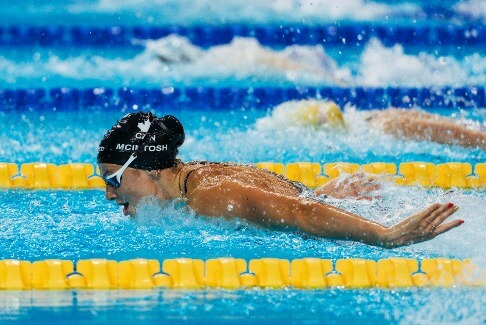
Behind Summer McIntosh, Women’s 400 IM Has Largely Stagnated
The 4:30-barrier in the women’s 400 IM went down during the polyurethane-suit era as Australia’s Stephanie Rice and Zimbabwe’s Kirsty Coventry (now the President of the International Olympic Committee) achieved the feat at the Beijing Olympics. Eighteen years later, the world record has fallen by an additional six seconds, but only four swimmers have gone faster than the marks recorded in that Olympic final.
Unsurprisingly, all of those women are Olympic gold medalists. China’s Ye Shiwen broke Rice’s world record when she won gold in London, touching in 4:28.43. Entering the Olympic final four years later, Katinka Hosszu had been in close pursuit of that world record before finally crushing it with a time of 4:26.36. And of course, Summer McIntosh has taken hold of the race since 2022, lowering the global standard on three occasions to get down to a mind-blowing 4:23.65.
Kaylee McKeown is the only other swimmer to ever swim under 4:30, clocking 4:28.22 in early 2024, but she dropped the event from her Olympic lineup — and the Australian surely has no regrets after repeating as Olympic champion in the 100 and 200 backstroke while also winning bronze in the 200 IM. The Paris final saw McIntosh cruise to gold in 4:27.71, more than three seconds off her then-world record, and she still posted a winning margin of 5.69 seconds.
American swimmers rounded out the podium in that race, with Katie Grimes earning silver in 4:33.40 and Emma Weyant getting bronze in 4:34.93, the slowest Olympic-medal-winning time in 20 years. Neither swam anywhere close to their lifetime bests, but none of the other potential contenders swam fast either. At the 2025 World Championships, it was a similar story: McIntosh winning in 4:25.78, not close to record pace but still in another world from co-silver medalists Jenna Forrester and Mio Narita, both at 4:33.26.
The all-time rankings for the event tell a similar story of an event stagnant outside its global dominator. Of the top-10 performers in history in the event, only McIntosh and McKeown remain active swimmers. The only other swimmer in that group to reach that territory in the last decade is Japan’s Yui Ohashi, who went 4:30.82 in 2018 before winning Olympic gold on home soil three years later.
The rest of the top-25 rankings do not show much fresh blood, either. The active swimmers among that group are Grimes at No. 13 (4:31.41), Forrester 15th (4:32.30), Weyant 18th (4:32.76), Narita 22nd (4:33.26) and China’s Yu Zidi (4:33.76). Yu was only 12 years old when she came out of nowhere to qualify for the 2025 World Championships and then nearly win a medal. No one is catching McIntosh anytime soon, but Yu has an opportunity to become a consistent medal threat here thanks to her own improvement and the event’s relatively little depth.
Across swimming, most races have become faster than ever; consider the new normal of 46s in the men’s 100 freestyle, 57s in the women’s 100 backstroke, 55s in the women’s 100 butterfly. Times quicker than gold-medal-winning times are now necessary to challenge for podium spots at major competitions. Not so much in the 400 IM as that 2008 Olympic final remains the only occasion ever with two swimmers breaking 4:30 in the same heat. Yes, so long ago that one of those swimmers now helms the entire Olympic movement.
