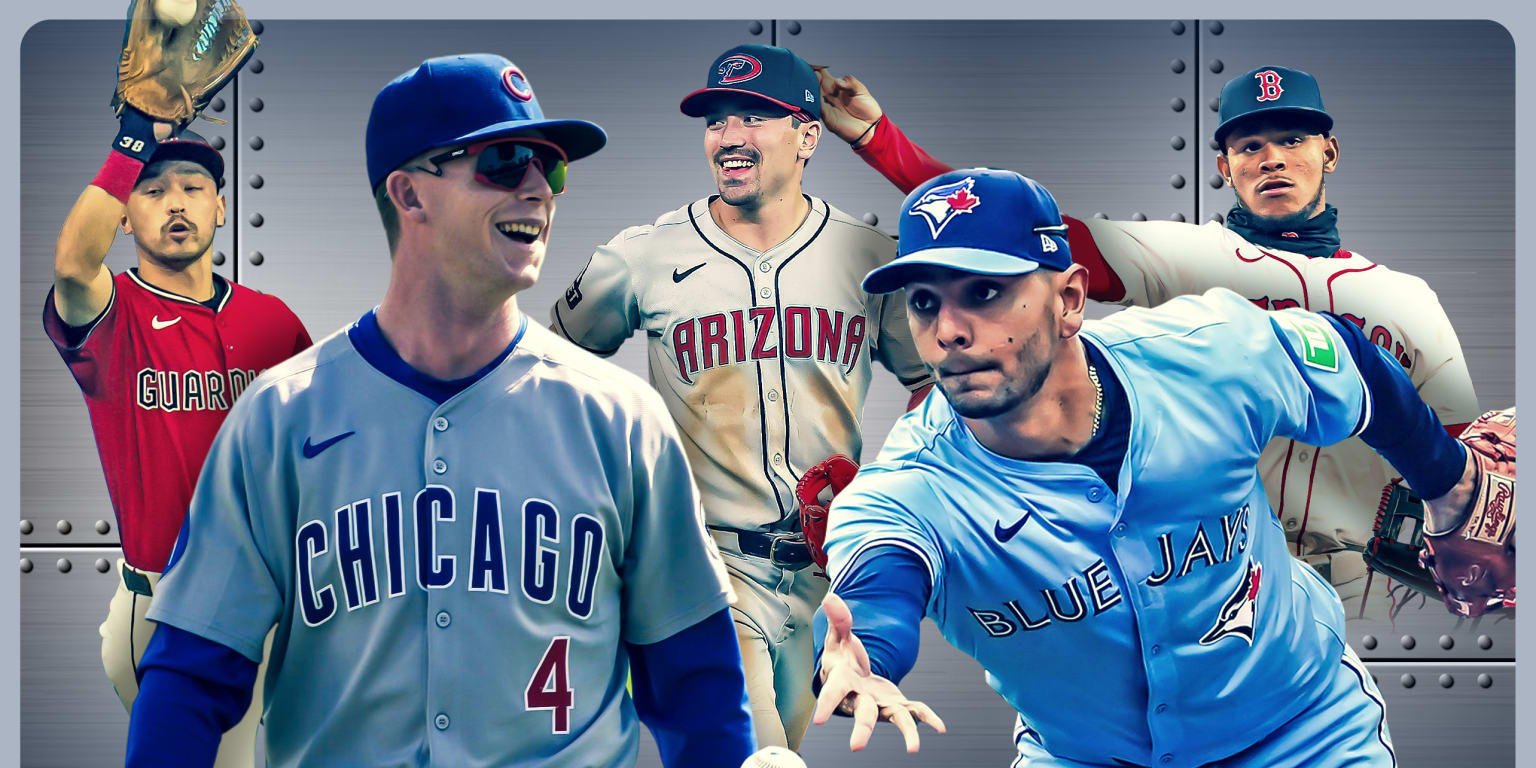
For all the focus on massive homers and red-hot fastballs, it’s far too easy to forget the absolutely critical role of defense in baseball. As Spring Training nears, let’s take a minute to ensure that we don’t do that. It’s important. Really important.
After, all, last year, we noted that in 2024, “five of the top eight fielding teams made the playoffs – and all of the eight weakest fielding teams missed the playoffs.”
That’s a lot of signal. Guess what happened in 2025? By Statcast metrics, the top five fielding teams all made the postseason. Only one of the bottom nine teams, Seattle, did the same.
We won’t go so far as to say “having a great defense guarantees you a playoff spot and having a terrible one guarantees you’ll go home,” but it’s not so far from that. It gets a little messier in the squishy middle, where most of the sport lives, but it’s something that matters, often more than you think.
So let’s again ask the question: Which teams are projected to have the best defenses in 2026? Which teams have improved the most? Which are projected to decline? We did it a little differently last year, but we flagged three contenders we thought had improved with the gloves (Cubs, Giants, Red Sox), and each did in fact improve. We worried about two others who we expected to field worse (Yankees, Royals), and each did that, too.
The way we did this is to swing on over to FanGraphs, grab some projections, and then do some manual work to remove the effects of designated hitters. For example: In WAR terms, Kyle Schwarber is hindered because as a DH, he’s adding no defensive value, and so WAR adjusts for that to compare him to a good fielder. But for our purposes, we’re not talking about overall value, we’re only talking about defense. Since Schwarber is projected to receive 98% of his plate appearances as DH, today we’re only worried about the 2% of the time he’s expected to play left. That means that even though he’s not a strong fielder, he will hinder the Phillies only a very small amount.
So, if we take the projected 2026 defensive numbers, with DH time removed, from Giants catcher Patrick Bailey at the top to Angels outfielder Jo Adell at the bottom, and apply those with projected playing time to each team, then bang: We have a 30-team ranking.
(We made one manual adjustment: Nick Castellanos is still projected to get a small portion of outfield time for the Phillies, because he remains on the roster, but it looks quite possible he’ll be somewhere else before the season starts. Since he’s long been a poorly rated defender, we took the liberty of taking him out of the Phillies projection and allotting that time equally among their other outfielders.)
The top 5 projected defenses in 2026
Shouldn’t be much of a surprise here, right? After all, four of these teams were in the top five in actual 2025 defense, and the fifth, Arizona, was just outside the top 10. For the most part, they’re returning the same cores, and for the most part, fielding skill doesn’t change that much year over year.
The Blue Jays have something like four elite defenders in catcher Alejandro Kirk, shortstop Andrés Giménez, center fielder Daulton Varsho, and second baseman Ernie Clement, and sometimes a fifth when backup outfielder Myles Straw is on the field. There’s also room for improvement, which is that Bo Bichette rarely rated well as a defensive shortstop, and with him off to New York, the middle infield duo of Clement and Giménez should be among baseball’s best. But there are potential downsides as well, because Kazuma Okamoto has much to prove at third, and if George Springer and Anthony Santander are both healthy, then one has to play outfield. The end result? Toronto is projected almost exactly the same as they performed in 2025. That’s still pretty good.
It’s much the same for the Cubs, who saw Pete Crow-Armstrong play something like the best defensive center field we’ve seen in forever, and still have Nico Hoerner and Dansby Swanson as a dynamic middle-infield duo. As with Toronto, their changes come out to net neutral; Alex Bregman is a better defender than Kyle Tucker, surely, but also that swap likely means more fielding time required from Seiya Suzuki. Good last year, good this year – at least assuming Hoerner remains in Chicago despite some trade rumors in the wake of the Bregman deal.
For the D-backs, the lone newcomer to the top five, it’s pretty easy to point to “they traded for Nolan Arenado,” because while he’s not the peak elite defender he once was, he should still be pretty good. (And certainly an upgrade over Eugenio Suárez and those who followed him.) You like Gabriel Moreno, Geraldo Perdomo, and Corbin Carroll all well enough, and Carlos Santana’s glove is still strong even if his bat isn’t, but really, this is less about superstar fielders and more about no obvious weaknesses. “No big trouble spots,” even if that’s not the same thing as “plus defenders,” can take you a long way.
The Red Sox had, and maybe will still have, a lopsided unit. The outfield is fantastic, particularly Ceddanne Rafaela and Wilyer Abreu, and catcher Carlos Narváez also showed excellent defense. The infield was considerably worse, but with some caveats. For one thing, a lot of that was from Kristian Campbell, who had rated as baseball’s weakest defender by the time he was sent down in June, and his path to playing time in 2026 is limited. For another, newcomer Willson Contreras rated as a strong first baseman. They still feel short an infielder, but adding Isiah Kiner-Falefa can only help, and if that unit can be just-OK, then the strength of catcher and outfield can carry the gloves overall.
As for the Guardians, they were good last year, and should be again. You know the names; Steven Kwan and José Ramírez are always strong, Austin Hedges is entirely defense first, and Daniel Schneemann provided solid fielding at multiple spots. Like Arizona, there’s not an obvious problem spot here, though it’s somewhat harder to project because there are just so, so many moving pieces that could find playing time in more than half the lineup spots.
Weakest: White Sox, Angels, Twins, Orioles. Likely no surprises here, either, after each of these teams played weak defense in 2025 – although the Angels might bounce back faster if they could find a way to get more playing time in center for the transcendent Bryce Teodosio.
What about teams that might not be great, but should at least be better? Time to look at improvers.
Top 5 projected improvers
There’s an obvious caveat here: You can’t improve by that much if you were already great, and all of these teams were … well, not great, in 2025. (Again, just on defense. We see you, Seattle.) Technically, the Angels were on this list, too, but going from baseball’s weakest defense – by a lot – to the projected second-weakest defense isn’t really in the spirit of what we’re going for here. For these other teams, we might see some real differences.
Take the Nationals, who were last year’s weakest NL defense. That’s not suddenly going to be a strength, but it is going to be different, at least. That’s because they shed some of their weaker defenders during last season (Josh Bell, Nathaniel Lowe), and that’s expected to open up some DH time for another below-average defender in James Wood. While it remains to be seen what kind of defender new catcher Harry Ford is in the Majors, he should at least take some time from incumbent Keibert Ruiz, who has routinely rated near the bottom of defensive leaderboards. That doesn’t solve the issue that CJ Abrams, Daylen Lile, and Luis Garcia Jr. all rate as negative fielders, but you have to start somewhere. Center fielder Jacob Young, at least, remains truly elite.
Meanwhile, the Rays have improved their defense just in the past few days, adding former Seattle prospect Ben Williamson and his well-regarded glove. Nominally a third baseman, he may end up seeing time elsewhere, but that’s in part because Junior Caminero quietly improved his fielding as 2025 progressed. That ought to help, though most of this is about shedding the below-average gloves of Christopher Morel, Josh Lowe and Brandon Lowe.
The Rockies are in the midst of changing everything, and that’ll take time. The projections adore both center fielder Brenton Doyle and shortstop Ezequiel Tovar, despite relative down seasons for each, and Hunter Goodman provided roughly average catcher defense, which is harder than it sounds. The expected improvement comes from the departure of first baseman Michael Toglia, who rated as among baseball’s weakest defenders, and the expectation that new outfielder and elite speedster Jake McCarthy might help shift Mickey Moniak into more of a DH role. Keep an eye out for third baseman Kyle Karros, who rated well in limited time last year and should get a larger opportunity this season.
As we said above, the Mariners were the only playoff team from the bottom of the fielding rankings. We’re projecting them a little closer to average in 2026, even though center fielder Julio Rodríguez and catcher Cal Raleigh are the only true obvious pluses with the glove. It’s about small upgrades, really. Josh Naylor is better than Rowdy Tellez or Luke Raley at first base; new addition Brendan Donovan takes pressure off 22-year-old Cole Young, who did not rate terribly well in his debut; and various below-average defenders, such as Jorge Polanco, Mitch Garver, and Dylan Moore, are no longer here. They might fare even better should Randy Arozarena find himself playing DH more than he does left field.
Finally, the A’s, though they come with some enormous error bars. We’re assuming that the truly phenomenal center fielder Denzel Clarke will get more than 159 plate appearances this year, but that requires health and at least a little offense. We’re optimistic that Tyler Soderstrom can retain some of the surprisingly good defense he posted in left field, but the history of players going from being catchers to first basemen to very good outfielders is essentially non-existent, long-term. Either way, they’ve shed some below-average fielders in JJ Bleday and Miguel Andujar, and Clarke is so special that anything more he offers could be a game-changer.
