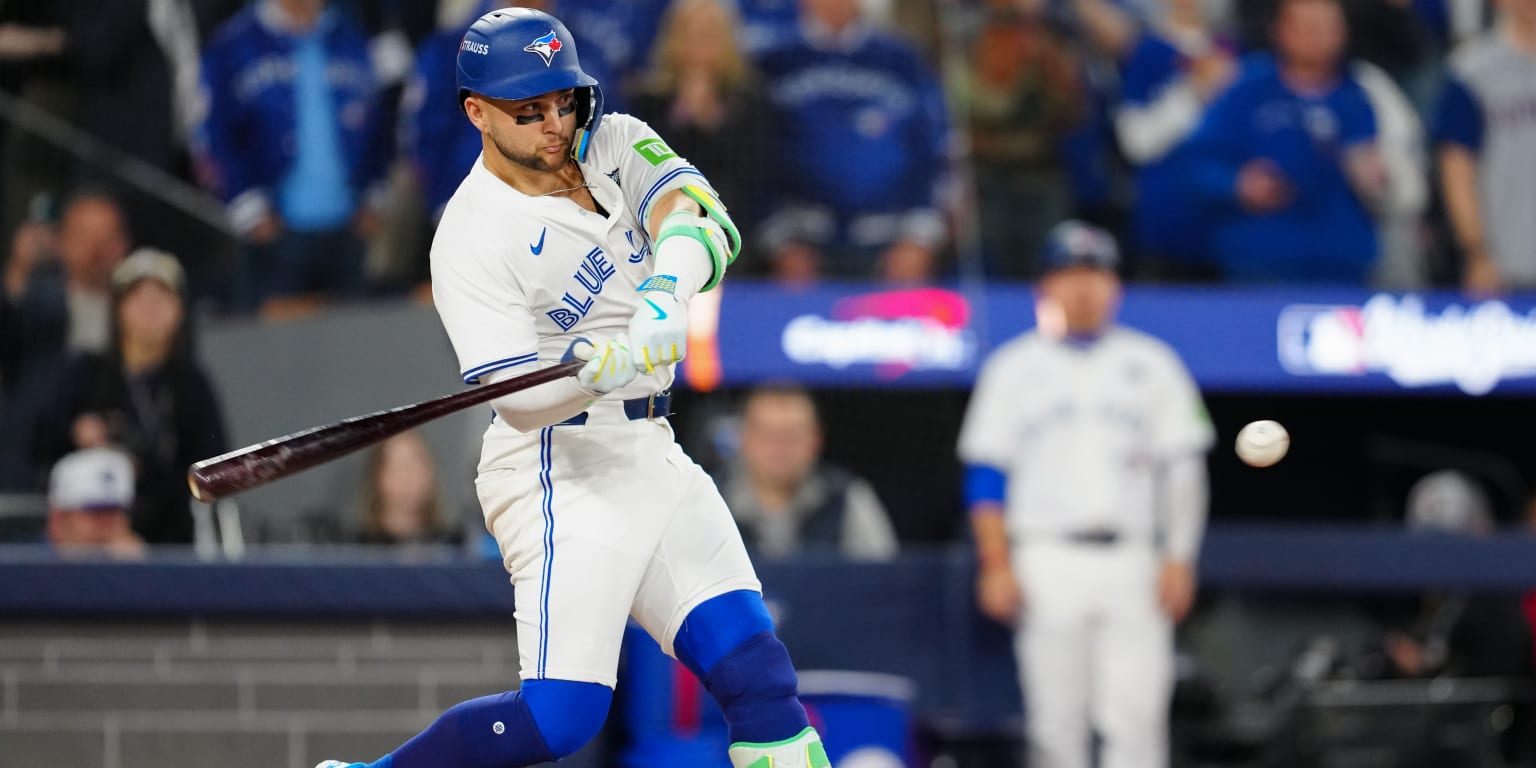
Just a few years ago, there was a debate about whether Blue Jays teammates Bo Bichette or Vladimir Guerrero Jr. was the better long-term investment for a club. They were both eligible to become free agents this offseason as under-30 stars.
There’s less debate now. Toronto chose to sign Guerrero to a $500 million, 14-year deal last April, while Bichette reached the open market this offseason.
While he’s still likely to earn a lucrative deal, Bichette’s outlook contains more uncertainty than it did just a few years earlier.
He’s played through injuries that have sapped his ability. His bat fell off to an alarming level in 2024 before rebounding last year. There’s also the question MLB.com’s Mike Petriello explored about where his future defensive home might be because his glove has deteriorated at shortstop.
There’s still a lot of good here, even if Bichette’s outlook is complicated. But that also means there is potential value to be enjoyed from a signing club. While an acquiring team is not exactly buying low on Bichette, it is not buying at peak price, either.
What does Bichette’s upside look like? What contender might be his best fit? Let’s explore perhaps the most fascinating free agent available.
Bichette’s upside is all tied to his bat. After the first down year of his career in 2024, he posted a .311/.357/.483 slash line last season.
But it was how he rebounded that was so interesting. Bichette’s always enjoyed elite eye-hand coordination and contact skills. Since his 2019 debut, he ranks eighth in the Majors in batting average (.294). He’s never struck out much, and he struck out at a career-low 14.5% last season. He’s also above-average at avoiding infield fly balls, another outcome with little value, much like striking out.
But as good as he’s been, Bichette also has made a lot of contact that is far from optimal. For instance, he ranked 219th out of 284 batters in pulling line drives and fly balls (25.6% of batted balls hit in the air) last season. Throughout his career, he’s often sprayed the ball around the field.
But what’s interesting is even though he remained far from a pull-heavy hitter in 2025, he did change his approach. He pulled balls in the air at the greatest rate of his career. In fact, Bichette enjoyed the 26th-greatest improvement (+7.1%) in pulled air-ball rate among the 204 hitters who put at least 90 balls into play in each of the past two seasons. He jumped from nine extra-base hits to his pull side in 2024 to a career-best 25 last season.
That evolution helped fuel the best full-season wRC+ of Bichette’s career (134) in 2025, and he posted a 177 wRC+ mark in the second half, speaking to continued growth.
The 2025 Blue Jays proved hitters can improve themselves, with the right focus and training regimens. Bichette is evidence of that.
Such batted-ball skill gains often stick. Think Justin Turner and J.D. Martinez, contact-oriented hitters early in their career who learned to better optimize that contact. José Ramírez and Francisco Lindor have accomplished this, too. Even Christian Yelich reached a different level by going from an extreme ground-ball hitter with the Marlins to getting into the air more often with the Brewers.
Even with modest bat speed – another area where he could improve – Bichette is a prime candidate to get more out of the batted balls he produces. And that’s where the upside is in signing Bichette.
His offensive floor is high. He’s posted a wRC+ of at least 120 in six of his seven seasons. But there’s the potential for him to reach an ever greater level, which is where the intrigue resides.
There’s another new tool Bichette can bring to the market, too: versatility. After never playing an inning of defense in the regular season at a position other than shortstop, he played second base for the Blue Jays in the World Series and handled the new role well.
In a thin shortstop market, Bichette remains a bat-first option at that position. But he’s also expressed openness to play elsewhere on the infield. For a contender already with an entrenched shortstop, Bichette can make sense at second or third base.
The Red Sox have been linked to Bichette, and he could replace much of what Alex Bregman gave the club at third last season. Fenway Park is also the perfect environment to reinforce and amplify his increased pull approach of 2025.
The all-in Phillies have a top-heavy lineup, and Bichette would lengthen it. While there is not a glaring infield void in Philadelphia, his bat would be an upgrade at third base or second and the club also needs outfield help.
If Bichette could be had on a shorter-term deal, the Dodgers reportedly have interest. The Dodgers prize positional versatility, and Bichette’s future could perhaps be a player who is capable of moving all around the infield. The Dodgers also field one of the oldest position player groups in the league and it’s rare to find an age-28 star on the open market who could help offset age-related decline from Freddie Freeman and Mookie Betts.
For the Yankees, he could help at second, third and shortstop – and whether he continues to evolve, his approach becomes less relevant in New York. His extreme all-fields approach, much like Derek Jeter’s, would fit well at Yankee Stadium. Bichette’s top three ballparks by expected home run totals for his career: Great American Ball Park (140), Citizens Bank Park (114) and Yankee Stadium (113).
On the other hand, a reunion with the Blue Jays seems less likely after the signing of third baseman Kazuma Okamoto crowded the infield picture in Toronto.
There is risk in paying nine figures to a player in defensive decline, but there’s also an opportunity in adding one entering his age-28 season, whose best offensive days could still be ahead of him.
