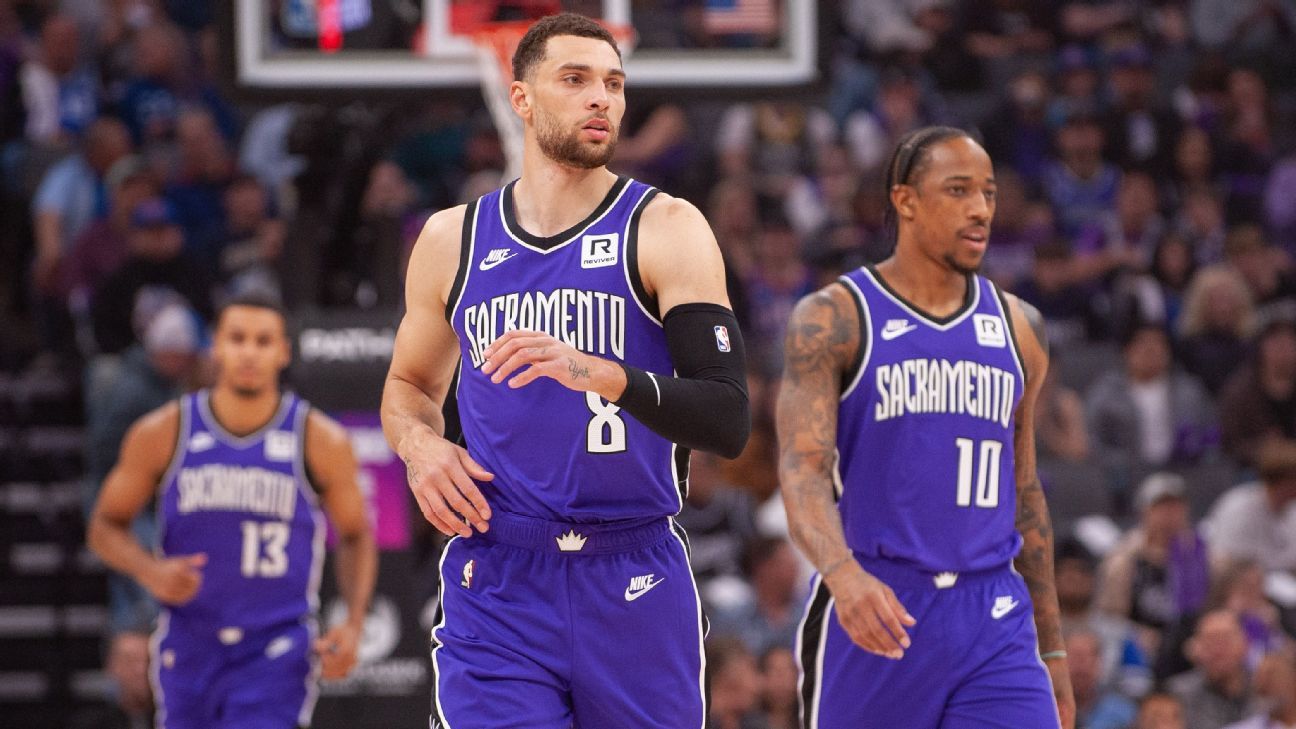
IN EARLY AUGUST, just four months into his tenure as Sacramento Kings general manager, Scott Perry took assistant GM B.J. Armstrong and coach Doug Christie to Latrobe, Pennsylvania.
For three nights, Perry, Armstrong and Christie stayed in the dorm rooms at Saint Vincent College and were given unfettered access to coach Mike Tomlin and the Pittsburgh Steelers.
“I went to the offensive line meetings,” Christie said. “Defensive back meetings. Quarterback meetings.”
The reason was simple: Perry, who joined the Kings in April, wants his new team to emulate the Steelers and needs the leaders across his organization to feel that same spirit.
Perry, a Steelers fan with a 15-year personal connection to Tomlin, is also a longtime NBA executive who has worked in the front offices of the Detroit Pistons, Seattle SuperSonics, Orlando Magic and New York Knicks.
But this opportunity with the Kings provides him with a level of autonomy to mold an NBA culture to a degree he never quite had before. Handpicked by team owner Vivek Ranadive, Perry, 62, is the unquestioned voice guiding the direction of the franchise.
Perry is transparent about what lies ahead — a second go-around with the organization after a brief stint under former GM Vlade Divac in 2017 — and the challenges he faces.
Ranadive has cycled through five different front offices and eight coaches since he bought the team in 2013. The Kings are about to miss the playoffs for the 19th time in 20 years, generating a natural and deep-rooted skepticism among a loyal but demoralized fan base about any front office declaring it’ll be different this time. Perry knows his ultimate success inevitably depends on the patience of a man who has rarely shown any.
“I was hired to create and build a sustainable winner,” Perry said.
This is where Perry hopes to emulate the Steelers. Under Tomlin, the Steelers haven’t had a losing record in 19 seasons. They’re always competitive, built on a brand of toughness and defense in the image of their city.
That’s the language Perry speaks. His plan centers on “six pillars,” as he calls them — wanting his employees to be competitive, tough, disciplined, accountable, team-oriented and professional. And he retained Christie, in part, because Christie agrees and drills that messaging daily, projecting a passionate portrayal of what Sacramento and the team are supposed to represent.
“I watched Scott’s first press conference,” said Christie, who took over in December 2024 after Mike Brown was fired. “I was like, ‘Damn, that sounds like me.’ I was vibing with it.”
But the reality is as inconvenient as it is daunting. The Kings resemble the Steelers in few conceivable ways. One has continuity in ownership and a healthy distance between the front office. The other does not, though team sources say Ranadive has kept his word in allowing Perry full decision-making freedom the past four months.
One organization has had three coaches in the past 57 seasons. The other has had 27. One has six championships. The other has zero. The Kings have been perpetually irrelevant — famously missing the playoffs for 16 straight seasons between 2007 and 2022 — while the Steelers have made the playoffs 17 of the past 25 seasons.
What’s more pressing: The Kings’ roster is ill-equipped to execute the style and brand Perry and Christie preach. So they sit at 8-29, stuck near the bottom of the conference again, reeling with the league’s 28th-ranked defense and 29th-ranked offense.
Reversing such a position, and doing so to a sustainable degree, is an enormous task. Beyond trying to emulate the NFL’s gold standard, Perry also knows he must answer the most enduring question in Kings lore. What the heck is the plan here?
“You can use the term rebuild,” Perry said. “I’m not a big labeler. But what I’ve said, from the very beginning, [is] we know it’s going to be a heavy lift.”
IN BROWN’S SECOND season, 2023-2024, the Kings dropped from 48 wins to 46, but the conference standings proved unfriendly. The two-win dip dropped them from third in the West to ninth. The Kings then failed to escape the play-in bracket, which generated a tense summer and an appetite for aggression.
League sources described Ranadive as extremely motivated to land DeMar DeRozan, nudging former general manager Monte McNair and former assistant general manager Wes Wilcox — his previous front office — to improve their offer in time for Ranadive to walk DeRozan out to their courtside seats in front of fans at halftime of a summer league game.
The Kings ultimately sweetened their offer to land DeRozan, delivering the Spurs a 2032 unprotected first-round pick swap as part of the three-team sign-and-trade construction. That could prove to be a dangerous and ill-advised move considering the current arc of both franchises involved. And then they gave DeRozan a three-year, $74 million deal, one that just a year later holds little value across the league.
This, team sources indicated at the time, was the first glaring sign that Ranadive was grabbing back firmer control of basketball operations from McNair, who had won Executive of the Year after the franchise broke the playoff drought in 2023 just one year prior, but had missed on a few fringe moves that had failed to improve on the 48-win Beam Team.
Then the spiral began. The DeRozan fit wasn’t clean. They started 13-18, punctuated by an 0-5 homestand littered with late-game mistakes, including a fatal De’Aaron Fox foul on a 3-point shooter, up three, in the final seconds of a loss to the Detroit Pistons. Panic was rising internally, team sources said at the time. Ranadive fired Brown, who had signed a three-year extension just five months earlier, the next afternoon.
That decision, which was made without consulting Fox, accidentally incriminated and ultimately alienated the franchise guard, who then pushed for a trade.
Ranadive green-lit the firing while on vacation in Cabo. McNair told Brown while Brown was driving to the airport for a road trip.
It was done one night after Brown had been publicly critical of Fox for that late-game error, which generated public perception that the star guard might’ve called for it, despite Fox’s vocal support of Brown behind the scenes. Nobody in management held a news conference to explain the choice — or correct the narrative.
“You fire the coach and don’t do an interview?” Fox told ESPN after the trade. “So all the blame was on me. … I felt at the time the organization didn’t have my back.”
A month later, in another desperation move, the Kings flipped Fox in a three-team deal for Zach LaVine, a player Ranadive had long coveted, despite McNair’s apprehension, league sources said.
As they stumbled into the ninth seed, Wilcox and assistant coach Luke Loucks departed midseason for opportunities in the college ranks.
McNair, for his part, was fired minutes after the Dallas Mavericks eliminated the Kings in the play-in game.
It had been an organizational exodus. Six months later, at the Kings media day in September, the normally measured and soft-spoken DeRozan encapsulated his first season with the Kings.
“S— show.”
Four days after McNair was fired, Perry had the job, tasked with cleaning up perhaps the league’s messiest roster, considering the glut of difficult to move veteran contracts and the lack of a future young star. It’s a deep rebuild.
“I use the phrase prudent and opportunistic,” Perry said. “Which I’m going to continue to be. I’m not someone who’s going to do something rash. Nothing rushed or panicked.”
THE KINGS TRAVELED to Los Angeles last week and lost by a combined 65 points to the LA Clippers and Los Angeles Lakers, the first of what was a five-game streak of double-digit defeats.
One of the common internal criticisms on the ground level the past few seasons, team sources said, has been a lack of player-to-player accountability.
Veteran guard Dennis Schroder, who Perry signed to a three-year, $45 million contract this summer, voiced as much recently, telling reporters at his locker after a 41-point road loss to the Clippers that it happens “here and there” but “consistently, I wouldn’t say.”
“With the [German] national team, when I’m on some B.S., people will call me out,” Schroder said. “‘Dennis, you gotta come on,’ That’s what we need.”
Domantas Sabonis, league sources said, has held a similar desire for more vocal internal leadership, prompting him to push for the organization to sign Russell Westbrook, his former teammate in Oklahoma City.
Despite the team’s record, early reviews about Westbrook’s time with the Kings have been positive, and he has been installed as the starting point guard ahead of Schroder. Westbrook has an obsessive work ethic, disciplined habits and a willingness to speak up if he doesn’t like the level of competitiveness, punctuality or professionalism.
Westbrook is on a minimum one-year deal, but Perry and Christie, who said he used to defend Westbrook against critical callers when Christie was a sports radio host in Sacramento, said they believe Westbrook has been a positive influence on shifting the attitude and culture.
“I want him here,” Christie said.
In McNair’s early days (hired in September 2020) as general manager and Brown’s as coach, team sources described how much autonomy they were provided positively. But it steadily reduced as a few of McNair’s draft picks (Davion Mitchell, Devin Carter), moves (Chris Duarte, Sasha Vezenkov) and non-moves (Pascal Siakam and OG Anunoby non-trades) didn’t pan out.
So the longer-term question isn’t whether Perry’s voice is powerful within the Kings’ walls, it’s whether that decision-making autonomy remains during the inevitable lumps of a challenging multiyear rebuild.
“Vivek and I are 100 percent aligned and I think any suggestion opposite of that would be totally false,” Perry said. “We talk all the time. Obviously, he’s passionate about his team, but we are aligned on the vision, and we both understand that there could be some short-term pain in order for some good long-term gain.”
ON SUNDAY AGAINST the Milwaukee Bucks, the Kings’ brightest young player, Keegan Murray, came down awkwardly on his left ankle and exited in serious pain. He will miss at least three weeks, the team announced Tuesday. Their best player, Sabonis, hasn’t played since mid-November as he tries to rehab a tricky meniscus tear.
“Your rookie year, you’re in the playoffs,” Murray told ESPN. “Three-seed. Things are going well. And then I mean, three years later, we’re [20] games below .500. So for me, it’s just about continuing to grow as a player so that we can create and obviously get back to the playoffs and be a team that isn’t just in the playoffs for one year but is there for a long time.”
DeRozan is about to become the 26th player ever to score 26,000 career points. In November, Westbrook passed Jason Kidd for the most rebounds by a guard in NBA history. In December, he passed Magic Johnson in career assists.
But these legendary feats have been relegated to brief moments of bliss in relative obscurity. The first few months of this Kings season have been defined by deflating losses and demoralizing news conferences.
Christie has been hypercritical of his team several times already this season.
“I wish I could have put on the jersey at 55,” Christie said after a Nov. 13 loss to the Atlanta Hawks. “I would have showed you better than that. At least I’m [going to] use all six fouls. I might can’t move, but I’m [going to] foul the f— out of somebody.”
Christie is on the first season of a three-year contract, league sources said, but the final season is a team option. This is a trial period for a first-time head coach, but Perry has been firm in his backing of Christie. Despite the poor record, his job is safe, team sources said.
“He’s got an organization that’s behind him and believes that he will be there to help push us through and turn the corner,” Perry said.
That alignment with Perry has been evident in Christie’s public messaging, freeing him to occasionally drill a team full of proud veterans about an effort that he has frequently deemed to be inadequate.
“To know that he has my back allows me to [speak freely],” Christie said. “Now those aren’t things I’m going to do all the time, but what I’m saying is this is who we are and this is what we’re about. And we are standing on this and it’s not just me saying it. Scott’s with me.”
THE KINGS ARE one of the most fascinating trade deadline teams because of the perceived availability of their veterans. Perry has been clear he will take and make calls and rival executives say he has been willing to talk about anyone on the roster outside of Murray and recent draft picks Nique Clifford and Maxime Raynaud.
But conversation won’t necessarily lead to a wave of movement. Sabonis has three years and $136.4 million left on his contract. LaVine has two years and $96.4 million left on his contract. Malik Monk has three years and $60.5 million left on his contract.
Those aren’t simple to move in the second apron world. Perry is on the ground floor of a rebuild and, for now, under no urgent mandate for immediate change.
Considering their place in the standings, it could be argued their most valuable asset is their 2026 first-round pick. They currently have the third-worst record, which would give them a 52.1% chance at a top-four pick in a draft that features a group of highly touted prospects at the top.
“This draft is shaping up to be pretty good,” Perry said. “You talk about some of the better teams in the league, they have built and got a lot of that talent through the draft. So I see us really diving into this draft process.”
Perry’s biggest decision was the Murray extension. Murray said he met with Perry soon after he took the job and that the two were “in line” on the team’s vision moving forward. Perry then worked out a five-year, $140 million deal with Murray’s representation. There are no opt-outs on either side, tying him to Sacramento through the 2030-31 season.
“Six-eight, six-nine and a two-way player,” Perry said of Murray. “Extremely valuable.”
Perry openly covets positional size and defensive versatility, sharing a belief with Christie that they need to build a roster to better fit a fast-paced, physical approach.
“Obviously, Keegan would flourish in that type of game,” Perry said.
The Kings do not have interest in Hawks scoring guard Trae Young, league sources said, despite his availability.
This past summer, Perry went after 6-foot-7 wing Jonathan Kuminga, whose career has stalled with the Golden State Warriors. Perry visited Kuminga in Miami when he was a restricted free agent, league sources said, cultivating a relationship that could still lead to a business partnership. There remains mutual interest.
Market dynamics eventually kept Kuminga with the Warriors on a two-year, $46.8 million contract that was structured to be traded. He’s out of Steve Kerr’s rotation and eligible to be moved on Jan. 15.
The Warriors, league sources said, are exploring the deadline landscape, and have been posturing in recent days that they would be willing to keep Kuminga past the deadline if nothing appealing materializes. But Kuminga will be available, and Perry checked in with Warriors general manager Mike Dunleavy last week, league sources said.
Perry has expressed reservations about offering the same 2030 protected first-round pick that was on the table for Kuminga this past summer. The Warriors, league sources said, don’t want to take on a multiyear contract they view as negative value, which has made Monk a nonstarter in these talks.
But there are multiteam constructions that could loosen up these obstacles, and the Kings do have Keon Ellis, a fourth-year guard on a $2.3 million expiring deal that has generated leaguewide interest.
As part of a recent youth movement, Ellis has leaped Monk in the rotation and could sign an extension with the Kings as early as Feb. 9, but his unrestricted free agent status clouds his future in Sacramento. Clarity is inevitable in the next month.
“My job, and anybody sitting in this seat’s job, is always to work the phones,” Perry said. “Whether that’s trade deadline, leading to the draft, summertime. Trade deadline just happens to be the closest thing now to being able to make a change with the roster.”
The first task is clear, though.
“We’ve got to get younger as a team,” Perry said.
