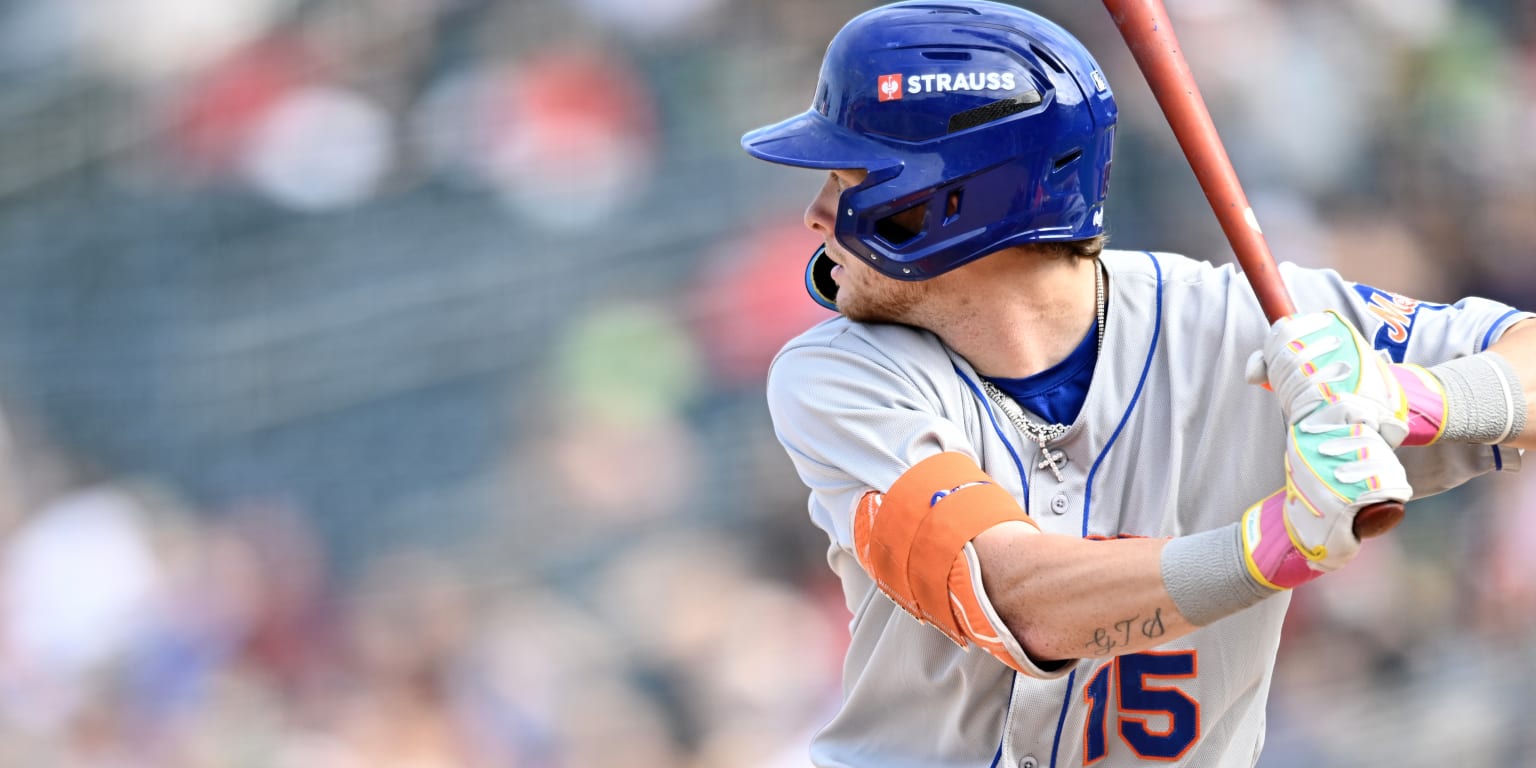
The Mets’ blockbuster trade to move longtime outfielder Brandon Nimmo to the Rangers for All-Star second baseman Marcus Semien accomplished much for the NL East club. It solidified the keystone position. It improved the team’s overall defense. And it may have cleared a lane for a Top 25 overall prospect to make the team’s Opening Day roster next spring.
Outfielder Carson Benge, ranked No. 2 among Mets prospects and No. 21 overall by MLB Pipeline, climbed three levels in his first full season and was set to head into his second Spring Training with at least an outside shot at cracking the Major League roster. With Nimmo no longer in the outfield picture, Benge’s chances at Major League playing time vastly improved.
COMPLETE METS PROSPECT COVERAGE
“Beyond the immediate player return part of this deal, we think this opens up possibilities and flexibility for us going forward, both from a near-term perspective and also allowing space for a number of very young outfielders who are coming, who are talented and will deserve spots at the Major League level and to play at the Major League level,” Mets president of baseball operations David Stearns told reporters in a press conference Monday. “This transaction also provides room for that to happen as we move forward.”
Stearns made the Benge connection more explicit later in the presser when he mentioned him by name when going through New York’s current outfield options, listing Benge behind only superstar Juan Soto and the returning Tyrone Taylor, interestingly ahead of veteran Jeff McNeil (who the Semien acquisition might bump to the outfield) and fellow prospect Jett Williams.
Drafted 19th overall in the 2024 Draft as a two-way player out of Oklahoma State, Benge immediately moved to the outfield full-time and enjoyed a breakout first full season, hitting .281/.385/.472 with 15 homers and 22 steals in 116 games across the High-A, Double-A and Triple-A levels. The 22-year-old caught the attention of evaluators across the game as a well-rounded talent and became New York’s top prospect in MLB Pipeline’s midseason update, only to be usurped by fellow Cowboys alum Nolan McLean after he became the Mets’ de facto ace down the stretch.
On the surface, it may have looked like Benge stumbled for the first time as a pro at Triple-A Syracuse. He produced just a .178 average, a .583 OPS and a 53 wRC+ over his 103 plate appearances at the Minors’ top level following his mid-August callup. Under the hood, however, he looked much better than those numbers.
Benge ran an above-average 105.9 mph 90th-percentile exit velocity at Triple-A, topped out at 110.4 mph and made contact on 87 percent of his pitches inside the zone. (MLB average for Z-contact was 83.2 percent.) His chase rates were fine, too, if closer to average, while his 18.4 percent K rate and 8.7 percent walk rate didn’t scream struggle. Instead, Benge may have fallen victim to rough luck in a smallish sample – his .188 BABIP was significantly lower than his marks of .372 and .337 at High-A and Double-A, respectively.
Benge also proved he can make adjustments at the plate over the course of the season. With Brooklyn – which plays in a home ballpark that traditionally kills left-handed power – he was ground-ball heavy, with a 45.1 percent mark. That was sliced to 38.8 percent with Double-A Binghamton, with much of the tradeoff being toward fly balls, and his slugging percentage jumped from .480 to .571. Benge, who also cut down on his infield popups, hit twice as many homers with the Rumble Ponies (eight) as he did the Cyclones (four) in 28 fewer games, all while maintaining an all-fields approach from the left side.
Batting from an open stance, he can see the ball well out of the hand and react quickly with enough bat speed to slap the ball to left when needed or drive the ball in the air to the pull side when able.
In terms of his other tools, he checks in as an above-average runner, and because of the range those wheels provide him, the Mets gave him the lion’s share of his looks in center field this year. He still has the arm strength from his pitching days, with three Triple-A throws clocking in at 95 mph or above (the Mets as a team only had two such seeds in the Majors last season). That would help him in either outfield corner, too.
As it stands, Benge should be in competition with Taylor to be New York’s Opening Day center fielder, but he’d certainly fit in left as a direct Nimmo replacement.
What looms over that decision is simply the rest of the offseason. It’s no secret that the Mets have money to play with, and Stearns didn’t shy away from acknowledging that ownership would approve adding payroll via free agency if the right players are out there. It just so happens that two of the biggest names on the market are outfielders: Kyle Tucker and Cody Bellinger.
Adding either star – or dipping back into the trade market for another outfielder with a strong MLB resume – would slide Benge down the depth chart. But it still wouldn’t rule out the possibility of the prospect winning a job. The Prospect Promotion Incentive plays a role here as he could net New York an extra Draft pick at the end of the first round if he accrues one year of service time in 2026 and wins NL Rookie of the Year or finishes top three in NL MVP voting before becoming arbitration-eligible.
At the least, Benge has certainly elbowed his way into the conversation.
