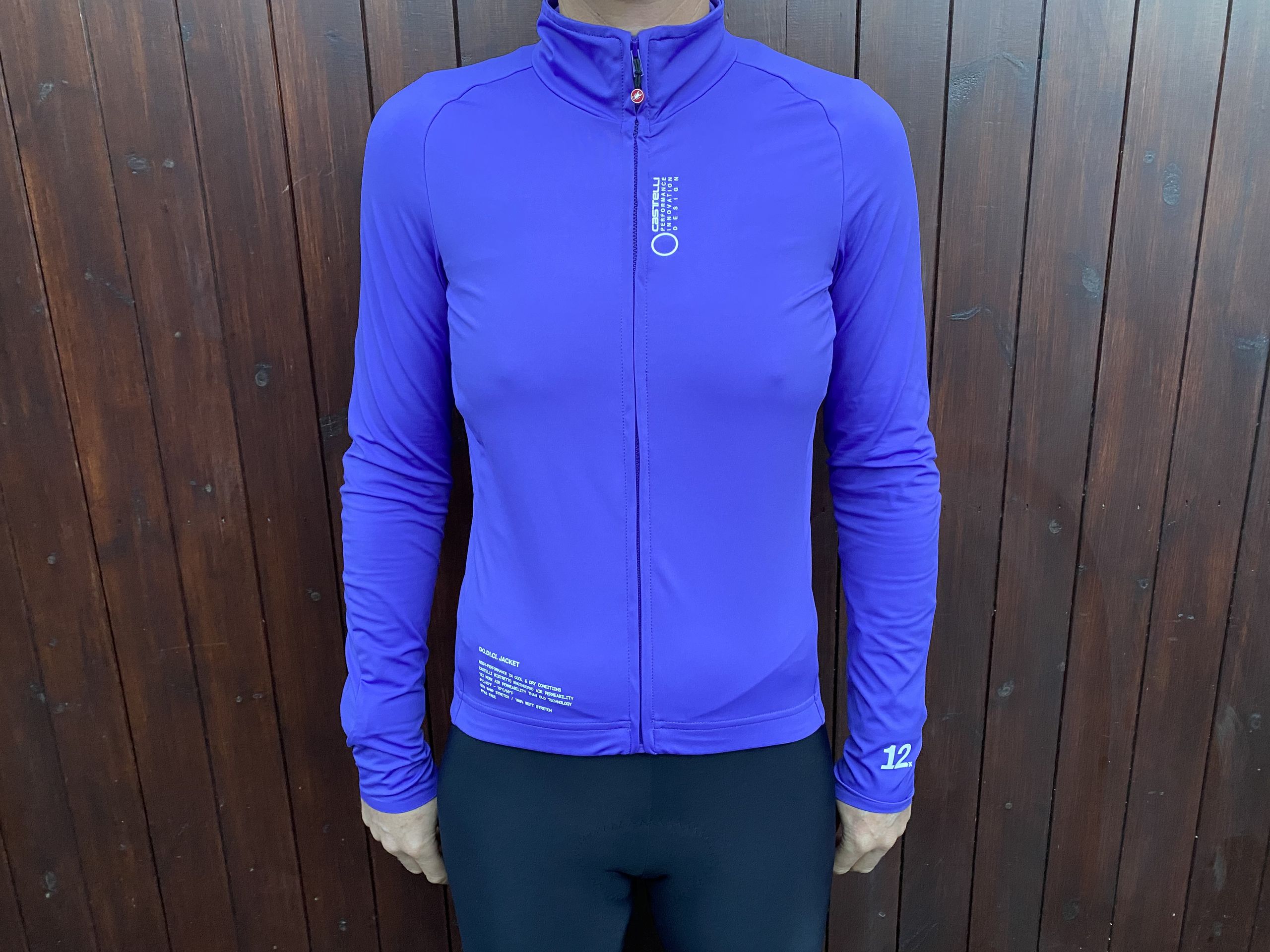
Castelli’s Do.Di.Ci Women’s Jacket was designed to fill a gap that the brand identified in its line-up. It’s a lightweight, shoulder-season layer specifically for performance-orientated riders wanting to purposefully train outdoors in dry, mild-to-cool weather.
It’s been 15 years since Castelli’s infamous Gabba Jacket first appeared on the pro scene. Granted, it took a few years – three to be exact – for the Gabba to be recognised as a pioneering piece of wet weather performance clothing. For Castelli fans, it became a must-have piece of kit.
The latest iteration, the Gabba RoS 2, isn’t for everyone. Its styling is divisive, and the absence of PFAS means it doesn’t perform quite like the original. Add to this the fact that many pros and amateurs now train indoors when the weather turns, and the Gabba feels increasingly like old news.
Construction
With a four-year-old size medium Castelli jacket in my wardrobe still getting regular use, I almost requested the same size of the Do.Di.Ci for testing. Wisdom prevailed – I checked the size chart. A word of warning: Castelli’s sizing is shifting, so be sure to check before buying. I’m pictured wearing a size large – it’s a good fit with room for a substantial base layer. If you want a very snug fit, consider sizing down. I’d say I could have sized down and not regretted it.
Sleeve length is wonderfully generous – great for maintaining coverage in an extended position – while the body length is noticeably short. It’s a classic race-fit.
(Image credit: Emma Silversides)
The fabric is uniform throughout. It’s very thin, stretchy and wholly unrestrictive. There’s nothing cosy about it when you put it on, but the simplicity works well for comfort and mobility. While it might seem pared back, it’s the fabric that is the USP for the jacket: “Exclusive Castelli Ristretto technology with engineered air permeability keeps most wind out, allowing in just enough to provide exceptional breathability – 12 times more than previous Castelli Perfetto jackets.”

(Image credit: Emma Silversides)
Although the jacket’s silhouette is distinctly feminine, additional detailing is sparse. Aside from a single piece of reflective piping at the base of the pockets, there’s no zippered security pocket, no differentiated cuff materials, no underarm panels, no separate waistband… It’s all in the name of “comfort” and “speed.” Indeed, my memories of team-issued kit mirror the Do.Di.Ci: something designed for the purpose of a no-stop ride, with no unnecessary bells and whistles.
The pockets are seriously roomy – sufficient to fill up for self-sufficiency on training rides. I had no issues accessing them while riding – this is a real positive, as I often find pockets placed too high on shorter-bodied garments.
In case you happen to forget when to use the jacket, Castelli has added a description to the front of the garment. It’s not visible when you’re riding, so unless you stop at a café, it remains subtle. However, for me, it feels completely unnecessary. It simply led to strained eyes whenever I met a group, as everyone tried hard to make out what was written there.

Simple cuffs and an interesting approach to detail at the front
(Image credit: Emma Silversides)
The Do.Di.Ci comes in just two colours for women – the beautifully bold ‘ultraviolet’ that I have tested, and black. That’s no choice if you like to buy clothing that increases your visibility on the road. The men’s version comes in four colour ways. Sizes range from XS to XL.

(Image credit: Emma Silversides)
The Ride
On my first few rides, I teamed the Do.Di.Ci with a thin, long-sleeve base layer… I immediately overheated. The best pairing – particularly in the 12–15°C range – is a minimal, sleeveless base layer, or even just a sports bra if you don’t mind that. This combination kept my torso warm enough, while allowing the jacket’s breathability to shine. Even during more intense efforts, I could maintain a stable core temperature without having to unzip the jacket. This surprised me – I genuinely thought the high collar would be stifling in milder temperatures. So the fabric really is impressive when it comes to airflow. The only negative comes when stopping mid-ride, for example to repair a puncture or attend to a mechanical. I found that my arms felt the chill first, rapidly followed by my torso.
The fabric has a claimed air permeability of three cubic feet per minute – if you are not working, you really sense any wind chill. Indeed, when descending after an intense climbing effort, my arms were the first to feel cool. For the tech-hungry readers, air permeability is a measure of the amount of air (in cubic feet per minute per square foot, CFM) passing through fabric at a given pressure. Not many manufacturers publish this data but, in general, softshell jackets can vary between 1 and 10 CFM. Windproof layers tend to be made from fabrics with an air permeability of less than 1 CFM, though they may use vents or more permeable panels to make up for this.
Dropping towards and into single-digit temperatures, I found the Do.Di.Ci still held its own. I transitioned to a more substantial, fast-drying base layer though.
While we all have our own internal thermostats, you are sure to find a perfect window for the jacket, which can then be broadened with an apt base layer. For me, the Do.Di.Ci excelled in temperatures hovering around 10°C – offering breathability, good moisture management and zero bulk. Slightly higher temperatures, if you are training intensively, are arguably just as well suited to a short sleeved jersey and arm warmers – indeed there is a short sleeved version of the Do.Di.Ci, but only for men…
I was lucky to have a window of weather in November when it was dry and relatively mild, consequently, the jacket got plenty of use. However, this isn’t so typical; rainy, changeable weather is the standard for shoulder seasons. Being someone who doesn’t shy away from showers, I’d always be carrying a waterproof in the back pocket; the Do.Di.Ci didn’t cope with even the lightest of showers – it became clingy, and I became cold. It isn’t the quickest to dry out either. Castelli don’t shy away from admitting that it’s exclusively a dry-weather jacket.
Value and conclusion
The £210/$280 Do.Di.Ci faces competition from mid-season, performance-focused long sleeve jerseys. At this price point, it’s easy to find options that offer more features – mixed fabrics, windproof panels or more functionality. For example, Assos’s £175/$210 Dyora R Spring Fall Jersey utilises various panels to help with breathability. Sportful’s £210/$250 Fiandre Shift Women’s Jacket boasts water repellency, windproofing and a two-way zip.
If you are someone who only ventures out with intent when the skies aren’t threatening, it may make more sense to have substantial arm warmers and a supporting base layer with a short sleeve jersey than commit to long sleeves. This set-up certainly convinces me that there isn’t a gap in my wardrobe.
Without doubt, the Do.Di.Ci is an exceptionally lightweight jacket with superior breathability that excels on performance-focused, dry rides. For sure, if you value minimalism, a race fit and the Castelli branding, you’ll love it. However, I personally struggle to justify the price tag given the extremely simple construction and stripped-back design that I’ve discussed, in addition to the fact that a short sleeve jersey and arm warmers may perform similarly.
While it may fill a gap in your wardrobe, it will also leave a noticeable hole in your wallet.
