
By Raymond Lee | Monday, January 12, 2026
Photo credit: Wikimedia Commons
When the 2026 Australian Open starts this weekend, the world’s top players will compete for AO supremacy on Rod Laver Arena.
Younger tennis fans may know Rod Laver best for the Melbourne Park Arena named in his honor or for the Laver Cup, which celebrates his legacy, or for the fact champions ranging from Bjorn Borg to John McEnroe to Pete Sampras Roger Federer have all called “The Rocket” one of their personal favorite players.
Who was Rod Laver, the tennis player, and why is he such a profoundly influential champion to this very day?
This article is a celebration of Rod Laver—the only champion in history to win the calendar Grand Slam as an amateur and as a pro—and arguably the greatest Aussie player of all time.
Australia has had a storied tennis history. One of the most passionate tennis nations on the planet has produced champions, including Jack Crawford, John Bromwich, Frank Sedgman, Lew Hoad (Laver’s hero and the man opponent’s ranging from Pancho Gonzalez to Tony Trabert called the best they ever faced), Ken Rosewall, Roy Emerson, John Newcombe, Patrick Rafter and Lleyton Hewitt.
Nowadays when you discuss the Greatest Players of All Time the assumption is that the Big Three are undoubtedly the three best players of all time.
As I have written previously: You cannot use the same parameters for the players in the
past compared to the players of today. There are several reasons for this fact.
First, if you go back to the 1920s, it was obviously a time with lesser technology. The strings and racquets were not nearly as powerful and the racquet heads were much smaller. Transportation was ridiculously slow. Airplane travel was not available so the only choice was to take a boat which would take weeks, perhaps months! Players could get out of shape. It was not worth the trouble most of the time.
Secondly, in later years, the Professional Tour and Amateur Tour were different. Pros could not play the majors and many of the older traditional tournaments that were not majors. Because of this a player could win many amateur majors like Wimbledon or the US Nationals that the Pros were not allowed to play. So simply counting majors as a way for evaluating the greatness of a player is not accurate.
If there was transportation like today, and there was a tennis tour like today that is Open to all, things would be extremely different. I believe a number of players like Big Bill Tilden, Pancho Gonzalez, Ellsworth Vines and Rod Laver could very well have won twenty or more majors.
Third, champions like Jack Kramer, Pancho Gonzalez, Ellsworth Vines, Pancho Segura and Lew Hoad often had to play extremely long World Championship Tours. The tours could be over 100 matches played in different towns. So, a player like Kramer or Gonzalez could not win many tournaments if they are playing a super formidable opponent for the World Championship.
The World Championship Tours were of immense significance for obvious reasons. If you won the tour, you were the Professional World Champion and probably the best player in the world! You could make a good argument that the World Championship Tours were bigger than the Amateur majors, perhaps several Amateur majors.
So, because of these factors I believe that Pre–Open Era greats like Vines, Tilden, Kramer, Gonzalez and Laver still have logical arguments to be the greatest ever.
Even now many experts consider Laver in the running for the GOAT or at least among
the greatest ever. They usually cite his two Calendar Year Grand Slams in 1962 and
1969 as the main reasons.
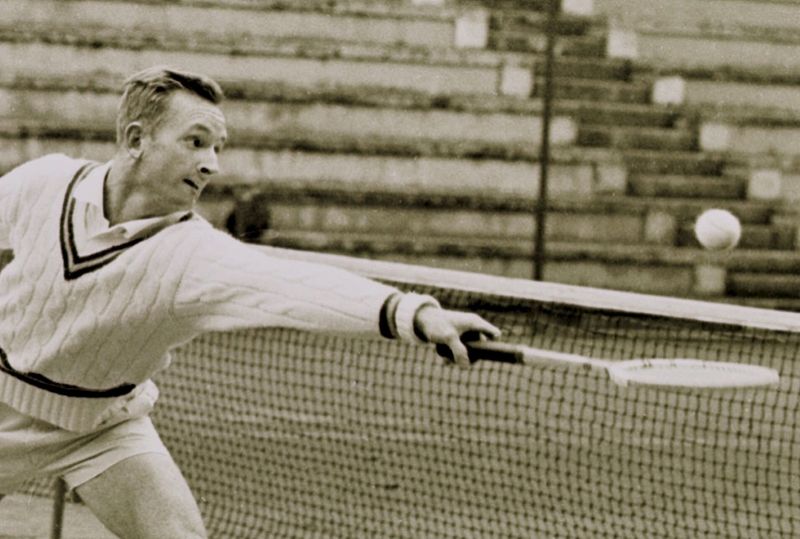
Photo credit: Wikimedia
The 1969 Grand Slam was particularly impressive because Laver won it in the Ope Era, against all the top players. Among the great players he played in majors during his Open Grand Slam were Rosewall, Emerson, Gimeno, Roche, Newcombe, Ashe, Smith, Okker, Ralston, some of these several times.
Laver won eleven majors in his career.
You may think to yourself, only 11 majors when he won 8 in just two years? You have to ask, why was he so dominant in majors in 1962 and 1969 and not win many majors in between. The Grand Slams years, 1962 and 1969 were spread apart by seven years. Yet in all the other years, prior and in between, he only won three majors.
The reason for such a small total nowadays is because Laver spent five years in the Professional ranks, when he was not allowed to play the majors. Laver generally was the best player in the Pros. He could have won many more Classic Majors like Wimbledon, the Australian, the French and the US Championship if he had played. I would not have been surprised if he won a couple of Grand Slams more during this period if he was allowed to play the majors.
Another reason was there was some boycotts during that time because often, in the early days of Open Tennis, many of the Professionals boycotted some majors because of the low prize money and various other reasons. Laver for example won the 1970 Dunlop on grass instead of playing the Australian Open.
Odds were, in my opinion, Laver would have won the Australian Open easily. The French Open was also boycotted in 1970.
The two Grand Slams are of course impressive enough but the record that floors me is the fact Laver won over 200 tournaments in his career. Would Laver have won 200 tournaments if Open Tennis was always around?
It is quite possible.
In the first three years of the Open Era Laver won 45 tournaments. This includes 18 tournaments won in 1969, which was his Open Grand Slam Year.
Laver played during a time in which the top players did not play for huge price money. They played a lot because it was their job and in order to make a good living. In other words, they were not super wealthy. Players like Laver entered more tournaments. When Open Tennis started the tournaments that attracted the top players were the big money tournaments. The majors were not necessarily the biggest prize money tournaments.
Perhaps the most impressive single tournament victory of Laver was when he won the 1971 Tennis Champions Classic without losing a match. Laver won 13 matches. Every match was best of five, like a major. The organizers assumed that with a field of this great strength and the number of matches that no player could go through the tournament unbeaten. It was a round-robin tournament. Some losses were expected by all the players.
It was the biggest prize money tournament of the time. The players in the tournament outside of Laver were John Newcombe, Ken Rosewall, Arthur Ashe, Tom Okker, Roy Emerson, Dennis Ralston, Roger Taylor and Tony Roche. Many of these players all-time greats. All of them at worst, top players. Laver played some of them several times in the tournament.
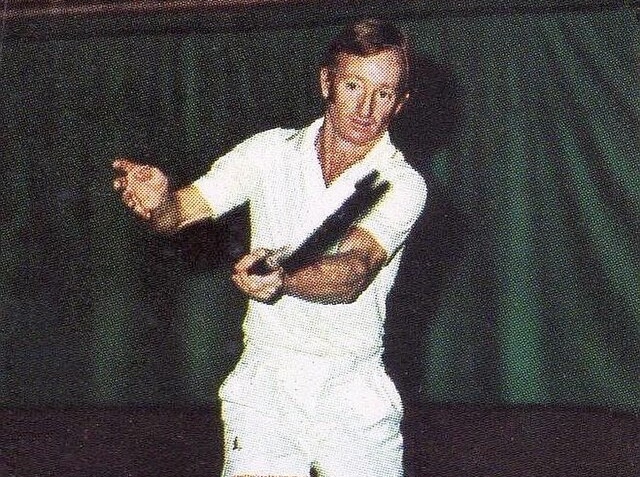
Photo credit: Panini/Wikimedia
Laver wasn’t that a tall player at 5’9” or so during his playing days but when he was
playing his best on any surface, he was thought to be unbeatable. Here’s a quote from Arthur Ashe’s fine book Arthur Ashe Portrait in Motion:
“Still, no one can ever feel secure against Rocket. People talk about me being a streaky player, but there is no one who can blow any hotter than Rocket. In 1968 in the finals of the Pacific Southwest, Rosewall beat him 7-5 in the first set and then didn’t win another game—love and love, a double bagel. When Laver goes on one of those tears, it’s just ridiculous. He starts hitting the lines, and then he starts hitting the lines harder–and harder and harder. No one can stop him.”
“Laver played one of those great matches, even for him against Tom Okker in the 1971 Tennis Player’s Classic. Here’s a quote from the Fireside Book of Tennis: “I feel I’m better prepared for this match than I was for our first,” said Tom Okker as he went out on the court to challenge Laver once again. And Okker was right. The young Dutchman played perhaps the finest tennis of his life. He had every shot, every move-but Laver had the answer to every shot, every move. It was, to that date, the greatest tennis Laver had played, and it was after this match that the grizzled veteran observer had said that maybe, just maybe, Tilden might have had a chance.
“At one point, Okker caught Rod flat-footed in the forecourt but Laver, in desperation, raced backwards, caught up with the ball, ran around it and put it away. Okker dropped his racket in astonishment and the spectators, even the umpire in the chair, howled in disbelief and admiration.
“In the locker room, Okker declared flatly that he had played as well as he had ever played, perhaps better than he had ever played, “but I was never even in the match. I couldn’t believe some of those shots. He couldn’t believe them himself,” Okker moaned.”
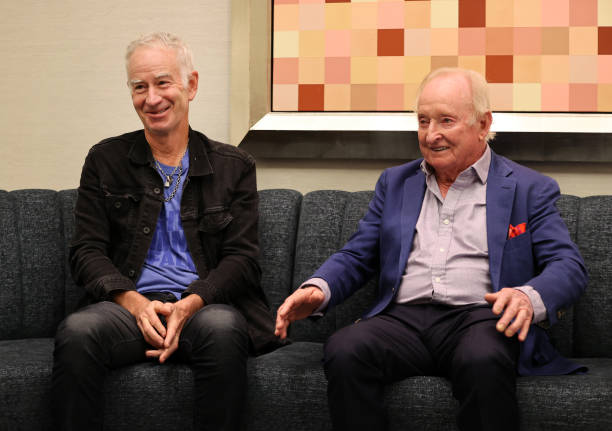
Okker was a gifted player. He had all the shots and won many tournaments in his
career. Okker’s best level was unbelievably high, yet Laver beat him handily.
Why was Laver able to play at this level when no one else in tennis could?
Clearly, he was ridiculously talented in many ways.
One of the reasons is that he had a left wrist the size of King Kong, as some have described it. His forearm was measured to be the size of the World Heavyweight Champion Rocky Marciano. Because his wrist was so powerful, Laver could flick shots back with his wrist that other players found impossible.
Remember in those days they played with a tiny but very heavy wooden racquet. Laver could attack with shots from defensive positions due in great deal to his wrist strength. He played ping pong with a wood tennis racquet. He could load the ball with heavy topspin that was extremely difficult to do because of the small racquet face and heaviness of the racquet. Laver was among the wood-racquet champions who could generate tremendous topspin off both wings. It’s one reason, I believe, if he played in today’s era with today’s equipment, he would still be a force.
Laver, like many great players, when he was at his peak, extremely fast. He was probably the fastest player in tennis. Arthur Ashe thought, of all the players he had seen, only Bjorn Borg was faster. While Laver had an excellent serve and volley, I think the service return, relatively speaking was greater. Of course this was one of his many strengths.
Here’s a quote from John Alexander from the book Tennis, Strokes and Strategies. It’s
from the article How the Pros Return Service:
“Laver’s return is a very different matter. He has an infinite variety of returns, and when they are all working, his opponents find it impossible to settle down. Serve wide to Laver’s backhand in the deuce court (which is not the best place to serve to Laver) and he has the perfect return-in six varieties. His three most noted are his full-swing topspin backhand-down the line and crosscourt-and a very angled crosscourt chip. He also has a moderately angled crosscourt chip which usually lands very close to
the sideline a little deeper than the service line. He has a full-bloodied backhand that can really give you shock. And, there is his punishing slice return down the line, a softer version of which will draw you a little too close to the net for comfort.”
The backhand was extraordinarily strong but players like Arthur Ashe actually felt Laver’s forehand was his superior shot. Laver, with a small heavy wood racquet could hit with heavy topspin on the forehand and backhand unlike many players of in that era.
Many thought Laver’s forehand in his prime was the best in tennis, along with players like John Newcombe and Tom Okker. Later great players like Borg had super forehands but Borg came along when Laver was past his best. Laver reduced his tournament schedule greatly after 1970 but still regularly won a
sizable number of tournaments per year. From 1971 to 1975, which is the last year he had a regular tournament schedule, Laver won five to seven tournaments a year for a total of 31 tournaments during that period. Laver won his last tournament in 1976.
Laver played a tremendous number of matches. If the numbers I have are correct, prior to 1970, Laver had already played 1411 matches. Some years Laver played as much as 166 matches. On the surface that is a lot of wear and tear on the body, but I would venture to write that it was worse than it is today because he used heavy tiny wooden racquets that didn’t damper vibration like the modern racquets do.
Laver had a nagging back problem and elbow problems at that point. I understand that he hurt his wrist in a fall also. Laver, while he was fairly young in the early 1970s had played so much that there had to be some physical problems.
In 1970 and 1971 Laver played over 100 matches each year. So, by the time Laver was 33 he had already played over 1600 matches. Laver probably played over 2000 matches in his career or at least near that level.
For perspective, Federer, whose career lasted to when he was over 40 years old played 1526 matches in his career. Nadal played 1308 matches. Djokovic so far had played 1396 matches as of January 2026. I don’t think Djokovic will play 2000 matches in his career.
Do I think Laver would do well in today’s game?
I believe if you transported the young Laver of 1959 to today, given his great physical gifts, mental strength and time to adjust to today’s game that he’d be great today. The equipment differences today are huge compared to the small wooden heavy racquets of the past. Laver could hit with great topspin with a tiny wood racquet, the amount of spin he could impart today would the bigger, more powerful racquets would be enormous. It’s a given that he would be able to hit the ball far harder today also. Laver admitted that he’d probably change his grip from his continental grip.
His great reflexes, strength, versatility and power would play well in any era. Laver was never the tallest player, even in his era but he was considered to be below average in height. I’ve seen many measurements of his height but in looking at the information I have received I would say he was about 5’9” tall. Some have him at 5’9.5 inches tall but I’ll go with 5’9”.
Would a player of his height do well nowadays? Well, that’s a question that could have been asked in the early 1960s to the mid to late 1970s when Laver was still active on the tour. The answer in those days was not only did he do well, but he was the best, some, like Bud Collins, thought at that time, that Laver was the best of all time.
Let’s not forget that Laver was probably the most powerful player in the game during his peak. Players like John Newcombe looked like they were much more powerful than the Rocket but Laver’s power off the ground and his variety of spins were superior to even players like the great John Newcombe. Laver wasn’t a soft hitting groundstroker, but a player who could hit with massive power off the ground and volley. His serve was strong too although not the power of Gonzalez, Newcombe or Smith.
Laver often enthralled people with his incredible shot making ability. He was very creative on the tennis court to say the least. He attempted shots most wouldn’t even conceive.
Here’s a quote from Gordon Forbes great classic book A Handful of Summers:
“We held firm until four games all in the first set, then dropped service and lost 6-4 in a very conventional sort of way. At about six-all in the second set it occurred to me that we were containing the game-that it was not, as I had been afraid, running away from us. If anything, Rodney was perhaps too much the individual ever to be as great in doubles as he was in singles. While he made some shots so quick and stunning that he left everyone, including his partners, with severe cases of dropped jaw, he also sometimes confused things by playing unconventional shots-things like drive volleys, or topspin lobs for service returns or colossal groundshots from the back of the court. He also sometimes advanced to net behind his own lobs, quite confident apparently of volleying back his opponent’s smashes, which he sometimes did.”
Topspin lobs on service returns and volleying back smashes is not exactly normal tennis
thinking. Nor were drive volleys in the old days with the tiny heavy wooden racquets with the lesser strings for spin.
We cannot say with 100% certainty how Laver would do nowadays. Then again, we cannot say with 100% certainty how players like Alcaraz and Sinner would do with a tiny heavy wooden racquet.
However, we can say that some smaller players like Marcelo Rios, who was also a lefty like Laver, reached No. w in 1998. This was with racquets that while not having the modern technology of today’s racquets, were larger and far more advanced than the heavy small wooden racquets Laver used. Rios was 5’9” tall. Diego Schwartzman at 5’7” tall, reached No. 9 in the world in 2020.
Here’s a video of the match that won the Open Grand Slam for Laver in 1969 against Tony Roche. Note that the courts at the West Side Tennis club in Forest Hills were in bad shape so it was very difficult to hit consistent groundstrokes and passing shots on the grass there.
While Laver lost this match to Rosewall, the highlights show the amazing shots Laver and Rosewall could make. Incidentally at about the 20-minute mark of this video, it mentions that Laver faced match point. The video shows Laver hitting a volley that won the point for him but that was a bit misleading. Laver saved the match point on his serve by serving an ace.
Here is Laver defeating Rosewall in the finals of the 1970 Dunlop Open, which in some ways was a replacement for the 1970 Australian Open which was boycotted by the WCT Professionals. They also boycotted the 1970 French Open. The reason was the low prize money. So, in a way when Laver won the Dunlop in 1970, you can argue he won a major equivalent.
Here’s Laver’s match against Arthur Ashe in the 1969 Wimbledon semifinal. Laver won 2-6, 6-2, 9-7, 6-0.
Here is another great match. This is between Laver and Borg at the 1975 WCT Championship in the semifinal. Borg won 7-6, 3-6, 5-7, 7-6, 6-2.
Bear in mind that Laver was 36 while Borg was 18 at the time. While Laver lost, his shotmaking skills were still quite impressive even at this late age. This was Laver’s last full year on the tour.
The Borg of 1979 versus the Laver of 1964 would have had matches that would have been mesmerizing to watch.
This is an interesting interview with Ivan Lendl in which he discusses a few players, among them Laver. Very few people would know more about tennis than Ivan Lendl, if any. So, if he says something about tennis, you have to take it to heart.
Laver had every shot and great physical talent. He had a terrific combination of power, spin and touch. His peak level was great, and his career accomplishments were astounding.
Do I believe Rod Laver is the Greatest ever?
On his best day, possibly.
But the same can be said about the Big Three and other past greats like Vines, Tilden, Kramer, Gonzalez, Borg, Connors, McEnroe, Sampras also who have been called the GOAT.
There can be no doubt Rod Laver was an amazing player who helped tremendously the development of Professional Tennis.
