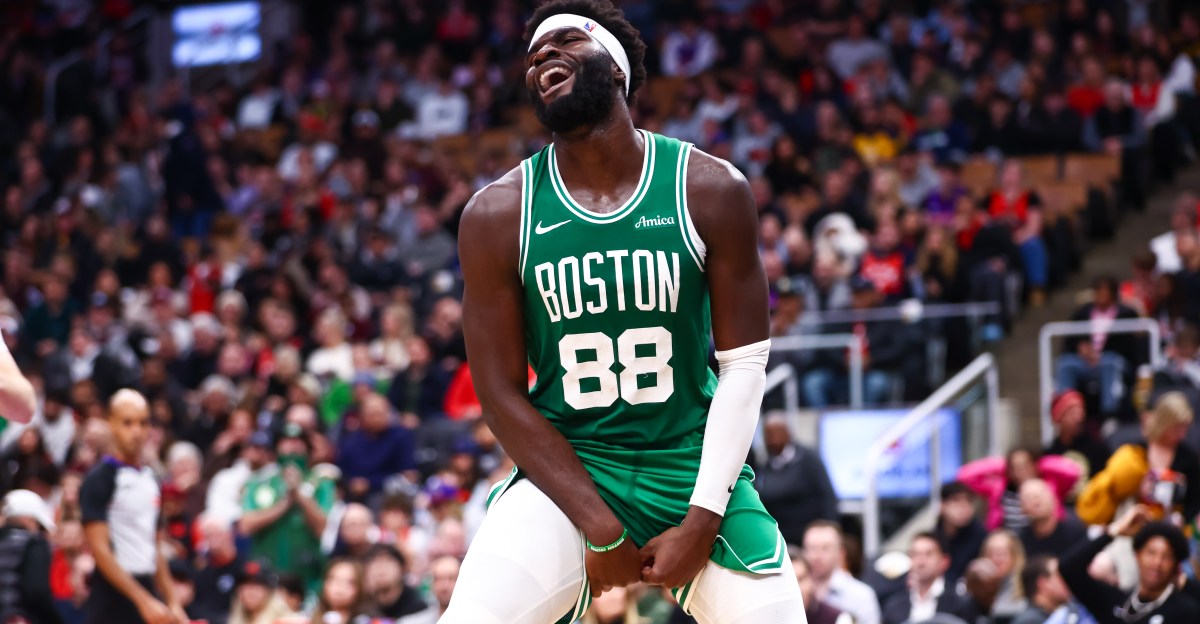
Boy, it’s been quite the hiatus. Like many others, I spent my holidays wondering when I could sneak away from the turkey to watch my hoops. I crammed and crammed to get up to speed on my Celtics games. For the first time, I found myself thankful for the Emirates NBA Cup, allowing me to chop up more film and focus on some real journalism. So, here we are, ready to distill almost ten games’ worth of tape into some noticing.
The lack of quality play from Luka Garza has put a real strain on this Celtics’ rotation. Now, Garza is seemingly out of the rotation, picking up three DNP-CDs in his last five games. Neemias Queta’s excellence (more on this later) keeps the main lineups afloat, and Joe Mazzulla is trying to graft together some backup groups. That has meant heavy experimenting with true small-ball lineups.
If you take Queta, Garza, Xavier Tillman, Chris Boucher, and Amari Williams off the floor, you’re left with 406 possessions. Boston has a +12.6 net rating in those minutes off the strength of the offense. These lineups have blistering shooting numbers, fueled by their ability to screen with any two players at any time.
Schematically, it’s simple. If all five players can shoot and screen, then no opposing defender is safe from being thrown into the action. Hey, Donovan Mitchell, come here. Tyus Jones, you busy? Jalen Brunson, may we have this dance? Julius Randle, how do you feel about pick-and-pops?
The skeleton key that unlocks the lineups is Josh Minott. He’s there for his defense, first and foremost, but they needed to find a way to make him work offensively. Screening and crashing the glass is fine enough, but the shot had to come around for everything to click. And boy has it come around; the former Timberwolf is hitting 45.6% of the 2.8 threes he takes per game.
Being the guy other teams will leave open is a mental game. They don’t believe in you, so you have to find a way to believe in yourself. Josh Minott sure as hell isn’t skeptical about his shot. He radiates confidence when he has a sliver of space, and does not hesitate to pull the trigger anymore.
He’s not just finishing what others create for him. Alongside his energetic cohort Jordan Walsh, Minott has been driving with confidence, and the two often find one another with their passes off the drive. Creating from a standstill in addition to their drives off the catch brings an extra element of dynamism to the small-ball looks. Both players look like great advantage extenders in addition to their play-finishing capabilities.
Now, some of you may have a question here. These small-ball looks are putting up an offensive rating of 138.2, but only have a net rating of +12.6? That’s right: the defense is tremendously bad.
These small-ball lineups, shockingly, have a size problem. I have found a fork in the kitchen; you can all clap now. First and foremost is the problem on the glass.
Any team running a four-out one-in alignment automatically has an advantage. The Rudy Goberts and Jalen Durens of the world can just play volleyball off the glass until the tip-in finally gets home. With no Jayson Tatum around, they don’t have a wing who can credibly match opposing bigs with size and physicality. It’s not for a lack of trying; this is a problem they have no way around at the moment.
Direct actions are a problem as well. A lot of bigs get clean rolls and looks in the paint, often necessitating fouls before they can go up with it. It’s part of the reason why these lineups allow a 26.5 free-throw rate. On top of that, they are conceding a 72.7% mark at the rim.
Another problem presented itself in their last game against the Toronto Raptors. If there’s one thing the Raptors have, it’s physical wings who can get a bucket on the drive and in the post. Scottie Barnes and Sandro Mamukelashvili took turns bullying Boston’s wings in that game.
The extremes of good and bad in these lineups fascinate me. Can they keep shooting like prime Steph Curry as a group? Will they continue to defend like prime Jordan Clarkson? You’d better believe I will have my eye on these quintets.
In our last edition of the film round-up, I focused on Boston’s Horns sets. They were a great way of attacking the Los Angeles Clippers in their November matchup. Over the past few weeks, they’ve been leaning on one set against teams with switching difficulties: Horns Flare.
The concept is simple. You have a shooter/driver like Jaylen Brown or Derrick White set up for a ball screen, then go over a flare screen. If the switch is not communicated well, there’s a window for the open three-point shot. Chasing over the screen brings up drive opportunities. It’s a tough set to communicate and navigate, and Boston has the versatile personnel needed to mix up all three components of the action.
Adding the layers of complexity adds to that communication pressure. I present to you a truly diabolical layering of sets.
You have the Horns setup and flare component, both times with a shooter setting the flare screen for Josh Minott. But instead of pressing the advantage from there, Minott hands off back to the ballhandler before receiving *another* flare. If you did your homework, you think you’ve contained the action after getting in front of the first flare. Then bam, it’s flipped on its head, and you have another screen to navigate or switch to communicate. Simple and lethal.
The revelation of Neemias Queta has arguably been the story of the season for the Boston Celtics. All offseason, the refrain of “where has the frontcourt gone?” echoed irritatingly, ringing in your ears like Christmas music in a department store. Neemias Queta arrived to turn off the noise and give the Celtics a legitimate frontcourt stud.
Let’s talk about the defense first. Boston’s defense allows 106.9 points per 100 possessions with Neem on the floor, and 126.2 per 100 with Queta riding the pine. That +19.3 net defensive rating is the second-best mark of any player in the NBA, behind only Zach Edey, who has played half as many minutes.
Neem’s impact comes first and foremost from his rim protection. Queta contests 9.0 two-pointers per game and allows only 47% of those shots to go in. Here’s the list of the other players who contest at least 9.0 twos per game and can match Queta’s mark of 47 dFG%: Zach Edey, Isaiah Hartenstein, Victor Wembanyama, Rudy Gobert, and Kristaps Porzingis. That’s some excellent defensive company.
He’s taken leaps and bounds as a drop coverage defender. With his footwork improved, Queta can flash higher on the screen before recovering to contest at the rim. No wonder his numbers are so astounding.
Queta isn’t just affecting shots in the action. If you run action away from him, he has excellent timing to rotate over and blow up the play.
It goes without saying that Neem can’t do it all by himself. As I mentioned earlier, Luka Garza’s rotation spot is gone, and the small-ball groups have their own defensive issues. But it’s better to have one capable big than none. And Queta has proven himself more than capable.
That’s all for this edition of my Celtics film round-up. We’ll check in next week to see what’s shaking with the C’s.
