A tribute to an avant-gardist
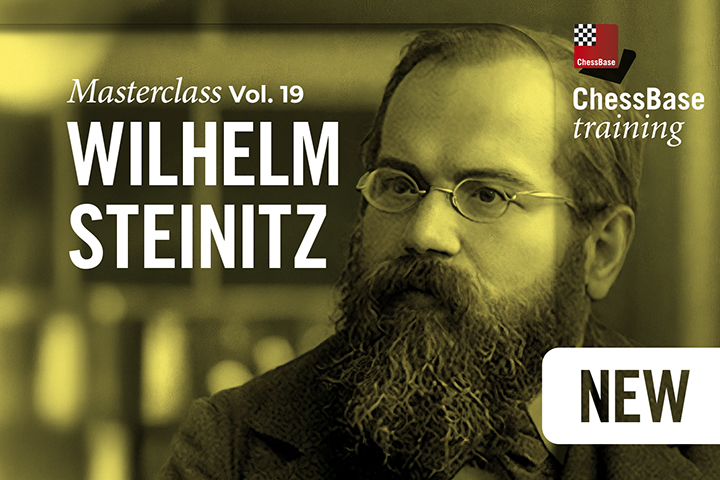
Volume 19 of ChessBase’s Master Class series is devoted to the first world champion, Wilhelm Steinitz. Four experts analyse his strengths and weaknesses in the different phases of the game in a series of video lectures.
Dorian Rogozenco highlights Steinitz’s many contributions to opening theory, which live on in variations that bear his name. Steinitz was an influential writer and was able to disseminate his ideas widely through his columns in the London newspaper The Field, his International Chess Magazine, which he published in New York, and his book The Modern Chess Instructor. At times he was overly dogmatic, something that became particularly evident in the Evans Gambit, where he entered into a theoretical duel with Chigorin and lost heavily. Nevertheless, many of his opening concepts have stood the test of time. Bobby Fischer, a great admirer of the first world champion, successfully adopted several of Steinitz’s ideas, as Rogozenco demonstrates.
Steinitz was the first to show that in the Italian Game it is possible to pose problems for the opponent with quiet moves. In the French Defence in particular, Steinitz introduced many new ideas with White and played a key role in developing an understanding of typical French pawn structures. Ironically, he himself considered the French Defence the “dullest” of all openings and never played it with Black.
In the Ruy Lopez, the line with an immediate …d6 is named after Steinitz—although he himself did not play it very successfully, losing many games with it during his world championship matches against the younger and stronger Emanuel Lasker. The variation became popular only in the early 20th century, when it was taken up by Lasker, Capablanca, and others.
In the Vienna Game, there is the Steinitz Gambit, in which the king forfeits castling rights early while the centre remains stable. In the Scotch Game, a Steinitz Variation can be found featuring the somewhat artificial move 4…Qh4, although Rogozenco still considers the line an interesting weapon even today.
Mihail Marin points out that Steinitz initially was a tactician and attacking player—like all his contemporaries. At some point, however, he experienced a kind of awakening that led to profound insights into positional play. From this emerged numerous principles, such as the idea that a lead in development must be converted into something concrete, as it is only a fleeting advantage.
Marin emphasises that there is still much to be learned from Steinitz today, as he was a pioneer in many respects. Many of his games from the 19th century appear astonishingly modern. Marin recalls that at one point, when his own play was in crisis, he prepared by studying Steinitz’s games—with a lot of practical success.
He also shows that Steinitz was already playing hybrid opening systems in the second half of the 19th century that are considered highly modern today. Time and again, Marin builds bridges between past and present by drawing on games from the last 35 years and revealing striking parallels with Steinitz’s games.
Much of what Steinitz wrote about strategy and positional play makes sense, Marin believes. Some of his theses, however, were formulated too emphatically and too dogmatically—most notably his tendency to overestimate the strength of the king. As a theoretician, Steinitz valued pawn structure more highly than piece activity, seeing pawn formations as something lasting, whereas initiative was, in his view, only a temporary phenomenon. As a practical player, however, Steinitz mastered both strategic–positional play and combinational, attacking chess.
Among the tactics exercises presented interactively by Oliver Reeh, the most famous game by Steinitz naturally appears as well: his victory featuring the “floating rook” against von Bardeleben in Hastings 1895.
Karsten Müller discusses Steinitz’s endgame play. The Steinitzian method of restriction has become an established term in the literature, describing how to exploit the bishop pair against bishop and knight. Müller vividly explains how one advantage can be transformed into another—an aspect that was also central to Steinitz’s theoretical thinking.
This Master Class volume impressively demonstrates how influential Steinitz’s ideas were not only in his own era, but how they continue to resonate, in part, to this day. Many of his ideas have endured.
Williams Steinitz, 1st World Chess Champion (1886-1894) The match between William Steinitz and Johannes Zukertort in 1886 was the first chess match for the ‘World Chess Championship’. Steinitz won, and has since been considered the first official world champion in chess history.
Free video sample: The Steinitzian method of restriction
Free video sample: Strategy Introduction
First published in Karl 04/2025. Translated and reprinted with kind permission.
