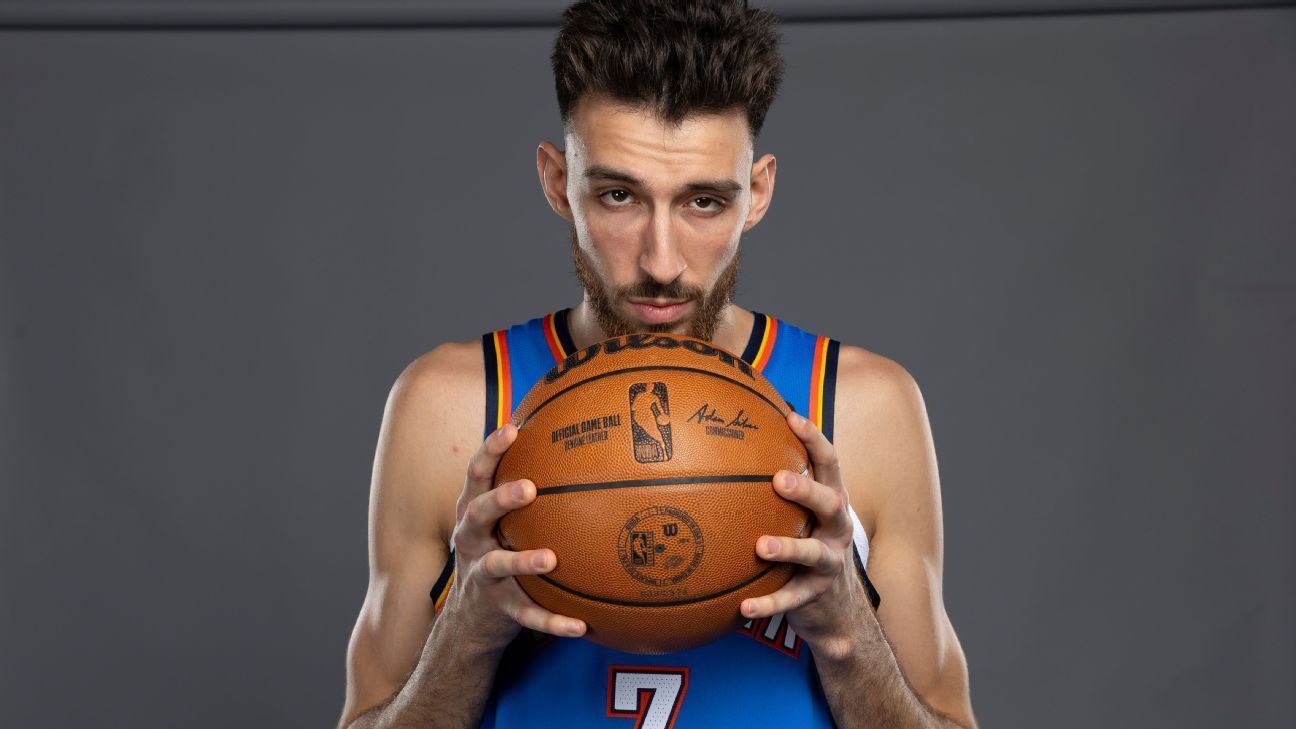
SEVEN WEEKS AFTER his 23rd birthday, Chet Holmgren won his first NBA title. Ten days after celebrating it, Holmgren estimated, he forced himself back into the gym.
“Nothing’s worse for your body than not training,” Holmgren told ESPN. “I learned that being on bed rest for six weeks watching my muscle just f—ing wash away.”
Almost everything about the Oklahoma City Thunder‘s dream ride to a 2025 NBA championship is remembered with radiance. But there’s some gloom within Holmgren’s retelling. It included the proudest and the darkest chapter of his basketball life.
Last November, in the Thunder’s 10th regular-season game, Holmgren rotated to contest a baseline drive by Golden State Warriors wing Andrew Wiggins. Wiggins squared up a leaping Holmgren at the wrong angle, using an extended elbow to send the aggressive but skinny shot blocker careening toward the court on a parallel descent.
Hip met hardwood. Holmgren fractured his pelvis and writhed in agony. His two biggest teammates, Isaiah Hartenstein and Jaylin Williams, followed the training staff to his aid, carrying the franchise center to the locker room and staying with him as he came to grips with the diagnosis. He went to the hospital that night. Hartenstein visited him.
“In my career, that’s the first time I really saw someone in that much pain,” Hartenstein said.
Holmgren, who returned for the Thunder’s title run after sitting out 39 games, has already checked a pair of boxes that most premium lottery picks spend their entire career chasing. Three summers after he was drafted No. 2 in 2022, he has been a major contributor on an NBA champion and, in July, signed a five-year, $240.7 million contract extension.
Holmgren is a proven and paid winner but is still in the infancy of his NBA development. He has appeared in fewer regular-season games (131), for example, than Amen Thompson (148), the Houston Rockets wing drafted No. 4 in 2023.
Holmgren’s hunger for a personal leap is helping drive the Thunder’s powerful repeat effort this season. In previous seasons, his extended absences partly opened the door for Jalen Williams to become the team’s second All-Star.
But Williams sat out the first 19 games this season dealing with a wrist injury, partly opening the door for Holmgren to stretch his legs. The Thunder have sprinted to a 20-1 record with a historic point differential (15.5). Holmgren is averaging a career-high 18.2 points.
“We don’t really have anybody on the team who is just sitting and reminiscing on what a great career they had,” Holmgren said. “I think everyone on the team is striving and chasing for more. The championship wasn’t the last check on their bucket list.”
HARTENSTEIN WAS OUT when the Thunder opened last season in Denver. That meant Holmgren was matched up at center against Nikola Jokic, the reigning MVP.
It was a perfect showcase for the work he’d put in between his second and third seasons.
“We’d lost in the second round [against Dallas],” Holmgren said. “Four-and-a-half month offseason. I took one weekend vacation. That’s it. I worked so hard. I was seeing it pay off.”
Holmgren had 25 points, 14 rebounds and 4 blocks in a dominant win over the Nuggets. He held Jokic to 16 points. Two nights later, Holmgren had 21, 16 and 2 blocks in Chicago. The next night, he had 25, 9 and 6 blocks in a win over the Atlanta Hawks. The leap was materializing.
“He would’ve been in contention for Defensive Player of the Year,” Hartenstein said. “He had a chance to make an All-Star team. So I think that’s probably another mental factor. You have to go through the what ifs.”
Two nights before he cracked his hip, Holmgren punished the Houston front line for 29 points in 29 minutes. The blowout pushed the Thunder to 8-1.
“Then boom,” Holmgren emphasized. “Backward. It’s just so disheartening.”
Holmgren compared his first month after the fractured hip to solitary confinement. He spent a week in the hospital and then three more stuck in his oversized bed, ordered to lay on his left side and move as little as possible to ensure healing.
“You don’t want people to be around you because you’re miserable,” Holmgren said. “You can’t go do anything. You’re not even living, you’re just surviving.
“That’s something I don’t think fans realize about some of these real f—ed up injuries.”
Holmgren sat out his entire first season because of a Lisfranc injury, but even that longer rehab was more bearable because it was more mobile and social. Most NBA injuries come with a freedom to be around the team and work out other areas of the body. On bed rest, as Holmgren put it, you just watch the growth and muscle “waste away.”
“Then you have another two weeks on crutches,” Holmgren grumbles. “Which, basically, it’s like parole from bed rest.”
IN THE DIMMING glow of that late June championship, after those 10 days away from the grind, Holmgren entered the gym intent on building back specific areas of his body and game.
To do that, he queued up tape. Holmgren returned in February from the hip fracture, figured out how to comfortably play the power forward position next to Hartenstein, who was signed in the offseason to reinforce OKC’s frontline, and reintegrated admirably as a winning player on a runaway train in motion.
He started all 23 playoff games, averaged 15.2 points in 29.8 minutes and finished second among all players with 43 postseason blocks. But he hated the film.
“The worst person to talk to about his good performances is him,” Thunder coach Mark Daigneault said. “He’s a perfectionist.”
Holmgren made only 29.7% of his playoff 3s. He saw a lagging release. He was held below 10 points in three of the seven Finals games. He’d watch himself run and cut and just didn’t see the athlete or playmaker he knows himself to be. Instead, he saw hesitancy.
“I look slow out there,” Holmgren said. “It felt slow, too. I didn’t have my pop and my movement at all.”
On a night that will partially come to define the legacies of those within this burgeoning Thunder era — Game 7 to win their first title — Holmgren had 18 points, 8 rebounds and 5 blocks. When the Thunder separated from the Indiana Pacers in the third quarter, Holmgren was all over the place. Four of his five blocks and 13 of his 18 points came after halftime.
“The best framework to look at him is through the lens of floor and ceiling,” Daigneault said. “That game is just a great example of the floor of the player. The guy just changed the game. I mean he blocks five, but he alters another probably two or three. Then he deters a few more because they won’t even go in there. So all of a sudden you’re taking 10 quality shots away in the biggest game of the season. You’re removing those because of his presence.”
Holmgren, even when compromised, is a 7-foot floor spacer defenses respect even when he’s missing shots. On the other end, he has been among the elite rim protectors the moment he stepped into the league.
For his career, he has given up a 46.4% effective field goal percentage as the contesting defender, third best among those to contest 2,000 shots in that span, behind only Victor Wembanyama and Rudy Gobert. This season, per GeniusIQ, Holmgren has held opponents to 39.9% as the contesting defender, best among the 42 players to contest at least 250 shots.
“He’s always got all that,” Daigneault said. “But then there’s still a ceiling for him because he’s such a young player. He has only played [131] games in his career. So we view him as a guy that is developmental still. And it sounds weird to say that because usually that is associated with guys who haven’t accomplished what he has.”
WINNING IS OFTEN rewarded in the NBA. Holmgren pushed hard in his hip rehab to get back as quickly as possible — needing just under three months — and pushed through discomfort to help muscle the Thunder over the finish line. Less than a month later, on July 9, they planted that monster contract offer on his table. He accepted.
“I never played basketball for the financials of it,” Holmgren said. “Obviously it’s a blessing. I can take care of my family for a long time. But I never did it for any amount of money. So my urgency to get out on the court and play has nothing to do with needing to get paid or finally being paid.”
But the changing financials will be the next story of this evolving Thunder team. This season, Shai Gilgeous-Alexander, Williams and Holmgren make a combined $58.5 million. Next season, they’ll make a combined $123.8 million. The season after, it’ll be a combined $150.6 million.
As they take up an increasing percentage of the salary cap, Thunder general manager Sam Presti will inevitably be forced to be stingier with the rest of the rotation and roster, even with a treasure trove of draft assets.
That makes Holmgren’s ultimate ceiling a greater part of the bigger picture. What can he become as he ages into the middle of his prime? The signs early this season have been positive. His raw scoring production is up. His 55.5% shooting is a career high. He says he feels better physically, and his superstar teammate also feel it.
“He just doesn’t fade physically,” Gilgeous-Alexander told ESPN. “His moves are stronger throughout the game. Naturally, he’s going to walk into 15, 17 points a night. Then as he continues to get stronger, he will develop his low post and midpost game, kind of the way Dirk Nowitzki did.”
Holmgren is finishing better than ever around the rim. He has made 75% of his dunks and layups, up from 63% last season. Daigneault also called one of the Thunder’s internal stats on Holmgren “very encouraging.”
“He’s taking a higher percent of his open shots than he did last year,” Daigneault said. “About 10% higher by raw percentages. I think it’s gone to 73 [percent] from 62 [percent] by our numbers.”
Williams returned to the lineup this week. In his first two games back, Holmgren still had 23 and 19 points on a combined 17-of-28 shooting. The two work well together, especially as the combo engine of second units when Gilgeous-Alexander sits.
But Williams’ climb in usage as he reintegrates will inevitably eat into everybody else’s, including Holmgren’s. It’ll be the latest balance for Holmgren to strike, as he tries grow into the individual player he wants to be within the needed confines of a juggernaut.
“The sky’s the limit,” Gilgeous-Alexander said. “He can take this game and his game wherever he wants it.”
