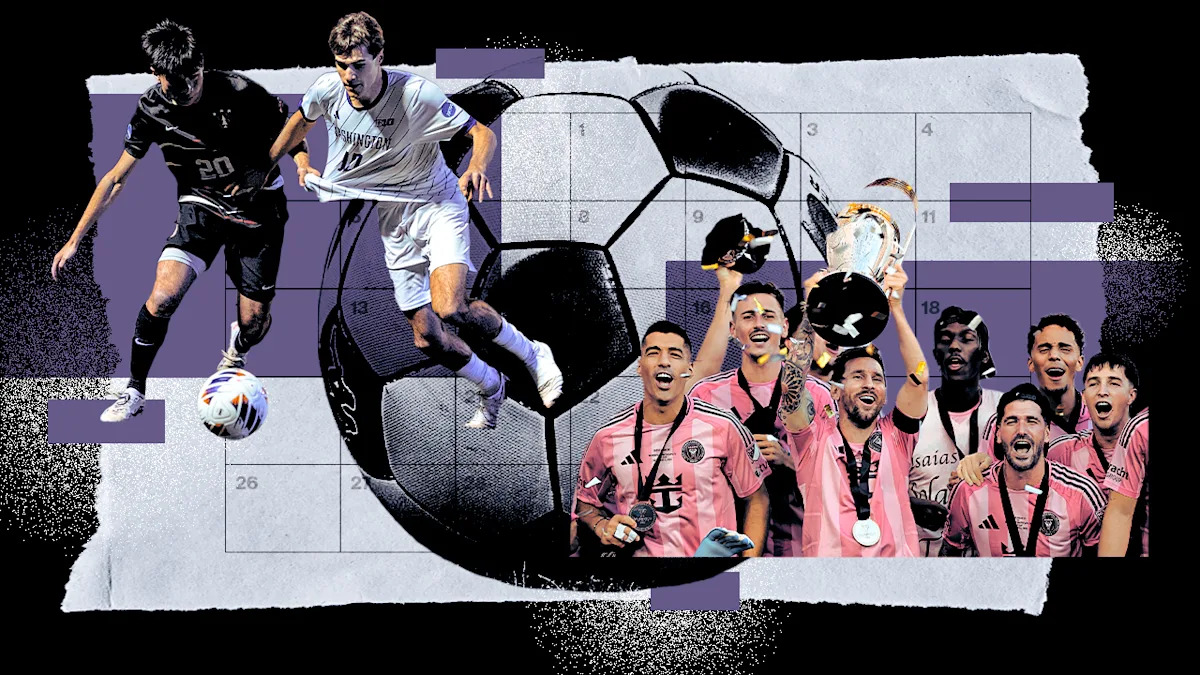
As the final four teams vie for the NCAA men’s soccer College Cup in North Carolina this weekend, work continues on plans to overhaul the college game. And those reform efforts may have received a boost from a radical change at the pro level: MLS’ recent decision to change its calendar.
Like MLS, the NCAA holds its soccer playoffs during the late autumn, in the long, eclipsing shadow of the NFL and college football. It’s one of several issues bedeviling the college game, particularly on the men’s side, as it struggles for relevance amid the collapse of amateurism and changes in the American soccer development system.
Advertisement
More from Sportico.com
MLS announced last month it will move its playoffs to the spring, part of a calendar switch to a July-to-May season. That change, set for the 2027-28 season, puts the U.S. pro league more in line with the rest of the world and its playoffs safely outside the American football footprint.
It also dovetails with reforms proposed by U.S. Soccer’s NextGen College Soccer Committee. In a white paper released in October, the committee recommends moving the men’s game, and perhaps the women’s, from the current fall-only schedule to one that covers the entire scholastic year and culminates in an April playoff festival.
If the committee’s schedule plan earns NCAA approval, having the MLS move in sync will create complementary growth and marketing opportunities for college soccer and the sport as a whole, NextGen committee chair Dan Helfrich said in an interview.
Advertisement
“If the two calendars are in alignment, the late spring becomes a chance for a celebration of soccer in the U.S.,” said Helfrich, a former Deloitte executive who will assume the role of chief operating officer at U.S. Soccer in January. “And if the right people get together, which I think they will, and align planning and marketing and broadcasting and those types of things, you can have a ton of synergy with high-stakes, postseason soccer in the springtime.”
It’s also a chance for teams in the College Cup playoffs to gain recognition, which is often in short supply—even when there’s plenty of drama. “This year will be a good final four, with an unexpected champion, which makes for good storytelling,” Helfrich said.
Indeed, a crazy tournament thus far led to a bushel of upsets. Washington beat favored Stanford in the quarterfinals, while NC State upset Maryland to garner a place in the semis close to home; the final two rounds will be Friday and Monday in Cary, N.C. The other two semifinalists, the Saint Louis Billikens and Furman Paladins, have lower budgets but strong soccer traditions—as well as mascots that send people scrambling for their dictionaries.
The best story in the group belongs to Furman. The small private school in Greenville, S.C., helped launch the career of three former U.S. men’s World Cup team players—Walker Zimmerman, Ricardo Clark and the legendary Clint Dempsey. But their coach, Doug Allison, has never made a final four. He’s there now, in his 31st and final year at the helm, seeking a career-capping title.
Advertisement
Stories such as Allison’s, and the buzz and loyalty they can generate among rabid college fan bases, are part of the reason Helfrich is optimistic about the success of a spring calendar switch, where college soccer, and the sport in general, can grab the stage.
“If you lay all of the college calendars on top of one another, you see this really interesting window between the end of March Madness and the start of the spring postseason for lacrosse, softball and baseball in that second half of April, early May timeframe,” he said. “We feel very confident that we can activate the college athletics fan in a way that galvanizes and grows soccer.”
Helfrich said it’s “premature” to speculate on what an MLS and college postseason tie-in might look like. But, he said, “the concept of creating extended moments of U.S. soccer fan engagement with major events that are linked together will benefit all.”
MLS agrees, while echoing that there’s a long way to go. “We appreciate the work being done to grow the game and evolve college soccer,” Ali Curtis, the president of MLS Next Pro and EVP of MLS Sporting Development said in a statement. “The discussions have been led by U.S. Soccer, but we have been involved in conversations. … It’s still early in the process, but MLS is open to conversations that benefit fans, student-athletes and the game as a whole.”
Advertisement
Curtis, who serves on the NextGen committee, emphasized MLS’ existing connections to college soccer, with a number of MLS and Next Pro players emerging from the college ranks. He noted that MLS Next, the league’s youth-development arm, “is the No. 1 source of talent” for top NCAA D-I programs.
Right now, Helfrich said, the NextGen group’s “core focus” is discussions with the NCAA’s men’s and women’s college soccer sport oversight committees.
Without their buy-in, the reform proposals won’t go anywhere. One of the NCAA’s main concerns has been how the women’s programs, which remain a major talent feeder to U.S. national teams and professional leagues, will be affected by any shake-up, including to the calendar. The NWSL season opens in the spring and concludes with playoffs in the fall.
The recommended calendar switch in the men’s college game provides advantages beyond a potentially higher-profile postseason. The season’s end would coincide with the global summer transfer window, enabling top college players to join MLS or most European teams in their offseason. “This would potentially sync naturally with MLS, but college soccer needs to be configured in a way that it can be a source of talent for leagues that operate on a variety of calendars,” Helfrich said, referencing the USL and Mexico’s Liga MX.
Advertisement
To be sure, players still develop into pros from the current system, and the College Cup has its hardcore supporters, likely bolstered this year in Cary by the presence of NC State and Furman fans.
But Helfrich believes the college game can offer more. “There is a segment of fans who are college sports fans first—above their support for an individual sport,” he said.
They’re fans of their schools—NC State Wolfpack hoops fans, for example, who want to see their other programs win a national title. He thinks that for soccer, it’s a market worth developing.
“Those fans get excited about high-profile college sports events that have high visibility and are marketed broadly,” Helfrich said.
Advertisement
Best of Sportico.com
Sign up for Sportico’s Newsletter. For the latest news, follow us on Facebook, Twitter, and Instagram.
