December 25th, 2025
Christmas puzzle 1 – Dawson problem
The reason why the problem has just one solution has to do with the fact that the black bishop, which was initially on c8, was not captured on c8. This is why:
There are a total of six black pieces on the board. This means that ten black pieces have been captured. Furthermore, in order to reach the squares on which the white pawns stand, they must have made exactly ten captures. This is possible, for example, if the white pawn initially standing on a2 takes the route a2-b3-c4-d5-e6 and the b2 pawn takes the route b2-b4-c5-d6-e7. That already makes seven capture moves. Three more captures are added to this, for example f2-e3 and h2-g3-f4. There are several other possibilities, but the white pawn formation cannot be achieved with fewer than ten pawn captures. Thus, the ten black pieces that are no longer on the board must have all fallen victim to pawn captures.
With that, we realize that the black bishop which originally stood on c8 cannot have been captured there by a white pawn, if there was still a black pawn standing on d7. So at some point during the game the black d7 pawn must have moved so that the c8 bishop could move and be captured by a white pawn. Which in turn means that the last move before the board position above cannot have been d7-d5.
Consequently, the last move before the board position must have been f7-f5, so that there is actually only one solution (variant 2). The decisive factor here is that the other black bishop, on f8 could have left its starting square with a black pawn on f7, in order to be captured by a white pawn.
This is the tiny asymmetry that gives this brilliant chess composition its great aesthetic appeal and artistic value.
Christmas puzzle 2 – Benko Christmas puzzle
The solution is 1.Qc5! dxc5 (1…Rxc5 2. Nd4# or 1…Bxe4 2.Nf4#) 2.Re5#. Quite amazing, this composition by an amazing chess artist.
Christian Hesse
December 26th, 2025
Christmas Puzzle 3 – Retro
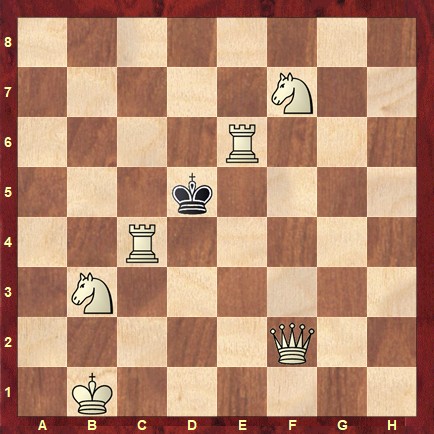
White to mate in two
Solution: The last move before the diagram position had to be made by White, not by Black, since the black king could not come from any of his neighbouring squares which are guarded by two or three white pieces. So it is Black to play, and the correct solution is 1… Kxc4 (1… Kxe6 2.Rc7 Kd5 3.Qf5#) 2.Qd4+ Kxb3 (2…Kb5 3.Rb6#) 3.Re3#
Christmas Puzzle 4 – Retro
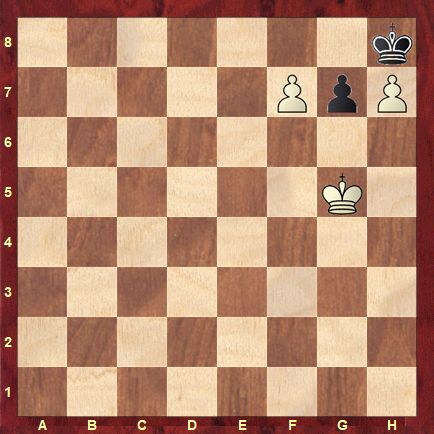
White to mate in three
Solution: Once again Black could not have made the last move, so it is Black to play: 1…Kxh7 (1…g6 2.Kh6 g5 3.f8=Q#) 2.f8Q g6 3.Kf6 g5 4.Qg7#.
Christmas Puzzle 5 – Direct mate
This problem has a symmetrical position – its mirror axis runs through the centers of the squares d2-e4-f6-g8. I dedicated it to grandmaster Matthias Blübaum, and it was published on October 4th 2025 by the Stuttgarter Zeitung.
Solution: 1.Rg5 Kd4 (1…Kf3? 2.Kd3,Nc5,Ndf6 and mate in five) 2.Rc5 Ke4 3.Ke2 Kd4 4.Ng7 Ke4 5.Nf6+ Kf4 (5…Kd4 6.Ne6#) 6.Ngh5#
December 27th, 2025
Christmas Puzzle 6 – Text puzzle
A game ends with the move 6…Nf1 mate. How did it go?
I have resisted giving the solution for decades, and used the problem on so many “victims”. But in recent years that failed, because especially the young talents to whom I would give the problem would instantly give me the solution. It had been revealed to them by their colleagues, or they had already found it on the Internet.
So here is the solution: 1.e4 Nf6 2.Qe2 Nxe4 3.f3 Ng3 4.Qxe7+ Qxe7+ 5.Kf2 Nxh1#. Of course the second and third moves can be reversed: 2.f3 Nxe4 3.Qe2 Ng3 4.Qxe7+ Qxe7+ 5.Kf2 Nxh1#
Christmas Puzzle 7 – Text puzzle
A game ends with the move 6…Nf1 mate. How did it go?
The full solution to the problem, which was given to us by GM Stuart Rachels, is 1.e4 e5 2.Bc4 Nf6 3.Ne2 Ng4 4.O-O Qh4. There are slightly different ways to reach the position on the bottom right of the board, but all variations converge to it – from here on they are identical, and the key idea we needed to find is shown in the following two moves: 5.Kh1 Nxh2 6.Rg1 Nf1#. The knight did not checkmate the king – it provided the discovered check by the queen, which did.
And here are the reactions of our readers ten years ago. Watch them struggle!
Note: you can enter the moves of problems 6 and 7 problems on the diagram above.
Frederic Friedel
