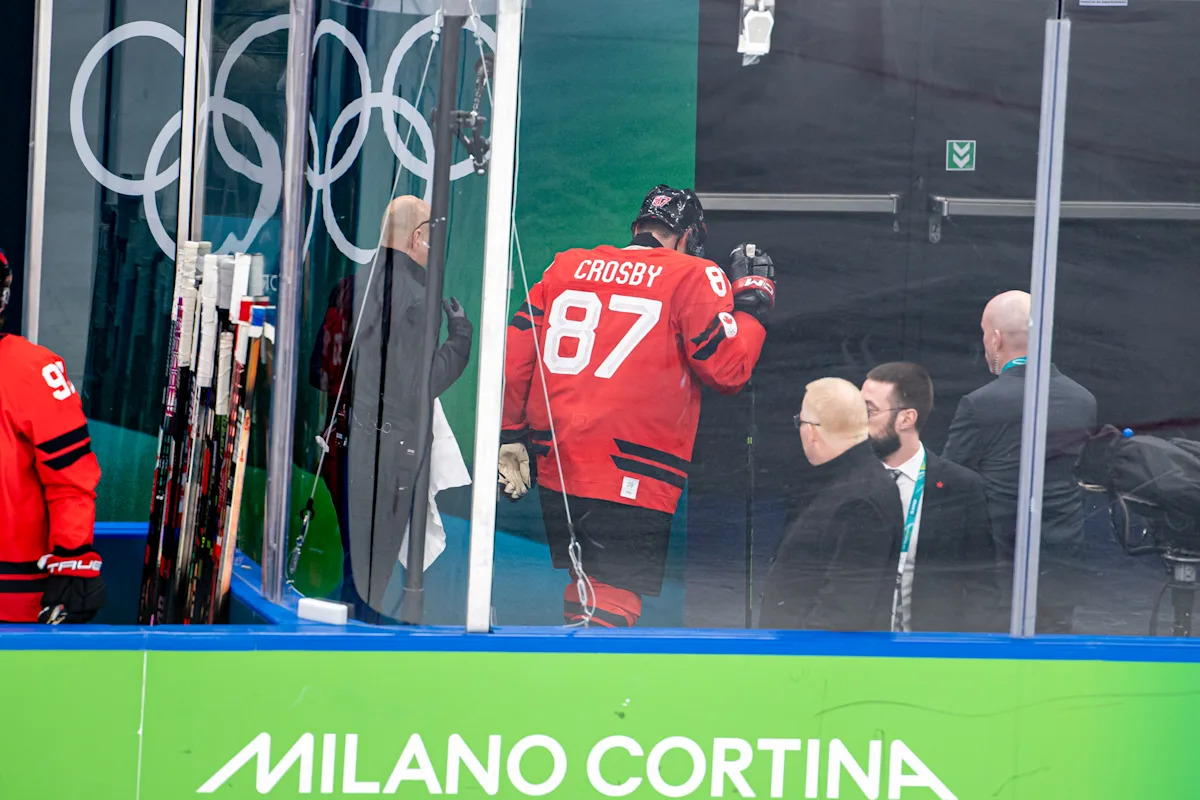
You could almost feel the rush start building up as soon as Sidney Crosby limped off the ice yesterday. Other players like Kevin Fiala (out for the season with a broken leg), Josh Morrissey (currently injured to an unknown degree) and Brad Marchand (who missed two Olympic games but has since returned) have picked up injuries in these Olympics, but a player on the level of Crosby raises the discourse to new levels.
It harkens back to the 2014 Olympics, when then-New York Islander star John Tavares was lost for the season with a torn MCL suffered in Sochi.
Advertisement
First, the latest updates on Crosby have been inconclusive at best. Crosby has not been ruled out by Canadian coach Jon Cooper for Friday’s semifinal game yet, however he obviously has picked up some level of injury that has his immediate future in doubt. Even if Crosby can return for the games, his status for a stretch of 12 games in 21 days for the Penguins, which begins in just a week, has to be at least partially in doubt.
It probably won’t be as severe as “Mario Lemieux only playing one NHL game after the 2002 Olympics” but then again the situations were drastically different with Lemieux back then clearly trying to hold onto as much of his health as possible to participate in the Olympics and then be forced to address his health in the aftermath. (Lemieux would go onto play only 10 games the following season). That was less the fault of an Olympic injury and more a different priority in a different time with a much different health situation.
Going back to 2014 and the endless debate, former NYI general manager Garth Snow didn’t take the news well on losing his best player, as one would expect. Snow called NHL participation in the Olympics a “joke” and said:
“This is probably the biggest reason why NHL players shouldn’t be in the Olympics, it should just be amateurs,” Snow told Newsday. “And it could have happened to anyone; it just happened to be us that lost our best player.”
“A lot of people pay to see John play,” he said. “It wouldn’t matter if we were 10 points clear of a playoff spot or 10 points out. We lost our best player and he wasn’t even [injured while] playing for us.”
Snow asked rhetorically if the IIHF and IOC would reimburse the Islander season-ticket holders who were out a lot of money. Ticket prices have risen significantly in the last 12 years, the same thought holds water for those Penguin fans who have invested hundreds or thousands of dollars in the 10 home games Pittsburgh will play through the end of March. That total investment will reach eight-figures with no small amount of the decision linked to the opportunity to see Crosby play.
Advertisement
On the flip side, Penguin coaches and teammates surely understand and accept the risk involved.
“It’s the Olympics,” coach Dan Muse said after a Penguins practice yesterday. “Anytime these guys get an opportunity to represent their countries, I’m just happy for them. To play in a tournament like that, to be playing in that setting, that is something I think everybody dreams of. The only thing for me is that I’m excited for those guys getting that opportunity that they’ve earned.”
Crosby’s teammate Bryan Rust encapsulated the overwhelming majority of player opinions by responding to the early news that Crosby got hurt and whether the risk justified the desire to still compete.
“You can get injured in practice, look at (Aleksander) Barkov, he (is missing) the year because he got injured in practice. (Kevin Hayes) got injured in practice. Things can happen all sorts of places. With the way these practices are now, with how intense they are, guys across the league, somebody might get injured.
Advertisement
“I don’t think guys in this league are too worried about that. The opportunity to represent your country at the highest level, the world stage, I think guys are more than willing to accept that risk.”
That rings true in a lot of senses. We can’t speak for injured players like Crosby, Fiala and Morrisey but it stands to reason all would get right back on the plane to Italy to represent their countries again, even knowing firsthand the price that could be attached in terms of pain that might entail.
The question becomes weighing player interest against what is best for the NHL season. Ancillary debates spawn from there about the impact of taking a three week pause and condensing a season into a reduced calendar is another element that impacts the league and the players who don’t get Olympic participation, held up against a notion about growing the appeal of the game (of which, results can be spotty for tangible impact of best-on-best drawing into increased NHL audience).
The debate draws down to competing opinions and viewpoints that will never align. Those with an NHL bent, be it for professional or monetary reasons, as Snow illustrated will justifiably be angry when the inevitable happens for star players getting hurt at the Olympics. Others, like the players themselves as Rust spoke to, are more than willing to risk it for the glory involved and opportunity to represent their country. There are decent enough reasons to be on either side of the fence, depending on where a perspective falls.
Advertisement
It’s a debate that will rage on for as long as the NHL and the Olympics both exist, neither of which are going away anytime soon. NHL players have been confirmed to compete in the 2030 Olympics, and the league is increasing their own involvement in staging best-on-best action in 2028. The questions about whether the cost is worth the benefit won’t change for people who run NHL teams compared to those that want to represent their countries, which will only lead to more instances of the topic coming back for further discussion as time goes on.
