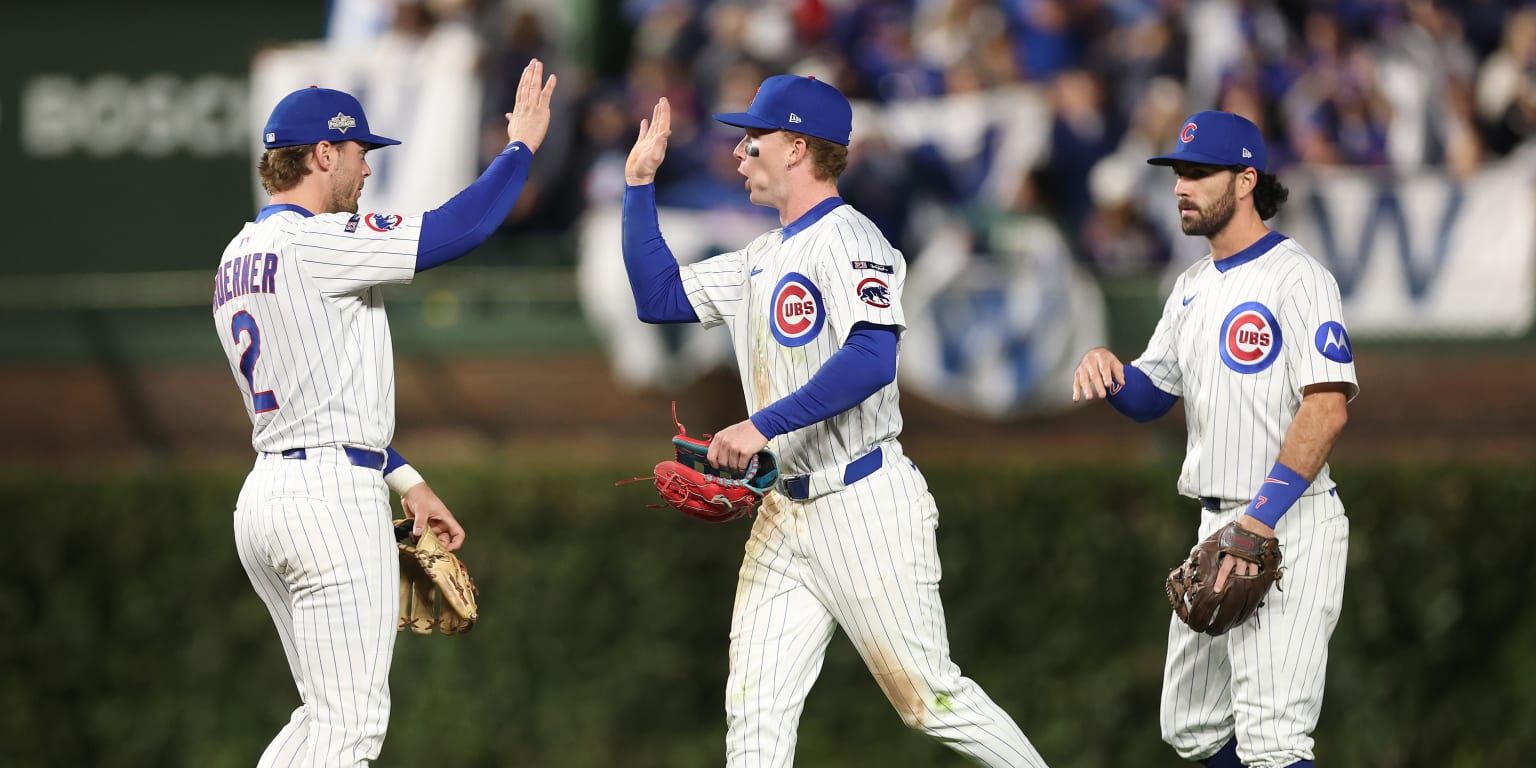
As Chicago works to address the need for multiple relievers and at least one starting pitcher — while preparing for the potential departure of star outfielder Kyle Tucker in free agency — it can at least be thankful that there is a solid foundation in place for 2026.
To wrap up Thanksgiving week, here are five things the Cubs can give thanks for when it comes to the roster currently in place.
1. One of baseball’s best defenses
In all, Chicago had three Gold Glove winners (Crow-Armstrong picked up his first for center, Nico Hoerner earned his second at second base and Ian Happ got the nod for a fourth year in a row for left field) and six Gold Glove finalists. Matt Shaw (third), Carson Kelly (catcher) and Matthew Boyd (pitcher) were all candidates.
Dansby Swanson — one of baseball’s top defensive shortstops — was not in the Gold Glove mix this year, but he still had an above-average showing (four Outs Above Average and seven Defensive Runs Saved). That gave the Cubs an incredible up-the-middle unit with a combined 43 OAA, per Statcast, between Crow-Armstrong, Hoerner and Swanson.
Looking ahead to 2026, nearly the entire position-player group is set to return, barring some unexpected moves. The skill of Chicago’s defense creates a situation where the team’s pitchers have confidence to attack the strike zone at a high rate. It’s one reason the Cubs have built a reputation in recent years of getting the most out of their arms.
2. A versatile offensive group
One of the goals for president of baseball operations Jed Hoyer during the mini-rebuild across the 2021-22 seasons was to get on a path toward a more well-rounded offense. The ‘25 lineup showed off the kind of versatile group that was envisioned so many years ago.
Not only did the Cubs feature an elite contact rate (78.4%, ranking third in the NL), but the team also had power (third in the NL in both Isolated Power, .181, and home runs, 223) and speed (second in the NL in both Baserunning Runs Above Average, 11.0, and stolen bases, 161). Even with some team-wide issues in the second half, Chicago’s offense was essentially a top-five unit overall.
Now, Tucker played a major role in acting as a catalyst for the lineup with his blend of patience, power and speed. That said, the bulk of Chicago’s lineup is penciled in for 2026, and there is still room to grow for plenty of the younger players.
3. A young core group locked in
What do those four players have in common? They are all 25 years old or younger right now. Michael Busch, while 28 years old, is only three years into his Major League career and broke out with a team-high 34 homers in 2025. Catcher Miguel Amaya missed time due to injury last season but at 26 has developed into a starting option.
4. Veteran group strengthening roster
One thing Hoyer has accomplished is having veterans anchoring the roster while having avenues to introduce prospects into the mix. The position-player group has a solid core with Happ, Hoerner and Swanson. The rotation has veteran voices and leaders in Jameson Taillon, Justin Steele and Boyd, while Colin Rea’s presence as an experienced pitcher willing to accept any role has a trickle-down effect on younger arms on the staff.
5. Pipeline again primed to make impact
Crow-Armstrong was given a developmental on-ramp in 2024 and blossomed into a star in ‘25. Both Shaw and Horton were introduced into the mix this past season. In ‘26, outfielder Owen Caissie (No. 47 on MLB Pipeline’s Top 100 list, No. 1 Cubs prospect) and catcher Moisés Ballesteros (MLB No. 53, Cubs No. 2) — who both got a taste of the Majors this year — are in a position to impact the MLB team. Pitching prospect Jaxon Wiggins (MLB No. 67, Cubs No. 3) will be on the radar for later in the summer, and former Top 100 outfielder Kevin Alcántara should be in position to contend for a job this spring.
