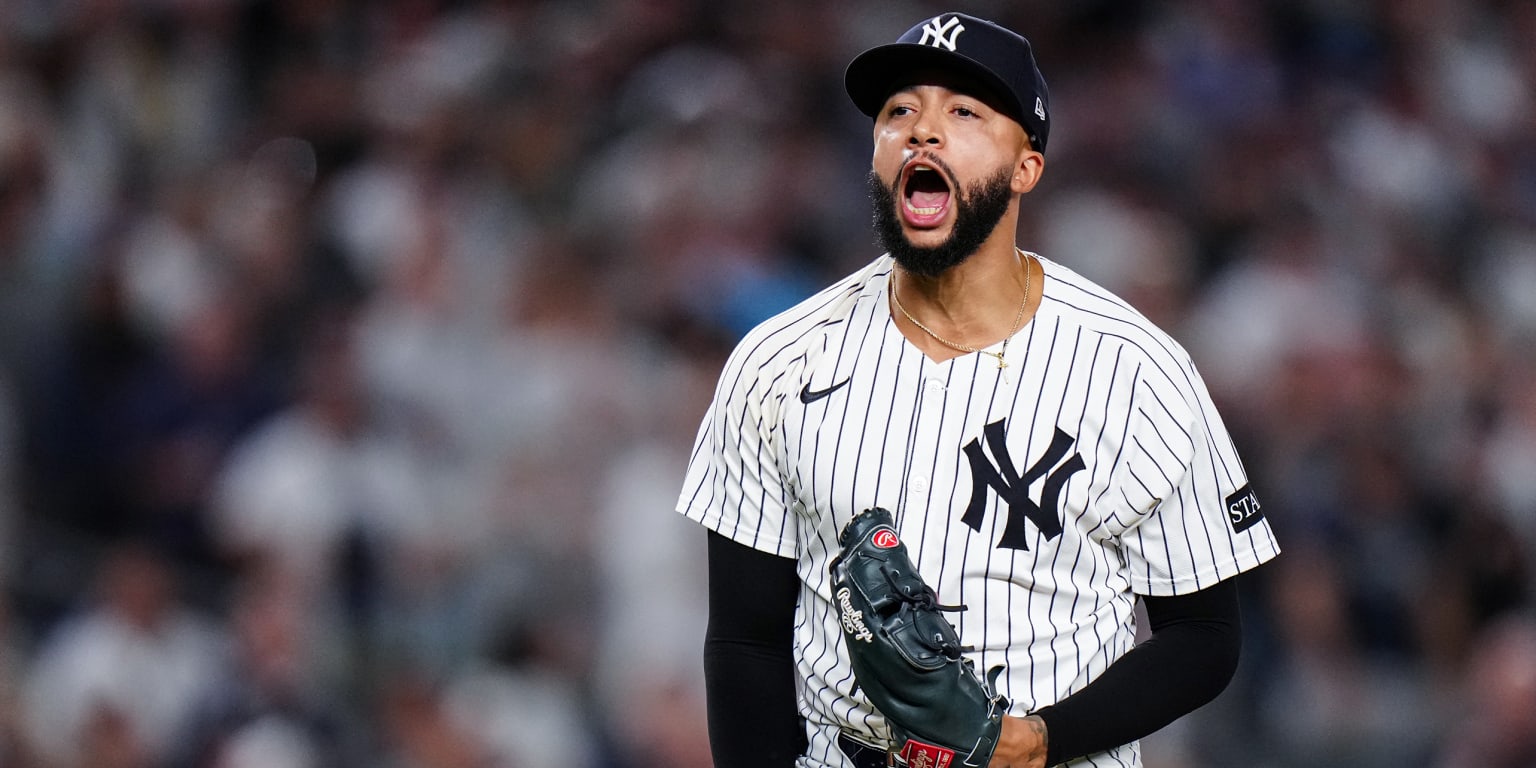
Devin Williams came to New York last winter with a 1.83 career ERA and plenty of high hopes. It didn’t quite go as planned, since he then went and posted a bloated 4.79 mark with the Yankees, losing the closer’s job for part of the season in the process. Our most advanced science and technology tells us that his New York ERA was 2.6 times higher than his Milwaukee ERA, and that is, of course, bad.
It’s surely not what the Yankees were hoping for when they traded Nestor Cortes and future NL Rookie of the Year finalist Caleb Durbin, and it’s definitely not the kind of platform year Williams wanted headed into his first trip to free agency.
But there’s more than one way to get to a bad ERA. There’s the kind where you earned every bit of it, where there’s really no talking around how ineffectively you pitched. (This way applies more to Carlos Carrasco or Marcus Stroman, two vets who didn’t last the season on the Yankees’ roster.) There’s also the kind where the inflated ERA doesn’t really tell the story of the season you had, or the kind of years you might have going forward.
Williams, for the most part, was the second kind – the kind where simply looking at the top-line ERA is missing the point. It’s important, because when he gets a nice contract this winter from a good team (there are already rumors of the Dodgers being interested), some portion of the Yankees fanbase will be stunned. Let’s help them be less stunned.
Two things can be true at the same time:
We’re going to throw some acronyms at you here, so bear with us.
We’re truly sorry for the alphabet soup, but the point here is that all of the major ERA estimator tools – those are, from the top, Statcast’s Expected ERA, Fielding Independent Pitching, and Baseball Prospectus’ Deserved Runs Allowed – tell a pretty similar story, despite working in different ways.
The way Williams pitched this year (attempting to strip out the effects of ballpark, defense and luck) tells the story of a pitcher who really earned an ERA closer to 3, not nearly 5.
If that gap between the 4.79 ERA and his 3.09 expected ERA seems massive, it is. Setting aside those with an xERA north of 5 – which is to say, pitchers who threw poorly in the first place – and looking at a minimum of 250 batters faced, only a small handful had a larger gap than Williams and his 1.70.
Those estimators don’t account for everything, as we’ll get to in a second, but also when they agree across the board, they’re telling you something – and this is the way that teams will view it this offseason, going beyond just, “Was the ERA good?”
At the same time, they’re also agreeing that Williams did pitch somewhat worse with the Yankees; that 3.09 xERA, for example, while still in the 85th percentile, was considerably higher than the 2.09 he had in 2024, and it was the highest of any full season of his career.
The reason they’re all saying positive things isn’t that hard to discern. Williams is still striking out a ton of batters, with his 34.7% K-rate in 2025 ranking in the 97th percentile despite being down a bit from his career norms. He also managed to cut down on his walk rate, with his 9.7% mark in 2025 (while still much higher than average) being his lowest since 2020.
He was so good late in the year that in August, when he struck out a truly incredible 49% of batters he faced, it wasn’t just his best month since 2020; it was the fourth-best strikeout month (minimum 40 PA) anyone had all season.
If you’re still capable of whiffing half the hitters you see over the course of a calendar month, you must be doing something right – in addition to ending the year with 13 consecutive scoreless outings, which included four postseason appearances against the Red Sox and Blue Jays.
So then: Where did the runs come from? They mostly came early: Williams got off to a brutal start (11.25 ERA in his first 10 games) before recovering (3.83 ERA in his remaining 57 games). But let’s drill down further and split this into “not his fault” and “OK, probably his fault.”
For a pitcher who now seemingly has the reputation of not being able to handle the big moments or pitching in New York City – and do note that he had a much lower ERA at home (3.69) than he did on the road (5.93) — something truly interesting happened in terms of how Williams supported his teammates, yet didn’t get the same support back.
He never added a run to the pitchers he relieved. Sometimes it didn’t really mean much, like when he entered with the bases loaded and the Yankees down 14-1 and induced an inning-ending double play. Sometimes it meant everything, as on June 11 when the Yankees entered the ninth up 6-0 before Mark Leiter Jr. turned it into a 6-3 game and left a runner on second with one out for Williams to clean up – which he did, by retiring the next two. Those are potential runs he kept off the ledgers of his teammates.
That’s not what he got in return. In his final poor outing of the year, on Sept. 3 in Houston, Williams entered a tie game and left it down 5-4, having walked the bases loaded with two out when Aaron Boone came to get him. (It’s fair to point out that he got more than a little squeezed on two of the walks, a fact Williams was vocal about when leaving the mound.)
Reliever Camilo Doval made it considerably worse, letting all three runs come in on a single, balk and wild pitch – all runs charged to Williams.
On a rainy night in May against the Padres, he entered in the eighth inning with a 3-0 lead, and it was still 3-0 when he was removed – but again with the bases loaded and two outs. Luke Weaver entered and again, it ended poorly, with three more runs charged to Williams.
Those two games account for six of the seven inherited runs. (Leiter allowed the seventh in an April game against Toronto.) Yet obviously, there’s a flaw here: Needing to be pulled after loading the bases isn’t exactly good performance, is it? Then again, perfection isn’t really possible, and leaving 10 runners on isn’t really that much for a late-inning reliever. Mason Miller left 19 (only four scored), and Edwin Díaz left 15 (only six scored).
But for Williams, it was 70% of bequeathed runners who came in to score, more than double the 31% Major League average. There were, in fact, 280 pitchers who departed with at least 10 runners on the bases, and some of them got really, really lucky. Consider Brewers lefty Jared Koenig, who had a shiny 2.86 ERA, in part because of the 24 runners he left on base, just three scored (13%). Williams’ 70% rate was so high that only four of those 280 pitchers suffered more damage to their ERA after they’d left the game.
If none of those runs had scored – probably not reasonable, but fun to think about anyway – Williams’ ERA would have been 3.77. If still not elite, it’s also an entire run of difference, or about 25% of his ERA, based on things that happened while he was in the dugout.
None of which is intended to say that Williams was exactly the same guy as ever, and all the extra runs happened to him, with no change on his part.
Williams did get hit a little harder, allowing a career-high 36% hard-hit rate. (Which was still in the 85th percentile; that this is a bad season for him tells you a lot about how good it had been before.) His barrel rate – and a barrel here is a combination of exit velocity and launch angle, so basically “hard hit balls in the air” – which was once truly, deeply elite, no longer was. In 2022, he threw 1,068 pitches and allowed exactly one single barrel; he was the most difficult pitcher in the game to barrel up. In 2025, that dropped to the 32nd percentile.
More noticeable is what happened on his “airbender” changeup. Including the playoffs, look at how many homers Williams has allowed in his career on the pitch that made him famous:
Why that is gets a little trickier, but it’s probably worth nothing that of the five homers he allowed on the airbender this year, four of them came in the span of three weeks between July 20 and Aug. 8. If that’s a bad slump – and it was – then the rest of the year looks pretty good.
It’s fair to wonder if Williams is post-peak, if a minor decline in velocity and swing-and-miss rate against his airbender means we’ll never see the best Milwaukee version of him again. On the other hand, he was so good then that we might not need to. Williams didn’t pitch like a 4.79 ERA player in 2025. He won’t be treated like one on the market, either. Don’t be surprised.
