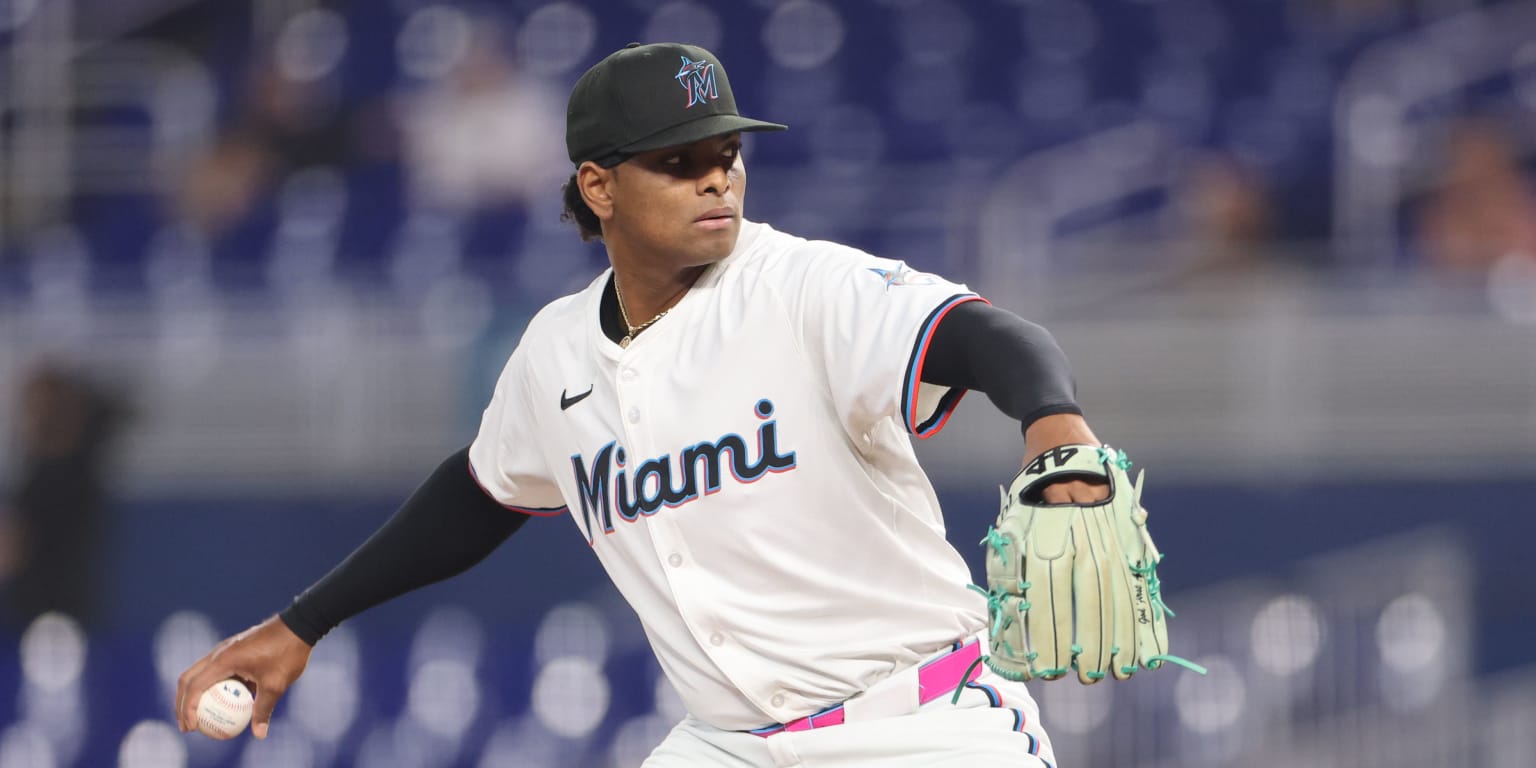
The Cubs have been rather forthcoming about their desire to acquire impact starting pitching, with Jed Hoyer, the club’s president of baseball operations, calling it the focus of their offseason back at the GM Meetings in November. On Wednesday, Chicago completed its pursuit by acquiring 27-year-old righty Edward Cabrera from the Marlins in exchange for three prospects.
Cabrera is not an ace, because he owns a career 4.07 ERA and 4.55 FIP, and has never thrown more than 140 innings in any of his five MLB seasons. But he did make significant improvements last season — most notably, reducing his walk rate to a league-average mark — and has elite stuff, with a five-pitch mix that he uses against both left-handed and right-handed hitters. The Cubs are betting that Cabrera, who has three more years of club control, can continue to make strides in that direction. That’s why they traded for him.
This is a particularly fascinating match. Cabrera is a hard-thrower who doesn’t use his fastball often, and for good reason: His -12 Run Value on fastballs (defined here as four-seamers and sinkers) was in the fourth percentile of MLB in 2025. With the Cubs, Cabrera joins a rotation full of capable arms who do the opposite, succeeding without premium velocity while actually throwing their fastballs quite often.
That makes Cabrera stand out. He is far different from any other starting pitcher on the Cubs’ 40-man roster, and any other starter they’ve deployed in recent years. Let’s dive in.
Cabrera’s average fastball velocity last season was 96.9 mph, good for the 87th percentile of MLB. If Cabrera sustains that in 2026, he will become the hardest-throwing starting pitcher that the Cubs have had in the pitch-tracking era (since 2008), a distinction that currently belongs to swingman Ben Brown. In fact, no Cubs starting pitcher (min. 500 pitches thrown) has finished a season with an average fastball velocity greater than 96 mph; Cabrera, on the other hand, has done that in each of the last three seasons.
We can take this absurdity a step further: Cabrera’s changeup averaged 94.2 mph last season. Using the same qualifier (min. 500 pitches) and timeframe (since 2008), the Cubs have had just five starting pitchers with an average fastball velocity of 94.2 mph or better in a single season: Brown, Cade Horton, Jake Arrieta, Jeff Samardzija and Matt Garza.
Chicago’s current rotation is not filled with high-velocity hurlers. Last season, as a whole, the unit averaged 93.3 mph on their fastballs, inflated mostly by Brown (75th percentile fastball velocity) and Horton (72nd percentile). Instead, the rotation has a number of outlier fastball shapes. Low-slot left-handers like Matthew Boyd and Shota Imanaga have hoppy four-seamers, which carry through the zone and create flat angles. Horton, Javier Assad and southpaw Justin Steele — slated to return from elbow surgery at some point early this season — throw fastballs with cut-ride action, meaning they fade glove side, countering a hitter’s expectation of what a four-seamer should look like. Marquee Sports Network analyst Lance Brozdowski has explored the Cubs’ fascination with cut-ride before, noting that while public stuff models don’t always favor these pitches, they do have some benefits — among them being that their unusual shape helps miss barrels.
These movement profiles help explain why the Cubs’ starters lean on their fastballs a lot, even if they lack high-end velocity. Last season, only two rotations — the Mariners and the Nationals — threw a higher percentage of four-seamers and sinkers than the Cubs. Seven Cubs starting pitchers threw at least 500 pitches last year and, of that group, Jameson Taillon had the lowest fastball usage rate (again, not including cutters) at 45%. Cabrera threw fastballs just 34% of the time.
Collectively, the Marlins eschewed traditional convention and drastically reduced their fastball usage in ‘25. They threw fewer fastballs than all but one team in the pitch-tracking era; only the 2024 Red Sox threw fewer. But this wasn’t a new approach for Cabrera, who has never eclipsed a 39% usage rate with his fastballs in a single season. Last year, only Lance McCullers Jr. threw a higher percentage of breaking and offspeed pitches than Cabrera, who did so over 66% of the time.
Pitchers should throw their best stuff more often, and in many cases, they are. Cabrera has three plus non-fastball offerings, which is why he combines to throw them two-thirds of the time. Let’s run through them quickly:
Cabrera was the only pitcher with multiple pitch types that generated a whiff rate of at least 40% last season (min. 300 pitches). That’s how a pitcher winds up with a 97.0 mph four-seamer that he throws just 13% of the time, along with a power sinker that is simply a third offering to lefties and a fourth offering to righties.
None of this is to say that the Cubs are going to overhaul Cabrera’s fastball shapes, or encourage him to throw his fastball more often. Smart organizations tailor their development plan towards a pitcher’s strengths and what makes them unique. For Cabrera, that’s not his fastball — even if it will light up the radar gun like we don’t usually see from a Cubs starting pitcher at Wrigley Field. Cabrera doesn’t pitch like most starters, and certainly not any other Cubs starter. That’s what makes this pairing so compelling.
