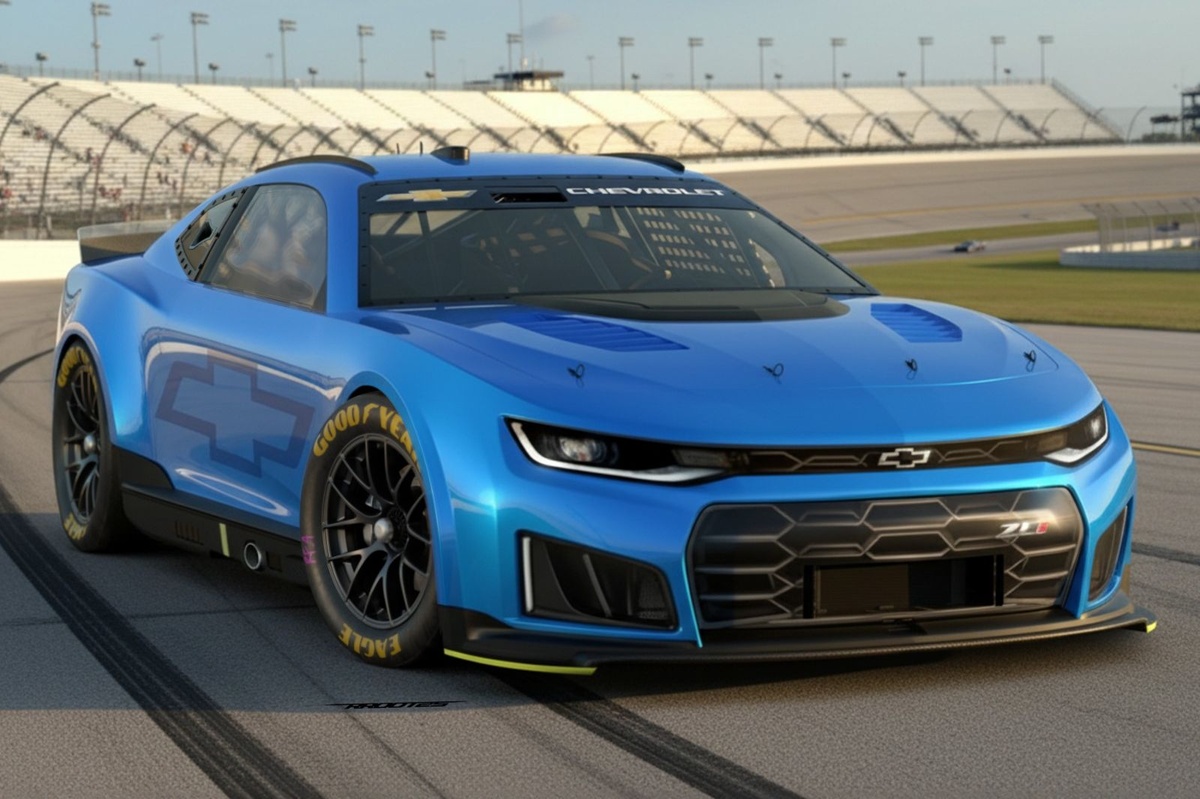
Chevrolet is updating the Camaro that they race in the NASCAR Cup Series for 2026 and bringing the most drastic changes to the body since the launch of the Next Gen car. While it may appear similar to the outgoing car at first glance, the Camaro ZL1 Cup car sees updates to every available body panel that NASCAR allows and is poised to be faster at short tracks and intermediates along with improvements for drag at superspeedways like Daytona and Talladega.
NASCAR updated some of the cooling requirements after the debut season of the seventh generation Cup car which required every manufacturer to make body updates. Chevy got a bit behind the Ford and Toyota on aero as these updates were deployed and we’re digging into the details of how they plan to catch up and be faster in 2026.
Advertisement
How Cup Car Aero Works
Kyle Busch, Richard Childress Racing Chevrolet
Kyle Busch, Richard Childress Racing Chevrolet
Those radiator exit ducts on the hood have been a large focus for the manufacturers that participate in the series because they are one of the few areas where they can differentiate themselves from an aerodynamic performance perspective. They allow them to make the choice of how they want to balance downforce and drag compared to engine temperatures by modifying the airflow out of the radiator.
Advertisement
Why Chevy Is Redesigning Their Cup Car
Alex Bowman, Hendrick Motorsports Chevrolet, Joey Logano, Team Penske Ford, Kyle Larson, Hendrick Motorsports Chevrolet

Alex Bowman, Hendrick Motorsports Chevrolet, Joey Logano, Team Penske Ford, Kyle Larson, Hendrick Motorsports Chevrolet
We checked in with Dr. Eric Warren who is the Vice President of Global Motorsports Competition at General Motors to find out why they decided to make changes and learn the details of how they anticipate making the Camaro Cup car faster in 2026.
“I think for us, particularly the past several years, we’ve kind of felt like we had a little bit of a deficit and we saw the short track performance of the other teams kind of keep advancing. And some of that’s just the aero balance, the amount of front downforce versus the amount of rear, and so that starts to constrain you a little bit on what ride height you can run. So if you’re trying to look at even the intermediates, it’s going to run the maximum downforce, you end up with the Next Gen car with this tail down attitude and it’s a little bit opposite of the old generation car where it was, the splitter you’re trying to cut atoms off of the asphalt as you went around the track. Now it’s a little bit the opposite, you actually want the back down and the front up just to get airflow under the car the right way.”
Advertisement
It’s not surprising that the Camaro needed to catch up to the Camry and the Mustang at short tracks because the other cars had been fully redesigned since NASCAR updated the cooling requirements and introduced a new underbody for short tracks and road courses while the Camaro only received some front end tweaks in 2023. It would seem simple at first glance to just adapt things to the changing aero environment and match the other manufacturers but the car needs to be aerodynamically balanced from the front to the rear and any airflow that changes across the car can also impact cooling along with a variety of other factors as Dr. Warren shared below.
“So everybody had migrated towards a little more front aero balance. And so that drove it, I think, as much as anything, like how do I get that airflow, when you start saying, okay, I need more front downforce, but I need more air to come through for cooling. Those are kind of contradictory things typically, so then you’re just trying to manage that and where that air goes and then again, a little bit of some luck in traffic, hopefully that behaves and don’t lose as much downforce, and try to keep that similar. That’s been one of the hallmarks of the Camaro Next Gen cars. It’s been fairly well behaved in traffic and we wanted to maintain that.”
NASCAR Cooling Requirement Changes
Nose of Ross Chastain’s No. 1 Trackhouse Racing Chevrolet

Nose of Ross Chastain’s No. 1 Trackhouse Racing Chevrolet
We checked in with Dr. Eric Jacuzzi who is the Vice President of Vehicle Performance at NASCAR to learn more about the constraints placed on the body design from the NASCAR side and he confirmed the cooling requirements that have been one of the big drivers of the evolving Next Gen body designs. Dr. Jacuzzi shared that NASCAR initially let each manufacturer choose how efficient they wanted to make their radiator outlets which meant that it was fully up to them to choose whether to prioritize aero or engine temperatures.
Advertisement
“We didn’t actually specify a minimum. We would just test at a certain velocity ratio and say, okay, it needs to be between here and here, because the radiator is flowing during the test.
That first round of designs ended up going in both directions with some manufacturers overestimating the cooling demands which meant they left some aero optimization on the table while giving their engines better cooling while others underestimated which gave them better aero performance but caused the engines to heat up at certain tracks.
“We really initially just left it up to the manufacturer’s best judgment, and I think it was pretty consistent across the board that they all sort of overestimated or underestimated the cooling demands on the engine, so they didn’t have as much margin as they thought on that first go around.”
Advertisement
Eventually NASCAR decided to prescribe some minimum requirements for cooling and the percentage of air that must flow through the radiator.
“From a performance perspective we make sure that the maximum velocity ratio achievable with no blocker plate or anything in that system is over ten percent.”
Once those changes were instituted, each manufacturer had to make sure that their design fit within the required windows whether due to the requirements from NASCAR or the requirements from their engine builders so all of the redesigned their radiator duct exits in 2023 which we saw as new louvers on the hoods of the cars. These updated exits were a compromise for all of the manufacturers because of how much they impacted the overall aero balance of the cars but Ford and Toyota likely weren’t terribly worried because they were already designing complete new bodies for 2024 to match their new road cars. Chevrolet didn’t have a new road car in the pipeline so they had to adapt their current body in order to balance the changes to the radiator flow which is why we saw changes to the nose and the hood of the Camaro in order to go along with the updated louvers.
Advertisement
Chevy ran that Camaro with the slightly modified front end until the end of the 2025 season but it became clear to them that they needed a full redesign in order to have a car built around the latest cooling requirements so they decided to build an accessories package for the roadgoing Camaro ZL1 that they could use as the basis for an updated NASCAR Cup car.
Why GM Chose To Update The Camaro For 2026
Kyle Larson, Hendrick Motorsports Chevrolet

Kyle Larson, Hendrick Motorsports Chevrolet
Many were surprised that there wasn’t a completely new car racing in 2026 but with the Camaro being out of production, the engineers were limited to items that they could offer through the Chevrolet Performance Catalog. GM engineers ended up designing the Carbon Performance Package for the Camaro ZL1 which includes a grille from the ZL1 1LE, a new splitter with unique carbon-fiber end caps, a carbon-fiber hood insert, carbon-fiber rocker extensions, and a large carbon-fiber rear wing with a wicker bill. When those parts are installed on the ZL1, they bring aerodynamic downforce on the car within 5% of a ZL1 1LE. Those design elements being effective is not a surprise because many of them were used as a baseline for what we will see on the Camaro ZL1 Cup car in 2026.
Advertisement
Every panel of the 2026 Camaro Cup car appears to be more aggressive but the headlight area looks to be a callback to their original 2022 design and that’s not by accident. Once all of the body submissions were completed ahead of the launch of the Next Gen car, NASCAR decided to use the 2022 Chevrolet Camaro as the target car for their downforce and drag window so what that meant is that any future car design would be measured against that specific car. When Toyota and Ford designed new bodies they had to be tweaked in order to get as close to the window of that target but since Chevrolet did not have a new car they were kind of stuck since the target was a variant of their current car.
How GM Redesigned The Camaro Cup Car For 2026

One of the most apparent differences on the 2026 Cup car are the hood louvers. They are now larger and look similar in shape to what we’ve seen from Ford and Toyota as they redesigned their cars. This isn’t by accident as Dr. Warren shared when we asked him about the design.
Advertisement
“You’re trying to maximize the exit area and stay within that envelope, you’re then just trying to make sure the flow stays attached. You learn a little bit as you go about how a car behaves in traffic and then what happens when the hot air comes out?
How does it flow around the rest of the car? Is it hitting the spoiler? Is it not hitting the spoiler? I think everybody’s kind of migrated to a similar solution because, at first you’re like, hey, I want the car to do this when it’s closed off or not.“
On the other end of the spectrum, the louver design has to be able to support enough cooling flow for special situations like racing on short tracks or racing in places with reduced cooling because of reduced air density like Mexico City.
Advertisement
Outside of the louvers, there are a variety of changes to the front bumper and the sides of the car and most of those were built as a correlation to the Carbon Performance Package that was released for the roadgoing ZL1. We can see the end of the splitter and the rockers on the production car directly translate to the Cup car bodywork and much of that is a combination of chasing downforce while also trying to balance downforce and drag across the entire car. The rear of the car also sees a change with the taillights now being a prominent piece of bodywork compared to the decal versions of the outgoing car.
Production Car Changes To Match The New Cup Car

The production car team and motorsports team worked together to design and test the accessories package which allowed them to increase the downforce on the Camaro ZL1 road car by 361-percent at 155 mph. This also brings the total downforce of the ZL1 within a few percent of the ZL1 1LE. The package is already in the Chevrolet Performance parts catalog under part number 19541257 and according to GM Authority, the Chevy Camaro ZL1 Carbon Performance Package starts at $17,495 and goes up to $21,375 with the optional Tech Bronze wheels.
Advertisement
Testing And Debut Of The 2026 Camaro Cup Car
That 2026 Camaro Cup car has already seen some track time as it was used for a tire test at Bristol Motor Speedway last month with Alex Bowman and will be used for some additional testing this winter at North Wilkesboro Speedway. Chevy tells us that they’re working on a show car that should debut over the next few months and give us a better view of all the details we’ve seen in the renderings and then all the Chevy teams will hit the track with the updated car at Bowman Gray for The Clash in February.
Read Also:

Chevrolet reveals new NASCAR Cup body for 2026
To read more Motorsport.com articles visit our website.
