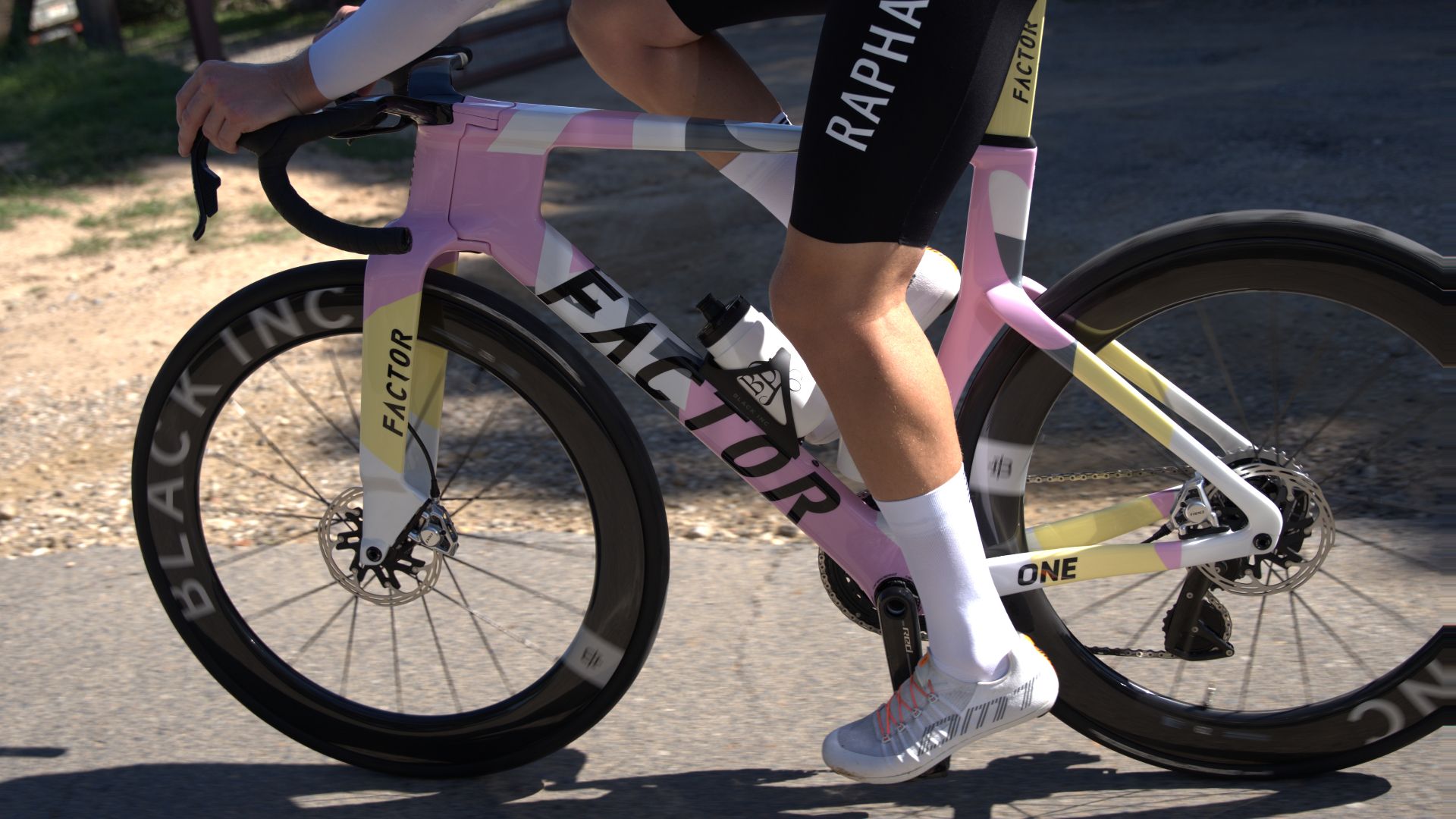
In bike racing, the streets of France and Italy aren’t just the sport’s arenas. They also serve as its catwalks. While fashion houses hit Paris and Milan to show off new collections, bicycle brands do the same with yet unreleased models, with the best riders in the world sitting atop them to, yes, win races but also to sell the bike to the masses.
This strategy means that we get to see the latest and the greatest well before they are available for purchase, by which point the cycling media has done its job of whipping the public into a frenzy ahead of the official launch date. Or something like that.
The prototype was the talk of the Critérium du Dauphiné well before it won the stage on its racing debut. Here was an aero bike created to push the envelope and, perhaps, even test the patience of the UCI. Factor asked itself just how fast can a race bike be? And the ONE is its definitive answer.
(Image credit: Future / Jamie Williams)
If, like me, you’re a bike nerd, then the new Factor One is probably the most exciting race bike that you’ve seen in the last five years. We already know that it’s like nothing else on the market; we already know that it’s been independently tested as one of the fastest in the world, but what we don’t know is what it’s like to ride…until now! I got on a plane to Girona to find out.
With most bikes you can take an educated guess about how it’s going to ride, before even swinging a leg over it; you can study the geometry chart and the tube profiles or perhaps ride the previous generation.
With the ONE though, the rule book has been well and truly torn up, and yes, we did ask Factor if the radical design will still be legal in 2026.
The Surprises Keep Coming
At the launch of the bike, I was expecting to have to step back in time to my university days where I studied aerodynamics. However, surprisingly, the main focus was on geometry instead, so I suppose we’d better start there:
Director of Engineering, Graham Strive, was keen to get across that it’s not Factor’s job to tell a rider how to ride a bike or indeed how to sit on a bike, instead it has studied emerging trends within the pro peloton such as wide tyres, short cranks and the desire to get as far over the bottom bracket as possible, and built a bike that satisfies these new desires.
The most obvious development driven by rider needs then, is a much steeper seat tube angle, 76 degrees in fact, up from 73.5 degrees on the Ostro VAM race bike, which itself is by no means slack when compared to the competition.

(Image credit: Future / Jamie Williams)
Factor says that this change is as a direct result of the WorldTour peloton requesting not only zero setback seatposts, but even positive ‘setback’ posts to try and get ever more forwards, further over the bottom bracket.
Factor says that the issue with this ‘race to the front’ is that stem lengths are ever increasing and a rider’s weight is being pushed further over the front wheel resulting in more high side crashes. To counteract this, the Factor One uses a longer wheelbase to put the front wheel further in front, a longer top tube (around 2cm) and a lower bottom bracket.

(Image credit: Arnau Linares, Factor)
Some quick maths will tell you that the increased top tube length all but cancels out the steeper seat tube angle so to further reduce effective stem length the bars are connected a full 2cm in front of the steerer tube. When peloton stem lengths average 130mm, with 140mm and 150mm girders not uncommon, Factor says that this will reset the balance.

(Image credit: Arnau Linares, Factor)
I was expecting the result of all this change to feel pretty drastic but as I completed my first few kilometers aboard this futuristic contraption, I was surprised by just how ‘normal’ it felt. Looking at the bike prior to riding it I was worried that this was going to be an aero at all-costs project, a bike which performed only in a wind tunnel or in CFD software but no, it can actually go around a corner.

(Image credit: Future / Jamie Williams)
The bike is stable, feels rock solid underneath you during a sprint, planted on descents and quick to react to sudden inputs. In short, everything a modern race bike should be. It’s also very stiff, especially so at the front end, for better and for worse; during a sprint or a technical descent this is very welcome, but it’s chalk and cheese between this and the comparatively floppy front end of the Colnago Y1Rs, which I was riding before heading out to Girona. After just a 60km test loop on the Factor One, I was acutely aware that I could feel every bump and road imperfection through my hands despite the 30mm tubeless tyres (measured width).
In fact, this stiffness is obvious from just leaning on the bars in the carpark, the 2cm shorter effective stem length results in next to no discernible flex – even less so than the infamously rigid Van Rysel RCR-F.

(Image credit: Future / Jamie Williams)
The speed though is undeniable and whilst no real world test can categorically tell you whether this is a few watts faster or slower than the competition it is certainly in the upper echelons. I didn’t feel the ‘lift’ sensations over 50kph, or any of the other cliche’s that IPT’s sponsored riders came out with in the PR, but on a flat road when pushing on, this is the bike that I’d want to be on.

(Image credit: Future / Jamie Williams)
It boils down to the fact that this is unapologetically a race bike and nowhere is that more true than when it comes to the bar width choice: 38cm. That’s it. Wider, and Factor says that you’re not using this bike for its intended purpose, narrower and they’ll soon be outlawed by the UCI, so Factor’s holding fire.
What you do get is two bar rise options, a low rise or a 20mm high rise gull wing design that reminds me of the riser bar that came on the equally radical (when it launched) Specialized Venge ViAS. There’s five different lengths of cockpit and a few spacer options, 0mm, 5mm, 10mm and 15mm. A total of 35mm of vertical fit adjustment seems surprisingly generous on a bike that looks like, and especially compared to its main rivals.
One topic that we won’t be covering in this first ride review however is the maintenance or ease of living with a Factor designed like this, you’ll have to wait for a full review for that and we’ll have one on its way to the UK shortly for test. Hopefully in this Blush Pink colour way so we can see if it turns as many heads back home as it did in Spain.

(Image credit: Future / Jamie Williams)
So often the main topic of bike reviews, the Factor One’s weight was hardly mentioned during the launch. It’s certainly no featherweight, the frame alone weighs 990 grams, add another 550 grams of fork and a few hundred grams of bars and seat post and you’re looking at 2.4kg before even adding a groupset. Despite this, a full bike can still be built up as light as 7.2kg and my fairly middling size build was just under the 7.5kg mark.
This is sure to anger some weight weenies out there but in a world where Grand Tours are won almost exclusively on aero weapons this is simply a sign of the times and Factor is confident that many of its sponsored riders, especially smaller ones, will opt to use this bike for every day no matter the parcours.
So will it be legal in 2026? Well, Factor will be surprised if it isn’t, they’ve been transparent with the UCI throughout the design process and seemed to be one of the few brands that weren’t surprised by the mid-season 2026 announcement. In their words – “we just ask the UCI what’s happening”.

(Image credit: Future / Jamie Williams)
Conclusion
The ONE isn’t just the most interesting looking bike of the 2020’s but one that signifies a pivotal switch in race bike geometry with others surely following suit in the near future.
Having ridden both this and the Ridley Noah Fast 3.0 with steep seat tube angles, I’m struggling to see the disadvantages inherent in this design, especially when the centre of gravity can be counteracted like it has been here. What this likely means is that along with the UCI’s relaxation of head tube/fork depths, this bike could be among the first of a wave of new aero race bikes, and so far it appears to be the best executed.
This is not a comfortable bike. It’s not a bike designed for the majority of people, but on smooth road, it certainly is fast and that is most definitely more than enough to a bike as brave as this a success.
