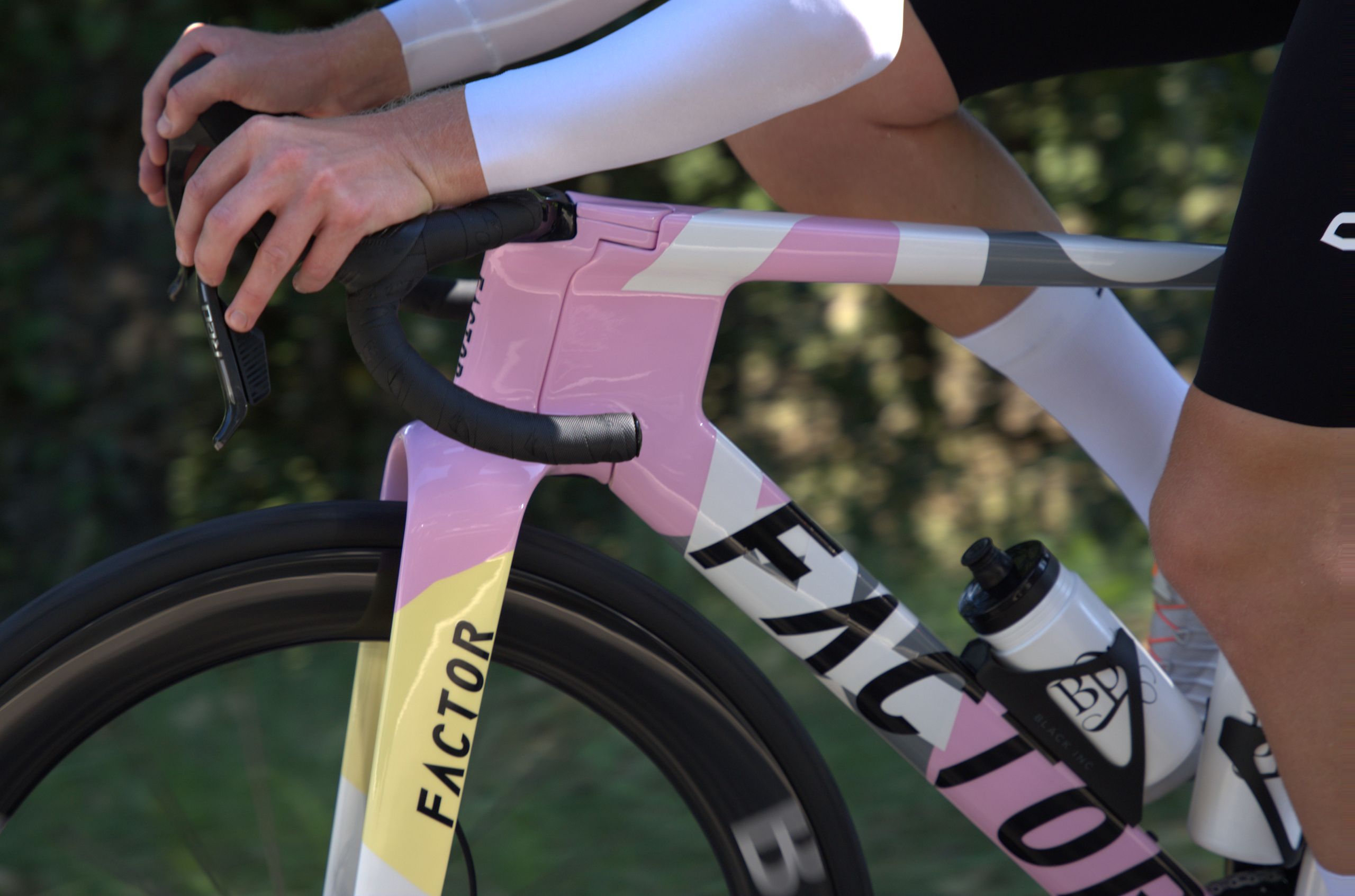
The new Factor ONE has a striking aero design but comes with some pretty unconventional geometry numbers, including a longer wheelbase and forward mounting position for the handlebars, ahead of the steering axis.
At the launch, Factor’s Director of Engineering, Graham Strive, spoke of “changing rider demands”. Factor’s approach to the geometry on the new bike, which offers a seat angle of some 76° degrees, and a further forward steering position, is a direct result of the WorldTour peloton requesting longer stems.
Factor says the issue with the “race to the front”, is that stem lengths are increasing with the rider’s weight pushed further over the front wheel. According to the brand, this has resulted in more crashes. To counteract this, the Factor ONE uses a longer wheelbase to put the front wheel further in front, a longer top tube (around 2cm) and a lower bottom bracket.
I’ve thought for years that the average cyclist, and many in the industry, still doesn’t really understand front-end stability. And now we’ve heard it from a big brand too.
The forgotten fundamentals of handling
Two-wheeled vehicles – whether a motorcycle or bicycle – obey the same principles. Just because my trusty Honda Fireblade has 130bhp on tap and the other bike, my road bike, has my somewhat sub-prime legs to do the drive, does not mean the physics get up and leave the room.
Foale’s work is useful here, as it tells us that stability is governed by:
– The position of the combined rider-bike centre of mass (CoM)
– Steering geometry (trail, rake, wheelbase, etc)
– The mass distribution over each wheel
– The inertias of the steering assembly
Notice what’s not in that list: stiffness, weight or aerodynamics, although good steering does rely on a measure of stiffness. Despite this, bicycle fitting in pro cycling for the past few years has shown a sort of collective disregard for these basics.
Instead, they’ve been traded off for other desirable characteristics such as aero, or a sense of ‘feeling forward’, often leaving it to the individual rider to specify a stem they think feels about right. Or they might use a slammed-forward saddle which reaches halfway along the top tube.
Riders have always downsized frames, that’s not troubling. That’s been one way riders have increased the stiffness of a frame, or achieved a lower position, and it isn’t in and of itself problematic. In doing so, to make more room ‘in the bike’, stem length has crept up. Racier stems and positions therefore, tend to be associated with going longer.
But the place we’ve arrived at is stretching from sensible to comical. Combined with forward saddle positions, which ignore set-back, a whole generation of pro bikes now litter the paddocks with set ups that are theoretically fast, but handle worse.
You can’t feel that in a wind tunnel. It’s instead, less measurable, and only felt in your wrists when descending at 90kph. While it might not be on graphs, it is seen in crashes and the techniques of some on descents.
(Image credit: Future)
The role of saddle set-back in weight distribution
What’s the problem? In bike design terms, pretty much everything starts at the bottom bracket. Set-back, stack and reach, front centre, rear centre, handlebar X and Y, are all measured from here. The position of the saddle relative to it is critical, that’s the saddle set-back. I think it could be one of the most misunderstood measures in frame design and fit.
Foale teaches us that a rider’s mass relative to the contact patches of the tyres determines the stability envelope. Move the mass backward and the front wheel becomes lighter, move it forward and you sharpen the steering. Overdo this, and you sharpen it too much. This balancing act, to simplify matters somewhat, starts with saddle set-back and stem length.
A forward saddle and long stem can make your bike handling harder, or at least require that you’re very much better at using the machine.
If you looked at WorldTour bikes today, you’ll notice a large number of riders in an extreme, forward position. Increasingly, riders have taken to sliding the saddle all the way forward on its rails, on a zero or even positive set-back post. When paired up with much narrower bars, and a long, slammed stem, the rider’s mass is in many cases is then precariously far forward, giving rise to significant instability in the steering.
It’s not just fashion that’s driving it. There’s a few perceived benefits too. A forward position opens up the hip angle, allowing more power generation. It also helps aero efficiency, getting the rider forward, and lower in the bike, and suits pro cycling’s obsession to “slam it, send it, suffer”, perhaps.
When you shift all the weight in the system forward, you load up your hands, and by shifting the system weight forward and on to the bars, you overload the fork and front wheel, and you reduce the margin for error, or correction, when cornering.
Practically, the bike can feel like it’s on a knife edge and for riders that expect a little focus in the handling of their race bike, or don’t know any better, this can feel fast. But it can also be catastrophically unforgiving.
Some pros are athletes rather than bike handlers, and don’t have the same innate skill that others do. To keep them upright when riding under pressure or in close quarters, they need a comparatively more stable set up.
The trouble is, a glance around the paddock shows that often, they’re the ones riding on the least stable set ups.
Slamming a stem is a pretty popular move. But, moving the bars out more on a longer stem, further ahead of the steering axis, moves more of the rider’s upper body weight (and CoM) further ahead of the headset.
This increases steering sensitivity. And introduces what Foale refers to as “parasitic input” – which basically means, the involuntary movements your torso, shoulders and arms make, can and do inadvertently become steering inputs. This gives rise to twitchy handling. It makes the bike feel nervous, because your mind and body is unable to filter out the unwanted motion.
Shift your weight further forward again, with a forward saddle position, and it gets even worse. You’re basically now trying to type on a keyboard whilst doing a handstand. You’ve made an otherwise relatively simple operation, very much harder.
Downhill performance isn’t just a head game

Whilst Nibali’s Tarmac may look a little dated now, he was arguably the best descender in the world for an extended period. Little has changed in the Specalized Tarmac’s geometry since then, and whilst he ran a longer than standard stem, saddle set-back was at a sensible level.
(Image credit: Brakethrough Media)
Descending with confidence is rarely psychological alone. It’s biomechanical. Neurophysiological. Above all, mechanical. For better descenders, their CoM is so well positioned, and repositioned so dynamically, they can probably drift round bends if they want to.
Imagine a rider battling constant micro-instability in their front end because the fit loads the bars too heavily. Each corner then becomes a small act of faith. Eventually, that’s going to knock your confidence, and eventually it will crack. Imagine that happening in a bunch, or off the side of a mountain at 90kmph.
In cycling, we often blame the rider. They just need to worry less, or go faster. And that’s patently ridiculous. At the same time, the quest for aero at all costs, is leading to some very whack set ups, that Factor now publicly acknowledges is putting riders at higher risk of crashing.
We have to take this issue more seriously and at least perform some common sense checks. The riding experience is just much less forgiving than it was 10 or 15 years ago. And crashes reflect that.
What can be done to fix it?

Remco rides a Tarmac SL8, it’s geometry is largely the same as the Tarmac Nibali would have ridden years earlier, but Remco’s more contemporary position shows a longer stem relative to the top tube length, and a forward position on the saddle rail, with an inline post. Remco’s position is by no means the most extreme of course.
(Image credit: Specialized)
Better fit, or tighter controls could help. The other aspect we could look into is the reframing of what it means to be confident on a bike.
As a bike journalist, you’d hope I can sense when a bicycle is looking after me, but a bike’s ability to hold a line effortlessly is often about fit or set-up. The way you feel you can adjust mid corner without upsetting traction, keeping the rear wheel in touch, or sense the way a front tyre feels loaded but not overwhelmed. This can all be down to set up, and can all give rise to confidence, for any rider.
And confidence isn’t just about bravery. It’s not even really about talent. It’s about stability. Stability can be designed in, or I think that’s what Tony Foale would say at least.

In-line seat posts with saddle rails ‘slammed’ forward, with stems as long as 160mm are now commonplace in WorldTour cycling.
(Image credit: Andy Carr)
