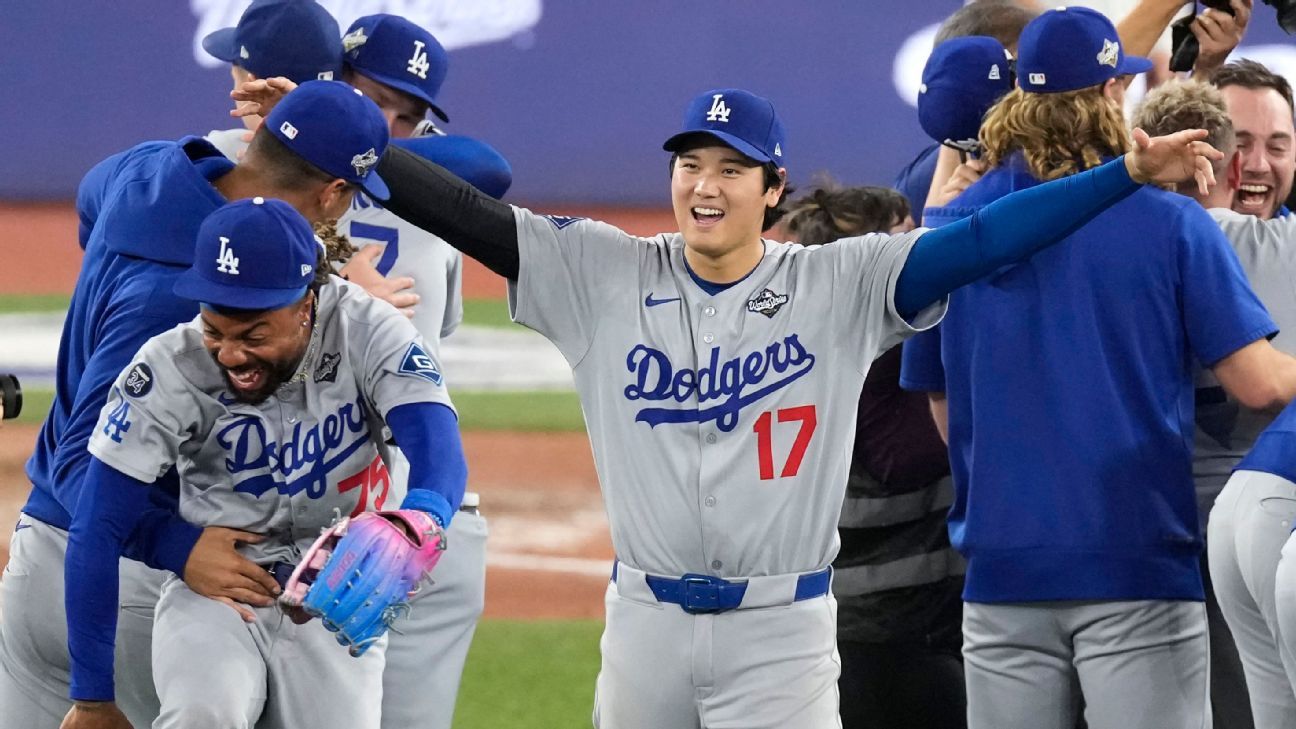
Welcome to the wide, wild, wondrous world of fantasy baseball!
Silly as this little game might sometimes seem, it’s going to change your baseball life. Whether you’re a casual New York Yankees fan who was outraged by Jazz Chisholm Jr.’s absence from the team’s 3-1 playoff opener loss, or a die-hard Pittsburgh Pirates fan who can name all three of the franchise’s Cy Young Award winners, fantasy baseball will both deepen your knowledge and heighten your passion for the game. (Bonus credit to those who can name all three of those Pirates. That answer is at column’s end.)
This game has something for everyone: competition, camaraderie, strategy, excitement, engagement. And that’s just to list a few. From the surge of seeing your team soar to the top of the standings after MacKenzie Gore strikes out 13 Philadelphia Phillies across his first six innings on Opening Day, to clinging to the edge of your seat in the final minutes of the final day hoping that Jose Ramirez can steal that single base you need to put your team over the top — yes, both happened in 2025! — fantasy baseball will take you through the gamut of emotions.
Few things can beat it.
Jump ahead, for those seeking advice in specific areas:
Commissioner tips | Scoring formats | League types | Roster settings | Draft formats
Lineup settings | Free agency | Trades | Additional settings | Be cool!
Let’s get started!
Anyone can play fantasy baseball, and you don’t even have to have a group of people preselected to play with you. (We can help with the latter; more on that momentarily.)
While it can be played individually, as with daily games, fantasy baseball is most commonly played as part of a league, or a group of people competing against one another. To sign up for a league on ESPN, go here, or go to the baseball tab within the ESPN Fantasy App.
If you already have a group of people in mind to start your league, you’ll want the “CREATE A LEAGUE” option on the left of that page. But there’s a catch: You’ll first need to nominate someone from the group to serve as your league’s commissioner — a role that includes creating and operating the league, as well as making any important league decisions. Your commissioner will be the one who creates your league, then uses the “Invite Managers” button to send out individual invitations through ESPN for the other members to sign into the league.
If you’re beginning your fantasy baseball quest solo, or lack the time to round up enough people to comprise a league, ESPN can hook you up with other people, using the “GET A TEAM” option on the right side of that page.
If you’re among a group of people creating a new league, you’ll need to elect a commissioner (or league manager) who will be responsible for entering all of the league’s settings upfront, as well as handling critical decisions or rulings in times of conflict. Make sure to review those league settings — twice if you must! Choose wisely, for as the commissioner’s job might be thankless, it’s also one that merits respect.
If you’re selected commissioner, my advice to you is this: Be fair, but be firm. An ideal commissioner always places the league’s interests as a whole ahead of their own, is detail-oriented and transparent.
As both additional advice to the commissioner, as well as a means to amplify the fun but also the formality of your league, consider that some commissioners craft their own, printable league constitutions. All the league’s settings details, which we’ll examine in detail next, are included within the constitution, to help settle any potential disputes that arise over the course of a season. Amendments, covering any topic unclear within the constitution or as a potential change to the rules, can be proposed at any time, or the league can decide to trust its commissioner to make necessary rulings.
Most critically, as a commissioner, never, ever change a rule governing the league once the championship season process has begun — this means as early as before draft day — unless not doing so would undermine the very functionality of the league. (Even then, I’d ask, why wasn’t this issue addressed sooner?)
Rules are to be changed between seasons, to give everyone a chance to approach the new year following the same set of guidelines. Make it clear what’s being changed, or if there’s a league vote — a preferred method for amendments — make it clear when it takes effect. Changes with long-term effects are best voted on with at least one year’s advanced notice before implementing the new rule.
In order to determine a winner, we need a method for scoring players’ performances. You’ll notice on the above page that “Scoring Type” is one of the menu elections. Carefully consider the type of scoring system you wish to play, especially as you won’t be able to change it once you get underway.
ESPN provides five scoring systems, explained below.
Roto (traditional rotisserie baseball): The game that brought fantasy baseball to the mainstream with its introduction at the now-defunct New York City restaurant, La Rotisserie Francaise, in 1980, rotisserie baseball compares teams’ seasonlong totals in select statistical categories to one another. The best-performing team in each category scores a point total equal to the number of teams in the league, with points awarded in descending order until the worst-performing team scores one point — 12, 11, 10, etc., down to 1, with ties sharing the points (a two-team tie for first in this scenario, for example, would mean 11.5 points for each).
These points across all categories are then totaled for an overall standing, with the team finishing with the most total points for the season declared the league’s champion. As new statistics are accumulated each day, they are added to the team’s cumulative totals in each category and the standings rerun daily, meaning teams can both gain and lose points throughout the year.
Roto leagues can use any number of categories on either side of play, hitting and pitching. The most common format is 5×5, for five categories each, including batting average, home runs, RBIs, stolen bases and runs scored for hitters, and wins, saves, ERA, WHIP (walks plus hits divided by innings pitched, which was created specifically for the original rotisserie league) and strikeouts.
The original rotisserie league used a 4×4 format that excluded runs scored and strikeouts. Some more modern leagues — including one that I have recommended for years but have eased back off because of the increasing scarcity of quality starts — use 6×6, replacing batting average with on-base percentage and slugging percentage for hitters, and replacing wins and strikeouts for pitchers with innings pitched, quality starts and K/9 (strikeouts per nine innings) ratio.
Feel free to experiment with the categories using the League Manager (LM) Tools. ESPN’s standard for Roto is 5×6, adding holds to the 5×5 categories above.
Fantasy baseball managers who prefer the Roto format enjoy the strategy involved in balancing players’ statistical contributions. For example, Elly De La Cruz‘s 37 stolen bases were valued nearly equally in Roto leagues to Eugenio Suarez‘s 49 home runs last season, which makes sense if you consider that there were 2,210 more home runs hit than there were bases stolen in the majors. Similarly, Will Vest‘s 23 saves carried almost identical value to Garrett Crochet‘s 255 strikeouts, which again is logical if you consider that there were nearly 34 times as many strikeouts as there were saves across the league.
If you’re considering a Roto league but struggle with the idea of calculating player values for the format, whether for draft preparation or in-season roster management, our Player Rater is updated daily in-season to reflect year-to-date as well as past 7-, 15- and 30-day earnings. Additionally, Eric Karabell provides rankings for the Roto format all season long.
Head-to-Head Points: The most common scoring format in fantasy football, which in turn has helped swiftly make it the most popular format in fantasy baseball, this pits teams against one another in weekly head-to-head matchups, with the team scoring the greater number of total points in each individual matchup declared the winner. Ties are recorded as such in the standings.
The season is typically divided into 26 scoring periods of one week, though baseball’s scheduling nuances can cause this to be 25, or 27, weeks in certain seasons, and “weeks” could span as many as 10 or even 14 days if needed to include shortened weeks, such as 2026’s opening March 25-29 weekend (which is included in a 12-day “Week 1” that spans the games from Wednesday, March 25, through Sunday, April 5). You can see the specific week lengths within your league under League > Schedule.
In a 26-week fantasy season, the first 22 weeks serve as the “regular season,” and the final four weeks are divided into a pair of two-week playoff matchups, where the teams with the best regular-season records advance to a single-elimination tournament to declare a league champion.
As with fantasy football, where many leagues eliminate the final week of the regular season (Week 18), during which NFL teams often rest regulars after clinching postseason berths, fantasy baseball leagues can also consider removing the final regular-season week, during which MLB teams often employ a similar strategy, and move their playoffs up by a week. This option is available in the League Manager Tools.
Points within these matchups are scored based upon a player’s accomplishments in a select group of statistical categories, which can include negative points for bad-outcome stats, such as strikeouts for hitters, or losses, blown saves, hits, walks or earned runs for pitchers.
ESPN’s standard leagues use the following point system:
Hitting:
Total Bases (TB): 1 (meaning a single earns you 1 point, a double 2 points, a triple 3 and a home run 4)
Runs Batted In (RBI): 1
Runs scored (R): 1
Stolen Bases (SB): 1
Walks (BB): 1
Strikeouts (K): minus-1
Pitching:
Innings Pitched (IP): 3
Wins (W): 2
Losses (L): minus-2
Holds (HD): 2
Saves (SV): 5
Earned Runs (ER): minus-2
Hits allowed (H): minus-1
Strikeouts (K): 1
Walks issued (BB): minus-1
Newer fantasy baseball players might find a Head-to-Head Points league more to their liking. Defined awards for players’ statistical accomplishments can simplify the draft preparation process and ease in-season decisions, as anyone with a basic knowledge of spreadsheets can calculate players’ production and determine which are the best.
In contrast to Roto, Head-to-Head Points puts more emphasis upon extra-base hitting, contact hitting and volume of quality pitcher innings. Vladimir Guerrero Jr. has been a top-40 scoring player overall in the format in each of the past three seasons, despite averaging a No. 62 finish on the Player Rater during that time. Logan Webb, meanwhile, gets his due in the format with top-25 overall fantasy point finishes in two of the past three seasons, but never higher than a No. 36 ranking on the Player Rater from 2023-25.
Worry not, as even if you’re no Excel whiz, I’ve got rankings for you for points leagues, updated all season long. Additionally, our Scoring Leaders page can be a handy resource for weighing players’ season-to-date contributions.
A word of caution regarding Head-to-Head Points: While it does an excellent job matching the “real-life” format utilized by real MLB teams, mapping the playoffs across four weeks of September (when some seasonlong standouts are either fatigued or tired) can lead to some randomness in those matchups — as experienced fantasy footballers can attest also happens in their game. A 22-week regular season, whereas fantasy football’s regular season runs 13, can amplify the sting of being a No. 1 seed losing to a No. 4 that barely squeaked into the tournament.
Head-to-Head, Each Category: A blend of the previous two formats, this uses the categories from Roto leagues but decides outcomes with weekly head-to-head matchups. Rather than having matchups decided by the team with more total points scored for the week, teams accrue “wins” by having the larger total in each of the included statistical categories.
In ESPN standard leagues, these are the same 10 categories in Roto 5×5 scoring but adding holds, for 11 total, meaning that the team that hits the greater number of home runs would score a point, the team with the lower ERA would score a point, and so on, in each weekly matchup. Categorical ties go down as ties in the standings, so a team can go 6-4-1 in a matchup. You can, however, include any categories that you wish.
Playoff teams are determined in the same matchups format as in Head-to-Head Points, as are league champions.
Final records are considerably larger in Head-to-Head Each Categories than in Head-to-Head Points, with 242 possible wins (11 categories times 22 regular-season weeks), providing more opportunities for trailing teams to play catch-up, while rewarding teams that do the best job of balancing week-over-week consistency with keen midweek roster management. Those playing and learning the game for the first time, while also willing to do the work of carefully managing daily lineups when facing tight matchups into a matchup’s final days, might enjoy this format. It’s never a good feeling to fully gain a grasp of fantasy baseball strategy by the one-third point, only to look at your league’s standings and realize there isn’t enough time for you to make up ground.
Both Karabell’s rankings as well as the Player Rater are ideal resources for fantasy managers evaluating players for Head-to-Head Each Categories.
Head-to-Head, Most Categories: Rather than scoring each statistical category individually, this format grants a single “win” to the team that wins the greater number of categories within that matchup. Returning to the team with the theoretical 6-4-1 outcome above — let’s say, a better number of home runs, RBIs, runs scored, wins, holds, ERA and strikeouts, the worse number of batting average, stolen bases and WHIP and an identical number of saves — it would pick up a singular win in the standings. Ties, again, are recorded in the standings as ties. Playoff teams as well as league champions are determined in the same way as the other head-to-head formats.
As with Head-to-Head Points, Head-to-Head Most Categories brings more of a fantasy football-style approach to the standings, but it also slightly diminishes the strategy involved in roster-building. For example, where balance carries greater importance in the Each Category format, in Most Categories, a team could opt to “punt” — or deliberately ignore in an attempt to pour its resources into another category or area of the roster — certain categories in order to load up on enough of the others to carry a weekly victory. Common examples of this could include punting stolen bases to go with a power-oriented lineup that can carry home runs, RBIs and runs scored, or punting wins and strikeouts to go with a loaded offense and a pitching staff that can dominate saves, ERA and WHIP weekly.
Karabell’s rankings and the Player Rater apply as much to Head-to-Head Most Categories as they do Each Category.
Season Points: Those who prefer points league play to Roto but aren’t a fan of the head-to-head format will love this format. Using the same format of awarding points for players’ statistical accomplishments as in Head-to-Head Points, the key difference is the lack of head-to-head matchups. Simply put, the team with the greater number of total points scored for the season captures the league’s championship.
Season Points eliminates the possibility of September MLB team shenanigans affecting the league championship, though in my experience it can also be the format most likely to allow a first-place team to run away with the seasonal race. It also grants minimal appeal to specialty players, such as speedsters, middle relievers, low-in-the-lineup hitters and platoon men (though these can have utility in daily matchups).
To illustrate, Jose Caballero stole a major-league-leading 49 bases last season, making him the epitome of the one-dimensional speedster (putting aside for a moment his defensive contributions, which have no bearing on most fantasy scoring systems). He contributed a good deal to his Roto teams, finishing 136th on the Player Rater, but Caballero’s 49 stolen bases were ultimately worth only — you guessed it — 49 points by themselves, or 25% of his entire fantasy point total of 195.
Putting that into perspective, 174 players hit as many as 13 home runs, the points-league value equivalent to 52 stolen bases (three more than Caballero had), and that’s before getting into the attached RBI and run scored, each worth an additional point, that home runs bring. Of those 174, 152 finished with more total fantasy points than Caballero. Keep that in mind in your player valuations if you choose a points league.
My points league rankings, and our Scoring Leaders page, are as helpful in this format as they are in the head-to-head version.
Once you’ve decided on your preferred scoring format, the next critical step is determining the depth of your league, or rather, the percentage of the MLB player pool you wish to utilize. This has a bearing both on the amount of research and strategy involved in preparing for a draft and managing your team in-season, as well as how plentiful you wish your league’s free agent pool to be during the year.
The number of teams in your league is key, both to the amount of camaraderie your league will have as well as how deep you’ll dig into the player pool. It could come down to simply how many friends (and/or family) you have who are interested in playing in your league, but you can choose as few as six or as many as 20 managers in your ESPN league. The more managers you have, the more knowledge of the player pool you’ll require and the thinner the free agent pool will seem during the year, but also the larger the number of prospective trade partners and the greater the challenge.
One way to decide the right league size for you is to examine MLB’s roster structure: There are 30 teams with 26 active players at any given time (until September, when rosters expand to 28), which roughly breaks down to eight field-position regulars, one designated hitter, one backup catcher, three backup infielders and/or outfielders, five starting pitchers, one closer and seven middle relievers. Typically only one or two backups per team have large enough roles to warrant fantasy consideration, and only the closer and one or two of those middle relievers also do so.
That’s a grand total of 17-18 players per MLB team with any fantasy relevance on any given day, or 510-540 total players. Considering that an original Roto roster would have included 23 lineup spots (14 hitters and nine pitchers), a league could have as many as 15 teams (thereby absorbing 345 players into lineups) while still leaving 34% of that group on the free agent list. The National Fantasy Baseball Championship (NFBC) format is one prominent league that follows this format. Keep in mind, however, that such an arrangement means most every star player is rostered at all times.
ESPN’s standard leagues utilize a more superstar-driven format that leaves a higher quality of player on the free agent list, with 10 teams of 16 starters and three bench players apiece. This format heightens the importance of daily matchups management, and it guarantees a high quality of players available on the free agent list at any time. Using the above estimate of 510-540 fantasy-relevant MLB players, only 36% of that group are rostered at any given time in standard leagues, leaving 64% for the free agent list.
If you’re ready for a formidable challenge, try an “only” league, where the player pool is divided into either American- or National League-only segments, as the prominent industry analysts’ competitions the League of Alternative Baseball Reality (LABR) and Tout Wars do for their longest-standing league types. A 10-team, 23-player traditional “only” league — my recommendation for this format — requires 230 active players at any given time, which means that more than 80% of the AL or NL player pool will always be in a lineup. LABR and Tout Wars use 12 teams for an even tougher quest, while one of my longest-standing home leagues uses nine teams.
A roster, or the list of players who are part of your team, can take on many shapes and sizes. The 23-man roster that the original Roto guidebook outlined included 14 hitters, broken down as two catchers, one apiece at first base, second base, third base, shortstop, corner infielder and middle infielder, five outfielders and one designated hitter/utilityman, and nine pitchers of any role (whether starter or reliever). Corner infielders, for these purposes, are any players who qualify at either first or third base, while middle infielders quality at either second base or shortstop.
ESPN’s standard lineup mirrors baseball’s traditional lineup. It starts one apiece at catcher, first base, second base, third base, shortstop and DH/utilityman, three outfielders and three pitchers, then adds three “bench” spots who are members of your team who won’t accrue statistics for you while slotted there. Teams are also afforded up to three additional injured list (IL) spots, which can be used only for players on the major league’s IL.
Feel free to experiment with your lineup and bench settings. Some leagues use only an infielder, who qualifies at either first, second or third base or shortstop, rather than a corner and middle infielder, some use multiple DH/utilitymen, and some others still break down pitchers into starting and relief pitchers.
Some leagues also exclude the bench, as a means of boosting the quality of the free agent pool, as players cannot be removed from your lineup without being released into free agency, and others exclude the use of IL slots. The primary rationale for either setting, besides strengthening the free agent pool, is to force managerial decisions on players who are serving as statistical dead weight to your lineup, rather than allowing them to be stashed on a bench or IL spot while they struggle or are hurt.
You can also limit the maximum number of players at a specific position, if desired.
Beginners should prefer to go with one of the standard roster sizes, either ESPN’s standard or my own preference of the 23-man original Roto roster with six bench spots. It’s a workable size that will not exceedingly drain your player pool.
For my money, the greatest part of the fantasy baseball experience is the thrill of draft day. These are events where every member of your league meets at a set time to select players to your teams, which will serve as the starting point to your season.
These events can either be held live and in person, or conducted online through the ESPN draft room, depending upon your members’ availability. We provide four different ways you can set up your draft, explained below.
Snake: A Snake draft proceeds in teams’ listed draft order in odd-numbered rounds, then in reverse in even-numbered rounds. For example, in a 10-team league, picks in Round 1 would proceed from 1-10, then in Round 2 they would go from 10-1, meaning the team with the first overall pick would also have the 20th overall, 21st, 40th, 41st, 60th, 61st and so on. This is designed to create equity among all draft positions, though there are advantages and disadvantages to certain positions, particularly dependent upon the makeup of the player pool each year.
Autopick: For leagues that struggle to find a common time at which everyone can meet, or don’t want to take the time required to complete a live draft, an Autopick draft has our computers assign players to all rosters for you based upon a set of predetermined rankings. These align to the standard rankings for the chosen scoring format, though in this option, individual managers also have an opportunity to enter their own rankings in advance for the computer to use.
Salary Cap: If you’re looking for some real fun and a heightened level of strategy to selecting your players, consider the Salary Cap method of player dispersal. In this format, each team is granted a set budget — typically $260 (of imaginary money) using traditional fantasy baseball rules, but you can make it whatever amount you wish — with which to fill its roster, and granted access to every player available in the draft (so long as that team has the requisite funds remaining in its budget). Players are nominated one at a time, with the team issuing the largest and final bid securing his services, until all rosters are filled.
This format alleviates frustration many managers have in being unable to draft certain players dependent upon where they slot in the draft order — a team that picks 10th has zero chance at rostering Shohei Ohtani — while expanding the level of strategy to afford teams an opportunity to construct their teams the way they wish. Want a team built around superstars Ohtani, Aaron Judge and Bobby Witt Jr., but otherwise surrounded by low-cost fliers like Dylan Crews, Carter Jensen and Jack Leiter? It’s called the “stars-‘n’-scrubs” strategy, and you can do it in a Salary Cap league.
Be forewarned that Salary Cap drafts require a greater level of skill, focus, patience and budget management than Snake drafts, and they take more time to complete due to the free-for-all nature of player bidding, often as long as five or six hours. It is therefore recommended more for intermediate and advanced players than beginners.
That said, it is my opinion that Salary Cap is the best method for drafting fantasy leagues, and it is well worth the additional time investment. In accepting the challenge, you’ll gain experience certain to make you a better fantasy player.
Offline: If this is your first exposure to a fantasy draft, I highly recommend the live, in-person format, as it’s the best way to build camaraderie, and it provides the most comparable experience to how a real baseball general manager would assemble a roster. The Offline setting grants you the opportunity to manage and record your live draft on your own time, then return to the site to enter the results.
This is ideal for those doing a Salary Cap draft in person. An ideal such draft would have the league select a master of ceremonies, preferably someone from outside the league. This individual keeps the process running smoothly, is an independent arbiter in the case of bidding or roster disputes, and sets the cadence for player bids, which helps managers determine the amount of time with which they have to make decisions on said bids. In these respects, the master of ceremonies role is nearly as important as the commissioner’s, which is why an offer of a meal and adult beverage as payment could prove effective in enticing a volunteer.
Keep in mind that you can still meet up in-person for the Snake draft format, but use the room to manage the process. To facilitate this, you could either set an extended timer for making picks, while first communicating them verbally before entering them in the game, or have the commissioner manually enter the selections as the draft progresses.
Whichever draft format you choose, remember to find a common time at which all managers are available to meet. For teams that are absent, or anytime a team’s timer expires without a pick, the ESPN computer manager will take control and select players, which can diminish the overall experience for those present. It’s a helpful tool for people in emergency situations who cannot be present to draft, as well as a failsafe to prevent one manager from slowing down the process waiting to pick, but the ideal arrangement has everyone available to make every pick.
Draft day isn’t the be-all and end-all in deciding a fantasy league championship. As we all know in sports, not everything can be predicted — far from it, seeing as the AL champion Toronto Blue Jays began the season with 1.6% preseason odds of reaching the World Series — and in-season management does make a big difference.
First, you’ll need to define the parameters for how teams can improve, whether via lineup changes, free agency or trades.
Teams in fantasy baseball leagues typically allow Lineup Changes, freely moving players between their lineup and bench spots on either a daily or weekly basis in order to capitalize upon their MLB teams’ schedules or individual game matchups.
If you choose a daily transactions league, you’ll grant the maximum amount of flexibility to managers aiming to exploit these matchups while improving their overall competitive experience. That can also come at the expense of teams making a large number of transactions, particularly free agents added to rosters, or trying to load up on “counting number” statistics like wins or runs scored. Daily leagues can also tax fantasy managers with busy schedules, as baseball is a 180-plus-day marathon.
If you choose a weekly transactions league, you’ll heighten the strategy by prompting managers to consider an MLB team’s entire week’s schedule as well as collective game matchups. This does, however, run the risk that a team could lose a player to an early-week injury that leaves it with an absent player for multiple days.
Also consider whether you prefer fantasy lineups to lock for the day or for the week (depending upon which of the former two you selected) with the first pitch thrown on that given day (or first game of the week), or can managers change players freely until the time their individual teams’ games begin that day or on their first game of the week?
There is no singular, correct arrangement. You simply need to choose the setup that best serves your league’s needs, so be sure to first get a feel of the schedules and needs of your fellow managers.
Fantasy baseball teams generally are allowed to pick up new players who aren’t on other teams within their leagues during the season, either to replace a player being released back into the free agent pool or placed on the injured list. As some free agents will be desirable to multiple teams within a single league, there are two different methods in ESPN leagues for fairly awarding these players, explained below.
Waivers: Players are awarded to the claiming team with the better predetermined order of priority, which usually runs in reverse order of the league’s standings. For example, if the teams with the Nos. 2 and 9 waiver priorities place claims on Konnor Griffin, the hotshot Pirates prospect, at, say, the time of a theoretical promotion to the majors in early June, he would be awarded to the team with No. 2 priority and that team would move to the back of the order for the next player.
This order, incidentally, can be adjusted to either reset each new week based upon reverse order of the standings on that date, or to never reset, with teams making claims always moving to the back of the order.
Free Agent Budget (FAB): Teams are granted a set budget (of imaginary dollars) at the beginning of the season, with $100 being a popular choice, from which they can bid to sign players during the season. This both provides additional strategy to the free agent acquisition system, as well better mirrors an open market determining a prospective addition’s worth. Commissioners can choose whether teams can bid $0 on a player or whether a $1 minimum bid is required, with the latter mathematically capping teams at a maximum of 100 free agent acquisitions in a season (if $1 is spent on each).
You can also cap the number of player acquisitions a team can make, both during the season as a whole and in an individual head-to-head matchup. While I generally advise against transactions limits — in these days of increased injured list usage in MLB, I feel that limits penalize fantasy teams that are unlucky in the health department — I see the argument for limits of eight acquisitions within a matchup and 200 over the course of a season as a means of curtailing teams trying to load up on counting stats. The latter practice is usually called “streaming,” and most often refers to adding starting pitchers on a daily basis as a means to secure more wins and strikeouts in a weekly matchup.
How to handle Trades is a critical decision that fantasy leagues and their commissioners must make. There’s no singular aspect of a fantasy league around which more controversy arises than when trades enter the conversation. As one of the most subjective (it relies entirely on two managers’ specific opinion of the involved players) and exclusive (it includes only, and specifically, two managers in the league) transaction types, everyone is swift to register an opinion on trades, whether specific trades made or how the league handles them.
Among questions you’ll want to attempt to reach a league consensus: Should there be a limit on the number of trades a team is allowed to make? When should be the league’s trade deadline? Should the commissioner be the final and/or only judge on the “fairness” of a trade, or should the league as a whole vote on them?
Each of these are options in the League Manager Tools, and you’ll find that the fantasy baseball world runs the full spectrum of opinions on the best setup. I prefer not to limit teams as far as the number of trades they’re allowed to make — again stressing the concern that limits can penalize the unlucky on the roster front — but also would want a trade deadline at least four weeks but not more than eight weeks in advance of the season’s end date (including being at least two weeks in advance of the start of the league’s playoffs if head-to-head), and trust my commissioner to provide all rulings on trades.
Every league, however, is different, and you can freely select the settings that make you the most comfortable. I’d strongly urge having an open discussion amongst your league managers before deciding, in order to avoid any future sore feelings.
ESPN leagues provide a few additional options, most of which are also common to fantasy baseball leagues across the industry. Each is explained below.
Undroppable Players List: Our staff regularly identifies a small group of superstar-caliber players deemed too valuable to be freely released into the free agent pool, as a way of preventing collusion amongst fantasy managers or a team tanking (deliberately losing) within leagues. Depending upon the level of trust, and knowledge, that you have in your league’s membership, you can opt out of this setting. I do recommend using it, however, even in more intermediate or advanced leagues.
Keeper Leagues: Also sometimes called Dynasty Leagues — though some advanced players will differentiate the two with the latter holding over the majority, or even the entirety, of a roster — these roll over a specified number of players from season to season. You can set the number of players that can be kept within the League Manager Tools, if you wish to convert your league to this format.
Keeper leagues can be more fun than leagues which redraft players annually, as they more accurately mirror the practice of an MLB general manager building and retooling a team over the course of several seasons. For those seeking to begin a keeper league for the first time but aren’t ready to dive fully in, consider setting a lower number of keepers, perhaps 5-10, to get a taste of the additional level of strategy.
Games Played Limits: Alluded to above with caps on the number of transactions a team can make in a week or season, fantasy leagues can also cap the number of games a hitter or starts a pitcher can make in either a season as a whole or an individual head-to-head matchup. To return to the topic of streaming, discussed in the transaction types section, one way to curtail the strategy is to limit a team’s weekly pitching starts to 14, or two per day over seven days, or another number of your choice. ESPN’s standard for this is 12 starts per week.
One wrinkle to this limit is that teams can only be prevented from accruing statistics only after exceeding its cap and when beginning a new day of competition. This means that if a team in a 12-start-cap league had nine starts entering play on Saturday, it can make two more on Saturday before being restricted from earning points from more starting pitchers on Sunday. If, however, this team had 11 starts entering play on Saturday, it could make up to seven starts (the maximum number of pitching slots in an ESPN standard league) on Saturday, before then being restricted from earning more points from starting pitchers on Sunday, or zero on Saturday and again up to seven on Sunday.
Divisions: Head-to-head leagues have the option to divide their teams into divisions, providing the opportunity to draw your league’s highest playoff seeds from the winners of their respective divisions. This option is under Teams and Divisions Settings in the League Manager Tools.
Schedule Changes: Fantasy leagues aren’t required to follow ESPN’s prescribed schedule for head-to-head leagues. You may make regular-season matchups extend multiple weeks, can make playoff matchups single-week contests and you can extend or shorten the length of the regular season. These can all be amended under Regular Season Setup and Playoff Bracket Setup in the League Manager Tools.
For any other topic not covered here, you can also go to ESPN’s Fan Support portal, which has an informative Q&A and provides a search for your specific question.
By now you’ve gotten a sense of how captivating fantasy baseball can be. But there’s one final, critical ingredient to a successful league: Doing your part to enhance the experience for everyone who plays.
I’m a big believer in the Golden Rule in all facets of life and, yes, it most certainly also applies to our wondrous game. That said, I’ll amend it for these purposes to say: “Treat others with the same respect with which you’d want them to regard you.”
-
Don’t be “that person” who doesn’t know the rules, or is challenging and/or seeking loopholes to every single detail within the constitution.
-
Don’t be “that person” who offers nothing but bogus trades, hounds people about trades at all hours of the night or completely ignores their trade offers.
-
Don’t be “that person” who won’t see their team all the way through to Game 162. The best leagues have everyone committed, from the start until season’s end.
All come down to the same root point: If what you’re doing would be something that would irk you if done by a competitor, there’s a simple answer to what you should do.
Don’t do it!
Now, let’s play ball!
Trivia answer: Paul Skenes (2025) is the obvious one, but you might be less apt to remember Vern Law (1960) and Doug Drabek (1990) as the Pirates’ other two Cy Young Award winners.
