Despite Roki Sasaki and Hyeseong Kim both earning World Series Championship rings with the Los Angeles Dodgers in their rookie season, it was still a frustrating year for players joining MLB from Japan and Korea.
To be fair, Sasaki was injured for most of the summer, but he was a key contributor in the playoffs, coming out of the bullpen to collect three saves and two holds for the back-to-back champions. Sasaki is slated to return to the Dodgers rotation in 2026, and keep in mind that many scouts and talent evaluators considered Sasaki almost as good a prospect as Paul Skenes, with better pure stuff than Yoshinobu Yamamoto.
Tomoyuki Sugano was the other notable Japanese pitcher to debut last season. He was successful early on for the Baltimore Orioles, posting a 3.04 ERA and a 1.04 WHIP over his first 12 starts (spanning 71 innings) before a low strikeout rate and high home run rate yielded a 5.97 ERA and a 1.57 WHIP over his final 18 outings (covering 86 frames).
This year, a pair of hitters share the spotlight with a promising starting pitcher, all coming overseas from Japan. There is also a large group of pitchers returning to the United States after having spent some time in Japan and Korea. Let’s review this season’s overseas class, with an eye on what to expect in terms of fantasy production.
Key names to know for 2026
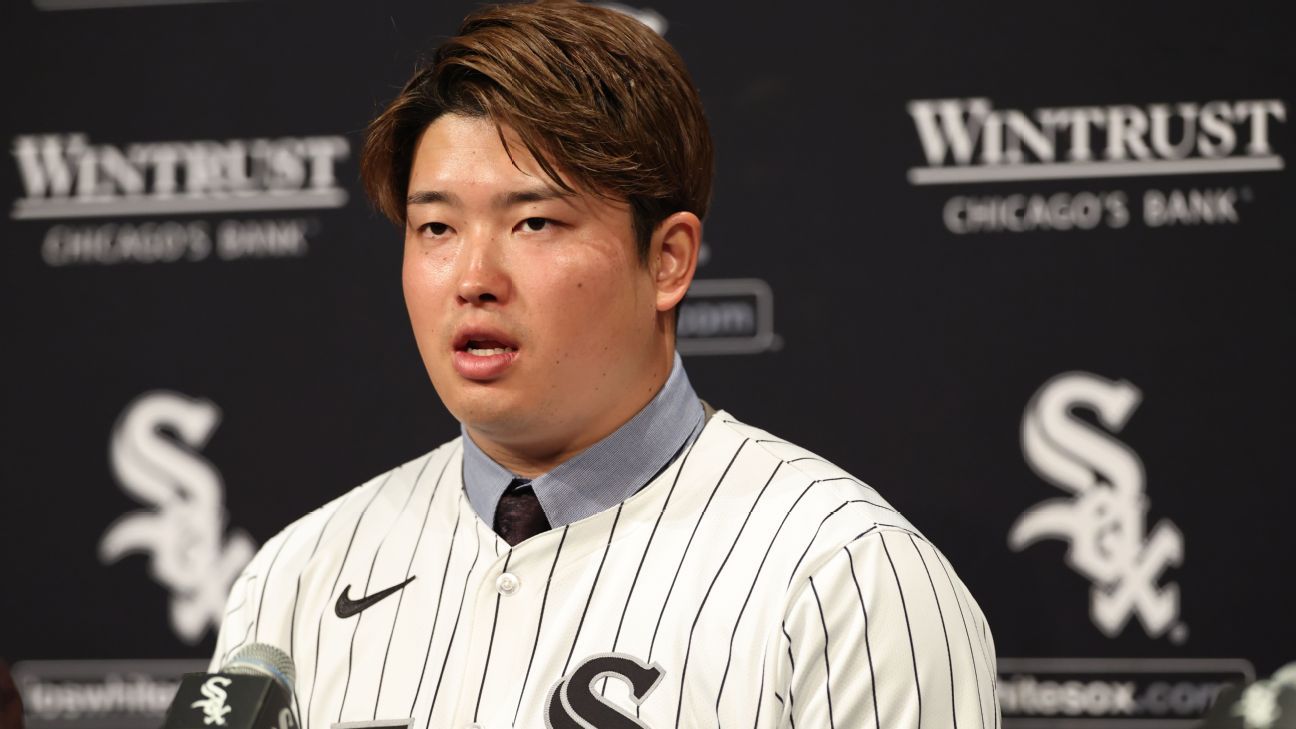
Munetaka Murakami, 3B, Chicago White Sox
Kazuma Okamoto, 3B, Toronto Blue Jays
These two corner infielders will be discussed together since they offer such a stark contrast in skill sets. Murakami is a 26-year-old slugger who won the Nippon Professional Baseball Organization (NPB) Triple Crown for the Yakult Swallows in 2022. After hitting 56 homers that season, he added 64 more over the next two years. Last year, he had only 22 homers, but those came in just 56 games as he experienced injury issues. He has fanned at a 29% clip over the past three years, which is clearly a concern, but he’s still young with massive upside.
On the other hand, Okamoto is almost four years older than Murakami. He played eight seasons for the Yomiuri Giants before being posted. Okamoto’s game is about putting the ball in play. He was also hurt last season, but when healthy, he managed identical 11.3% strikeout and walk rates.
Both players can handle both corner infield spots, though Okamoto is the better defender with a better chance to man the hot corner in the majors. Murakami is better suited for first base or designated hitter.
Including Murakami’s Triple Crown season would tip the scales in his favor, but for the past three seasons these two are very comparable, at least in terms of surface stats. Of course, the more important analysis is how they’ll produce in MLB. The level of play in NPB is considered to be akin to Triple-A. Players’ skills don’t necessarily translate linearly, but we have compiled enough data over the years to treat Japanese players as Triple-A prospects and apply composite Triple-A Major League Equivalencies (MLE). Again, since Murakami is older, his translation suffers more, especially in terms of strikeout rate.
Admittedly, the projected playing time might be generous, as both are coming off seasons abbreviated by injury. Still, we’d estimate that Okamoto is the better player for points leagues, while Murakami’s steals give him the edge in category-based scoring. This assumes both meet their projections, which is a big assumption, especially for Murakami and his elevated strikeout rate.
Along with the cultural differences, players entering MLB from Japan and Korea need to learn a whole new set of pitchers. Also, keep in mind that there are fewer teams in NPB and KBO, so batters can learn pitchers easier than MLB hitters can. It has been reported that 19 of the 30 MLB teams use Trajekt technology, which is a robot designed to emulate the delivery and repertoire of every MLB pitcher. Hitters can stand in against the machine to help get familiarized with every opposing pitcher.
This could be especially useful for Murakami and Okamoto since, on average, MLB pitchers are 2-4 inches taller than their Japanese and Korean counterparts. Unfortunately, the identity of which specific teams use the technology isn’t public. However, the company is based out of Toronto, so keep an eye out for reports of Murakami using Trajekt, which could ease his transition.
ESPN contributor Derek Carty’s THE BAT projection system views the production of Murakami and Okamoto a bit differently.
Here, Murakami’s strikeouts climb even more, but his power better survives the transition. It’s fair to question whether a player fanning nearly 40% of the time will get a chance to stay in the lineup, but the White Sox have no reason to keep him on the bench — and if he is indeed generating a 30 HR/10 SB season, they’ll hope he makes more contact. It’s not as apparent in standard 10-team ESPN leagues, but in deeper formats, third base thins quickly, so Murakami and Okamoto are both in play. Consider Murakami as the high-risk/high-reward choice, with Okamoto representing the safer option, albeit with a lower ceiling.
Tatsuya Imai, SP, Houston Astros
Imai is the only pitcher in this year’s overseas class worth drafting in a standard 10-team ESPN league. He is a 27-year-old right-hander coming off a career year for the Saitama Seibu Lions, establishing new personal bests in ERA, WHIP, K% and BB%. He throws a mid- to high-90s four-seam fastball, a mid-80s slider and a changeup that some classify as a splitter. Additionally, he throws from a sidearm angle, so his heater has more arm-side run than a typical “rising” fastball. This complements his slider, which runs to the glove side.
The Astros will slot him into the middle of their rotation. While foreign hitters need to get accustomed to MLB pitchers, incoming hurlers often benefit from facing new batters — especially those with deceptive deliveries, like Imai. As such, the MLE translations may not be as harsh. Keep in mind, though that Imai took a big step forward last season.
Home runs are the trickiest aspect of the MLE translation. Even after applying a Double-A MLE, the HR% feels low for most Japanese pitchers, so I usually expect even more, as does THE BAT. Keeping in mind that Carty’s system does not specifically project PA or IP, 152 innings feel generous. Most Japanese pitchers are restricted to one start a week, capping them around 26 or 27. Imai would need to average almost six innings per start to reach that workload, which is too optimistic. In 2025, there were more games started with five days of rest (46.7%) than with four days (29.8%).
My rule of thumb is to be more aggressive drafting Japanese pitchers who exhibit solid strikeout rates, since there are many examples of improvement in that area, at least until opposing batters get accustomed to their stuff. Factor in Imai’s deceptive mechanics and the unusual motion of his fastball, and he could outdo expectations.
Sung-Mun Song, 3B, San Diego Padres
There is another third baseman to discuss, this one arriving from the KBO, with the Kiwoom Heroes posting the 29-year-old Song after a .315/.387/.530 season with 26 homers and 25 steals. With Manny Machado established at the hot corner in San Diego, Song will likely shift to the keystone or first base, having played both in Korea. He could also serve as a utilityman. KBO play is considered closer to Double-A, so the MLE translations here are a bit harsher, especially for power. As such, Song is more likely to carry over his speed than his pop.
The rates are comparable, although THE BAT penalizes contact more. Both view Song as more of a utilityman than a regular.
Names to know for deeper mixed leagues
Cody Ponce, SP, Blue Jays
Ponce pitched for the Pittsburgh Pirates before heading overseas prior to the 2022 season. He spent three years in NPB, the first two with Hokkaido Nippon-Ham Fighters, then a season with Rakuten Golden Eagles before heading to KBO last season, pitching for the Hanwha Eagles. Ponce struggled in Japan but excelled in Korea, winning the KBO Triple Crown with 17 wins, a 1.89 ERA and a 0.94 WHIP. The 32-year-old righty scored himself a three-year, $30 million contract, so the Blue Jays must trust that Ponce figured something out. Perhaps he did, but he was also facing the equivalent of Double-A hitters. So, while taking a flier is viable, temper your expectations.
Foster Griffin, SP, Washington Nationals
Griffin toiled in the minors for eight seasons, collecting only eight innings in the majors before heading overseas to join the Yomiuri Giants, compiling a 2.50 ERA and 1.05 WHIP while improving in each of his three seasons. He only logged 78 innings last year, but he had a terrific 1.62 ERA and 0.95 WHIP. Griffin was slated to begin the season in the Nationals’ rotation, but after MacKenzie Gore was dealt to the Texas Rangers, the 30-year-old southpaw could be in line for the Opening Day nod. However, with a below-average fastball, Griffin is likely to struggle against the better MLB competition.
Anthony Kay, SP, White Sox
After posting a 5.59 ERA and a 1.61 WHIP over 85 1/3 MLB innings from 2019-2023, Kay spent the last two seasons with the Yokohama DeNA BayStars in NJP. In 2024, he posted a 3.42 ERA and a 1.34 WHIP before dropping to 1.74 and 0.98 last season. The White Sox took notice and signed the 30-year-old left-hander to fill out their rotation while top pitching prospects Tanner McDougal, Hagen Smith, and Noah Schultz continue their development. Rate Field has the reputation of being a hitter’s park, but it actually slightly favors pitching. It is generous to home runs, though Kay’s fly ball rate in Japan was a minuscule 27%. That said, both projections are skeptical that he can maintain that low extreme rate.
Names to consider in AL- and NL-only formats
Tyler Austin, 1B, Chicago Cubs
Austin spent six seasons with the Yokohama DeNA BayStars, compiling a .293/.377/.568 line over 403 games. He’s returning to MLB as a 34-year-old, likely to serve as the right-handed portion of a DH platoon alongside Moises Ballesteros, though if Ballesteros proves capable of handling left-handed pitching, Austin will be relegated to backup duty.
Drew Anderson, SP, Detroit Tigers
Anderson pitched in parts of five MLB seasons before heading overseas with a career 6.50 ERA and 1.58 WHIP. He spent 2022 and 2023 with the Hiroshima Toyo Carp in NJP before heading to KBO, where he pitched the last two seasons for the SSG Landers. In between, he returned to the States but was unable to win a job with the Tigers in spring 2024. Anderson transitioned to a full-time starter in Korea, adding velocity, which helped him dominate the lesser competition. He’s now back with the Tigers, where he’ll get another look for the rotation, though he could end up serving as a swingman.
Ryan Weiss, SP, Astros
Weiss pitched five minor league seasons, including three at Triple-A, but never received the call to The Show. He played independent ball in 2023 before heading overseas to join KBO’s Hanwha Eagles. After showing improvement in 2024, Weiss broke through last season with a 2.87 ERA and a 1.02 WHIP. The 29-year-old righty will work as a starter in the spring, but the Astros have a deep rotation, and Weiss’ fastball and slider combo could play well as a reliever.
