image:
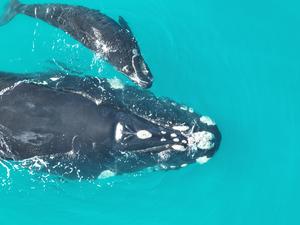
Southern right whales (Eubalaena australis) have been described in new research as a sentinel species for climate change.
Credit: Video and photos courtesy Richard Twist, Current Environmental Australian Right Whale Research @southernrightwhales.
The tide has turned on the conservation success story of the southern right whale.
Once considered a global conservation success story, the species is now emerging as a warning signal of how climate change is impacting threatened marine life, according to new research led by scientists from Flinders University and Curtin University with international collaborators in the US and South Africa.
Southern right whales (Eubalaena australis), a sentinel species for climate change, provide critical insight into ecosystem changes occurring in the Southern Ocean, warn the marine mammal experts.
In a major new study funded by the Minderoo Foundation, researchers reveal a significant decline in southern right whale reproductive output over the past decade, driven by prolonged calving intervals.
Drawing on more than three decades (1991–2024) of photo-identification data collected at the Head of the Great Australian Bight – located within the Yalata Indigenous Protected Area in South Australia – the study found that declining breeding rates coincide with reduced Antarctic sea ice, changes in oceanic conditions including persistent positive Antarctic Oscillation, signalling broader ecosystem shifts.
“This reproductive decline represents a threshold warning for the species and highlights the urgent need for coordinated conservation efforts in the Southern Ocean in the face of anthropogenic climate change,” says academic and director of Current Environmental Pty Ltd, Dr Claire Charlton, the long-time leader of the Australian Right Whale Program in the Great Australian Bight.
“These findings add to global evidence showing the sensitivity of southern right whales to climate variability in their offshore foraging grounds, reinforcing their role as effective ecological indicators of environmental change.”
Similar trends have been observed in southern right whale populations across South America and South Africa, with other krill-dependent predators including whales and seabirds also facing growing pressure from marine heatwaves and declining sea ice, researchers say.
Alongside unprecedented climate change and declining food resources, this flagship species is also facing increasing pressure from human activities, including vessel strikes, underwater noise disturbance, entanglement in fishing and aquaculture equipment, and habitat degradation from coastal and offshore development across breeding and migration areas.
Dr Charlton, an adjunct academic at Flinders University and Curtin University researcher, says while climate change in the Antarctic may feel distant, its effects are already being felt on Australia’s coastline.
“Long-term monitoring in the Great Australian Bight shows how climate impacts are influencing animals that seek sanctuary in our coastal waters, emphasising the value of annual research spanning four decades for detecting changes to population trends.”
Southern right whales were hunted to near global extinction during commercial whaling in the 19th and 20th centuries but have shown a slow recovery since international protection.
“Ongoing annual research across biologically important areas in Australia is essential to inform population assessments, guide coordinated conservation action to support adaptive strategies to safeguard threatened species into the future,” Dr Charlton says.
Recent aerial survey data from 1976 to 2024 indicate that the Australian population size currently ranges between 2,346 and 3,940 individuals – approximately 16%-26% of pre-whaling levels. Calf numbers have declined since 2017, from a peak of 222 in 2016 to 200 in 2024, according to University of Tasmania research.
In response to environmental change, some southern right whales have shifted foraging grounds from high-latitude Antarctic waters to mid-latitude sub-Antarctic regions and diversified their prey from Antarctic krill to more copepod-rich diets.
The article, ‘Climate-Driven Reproductive Decline in Southern Right Whales’ (2026) by Claire Charlton, Matthew Germishuizen, Bridgette O’Shannessy, Robert McCauley, Els Vermeulen, Elisa Seyboth, Robert L Brownell Jr and Stephen Burnell has been published in Scientific Reports DOI: 10.1038/s41598-026-36897-1.
The study was conducted by Australian researchers from Current Environmental Pty Ltd and Flinders University, the Curtin University’s Centre for Marine Science and Technology and Oceans Institute, University of Western Australia; as well as the Mammal Research Institute Whale Unit, University of Pretoria, South Africa; and National Oceanic and Atmospheric Administration (NOAA), Southwest Fisheries Science Centre, USA.
Acknowledgements: The Minderoo Foundation provides cornerstone funding for the Southern Right Whale Research Program. In-kind support for this study was provided by the South Australian Museum, WA Museum and SA Department for Environment and Water (DEW). Research was completed under the SA DEW and Natural Resources Scientific Permit with animal ethics approval from Curtin University and Flinders University. Researchers acknowledge the Yalata Anangu Aboriginal Corporation and Yalata Anangu Community for their partnership with field research and monitoring at Head of Bight.
Caption: Video and photos courtesy Richard Twist, Current Environmental Australian Right Whale Research @southernrightwhales. All drone imagery must be displayed with a water mark of drone permit number, as required by research permits. Permit Number M26085-13.
Key points
· Southern right whales are showing climate-driven declines in reproduction after decades of recovery.
· Long-term data link reduced breeding success to marine heatwaves, declining Antarctic sea ice, changing ocean conditions and reduced availability of prey such as krill.
· Similar patterns across the Southern Hemisphere suggest a global climate signal.
· Whales are acting as warning indicators of broader Southern Ocean ecosystem change.
· Environmental protection and threat reduction are crucial to safeguard threatened species into the future.
Journal
Scientific Reports
Method of Research
Data/statistical analysis
Subject of Research
Animals
Article Title
Climate-Driven Reproductive Decline in Southern Right Whales
Article Publication Date
11-Feb-2026
Disclaimer: AAAS and EurekAlert! are not responsible for the accuracy of news releases posted to EurekAlert! by contributing institutions or for the use of any information through the EurekAlert system.
