By the early 1980s, it was clear that the reigning world champion, Anatoly Karpov, was about to face a serious challenge from the young Garry Kasparov. After overcoming a number of obstacles, Kasparov qualified as the challenger, but in the 1984/85 World Championship match in Moscow the titleholder proved a tenacious opponent. After 48 games, with Karpov leading 5–3, the match was abandoned, as there was no realistic prospect of either player reaching the required total of six wins. Under revised regulations, the World Championship match was rescheduled for November 1985.
In his chess column of 23 December 2025 in the Frankfurter Allgemeine Zeitung, Stefan Löffler recalled one—or rather two—visits by Garry Kasparov to Hamburg.
Stefan Löffler’s column in the FAZ | Source: Stefan Löffler
In May 1985, Kasparov accepted an invitation from Der Spiegel, one of Germany’s leading weekly news magazines, to visit Hamburg. At the time, Der Spiegel had in Werner Harenberg a highly chess-savvy editor who did much in the 1980s to popularise chess in Germany. Harenberg worked closely with Gisbert Jacoby, who was active in Hamburg as a regional training coach, was a close associate of Robert Hübner, and had also established contact with Garry Kasparov, even visiting him once in Baku. The Spiegel editors were also in close contact with Frederic Friedel, a science journalist and a specialist in computer chess.
As a result, in late May 1985 Kasparov played a training match in Hamburg against Robert Hübner, organised by Der Spiegel. The young Soviet grandmaster won the match convincingly by 4½–1½.
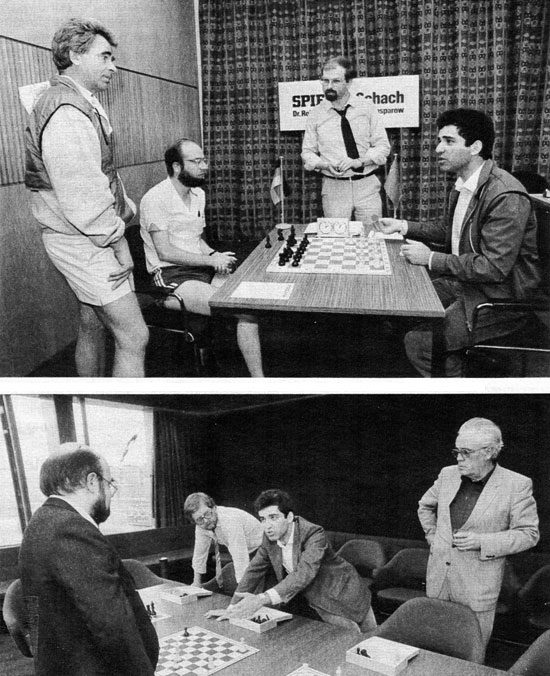
Top: Robert Hübner with his second, Boris Spassky. Horst Metzing acting as arbiter.
Bottom: Gisbert Jacoby, Garry Kasparov; on the right, Werner Harenberg.
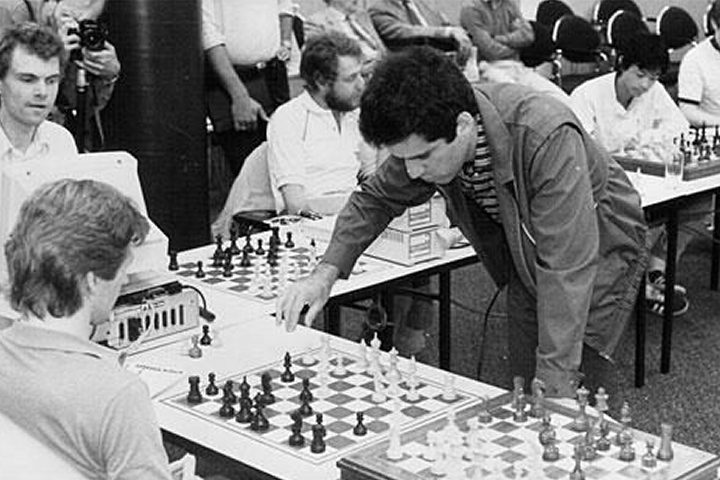
Garry Kasparov also took on a “test match” on 5 May, facing 32 chess computers simultaneously. Kasparov won all 32 games, although some of the machines held out for a long time. A few came close to a draw, some even to a win—but only close.
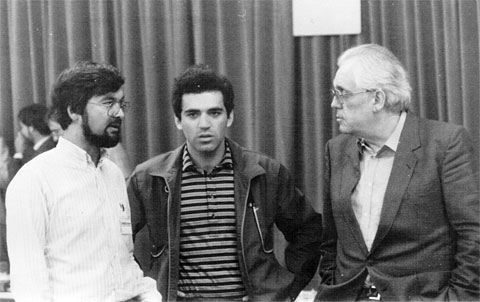
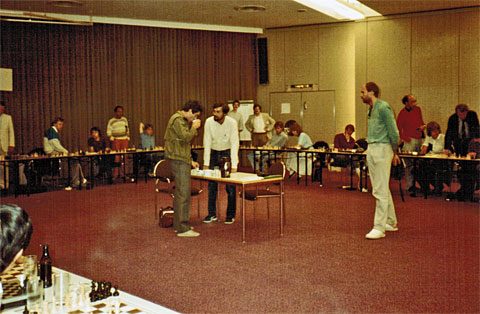
In a parallel simul, Gisbert Jacoby faced 24 chess computers, winning only 13 games, losing five and drawing six.
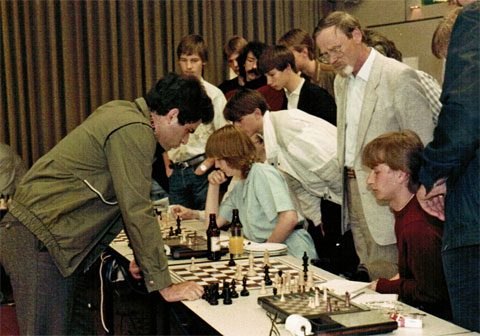
On 7 June, to conclude his visit to Hamburg, Garry Kasparov played a clock simul against eight members of the Hamburger SK Bundesliga team, some of them very young players. In later years, Kasparov played several such clock simuls against strong teams and won them all—but not this one.
The Hamburg Bundesliga team consisted largely of amateurs. The only grandmaster and full-time professional was Murray Chandler, who won his game against Kasparov. Against his eight opponents, Kasparov had White four times and Black four times. He defeated Frank Behrhorst (later a mathematics teacher and chess coach) and Rainer Grünberg (later a sports reporter for the Hamburger Abendblatt). Kasparov drew his games against Helmut Reefschläger (a mathematician and chess columnist) and Christian Hess. His game against the then fifteen-year-old Hannu Wegener also ended in a draw.
The greatest difficulties, however, were posed by another fifteen-year-old—future grandmaster Matthias Wahls—and by Hans-Jörg Cordes, who was then training to become a doctor.
With White, Matthias Wahls began his game solidly, but then took an aggressive approach. With a piece sacrifice he initiatiated complications, forcing the Russian to spend time. And in the end, it was lack of time that cost Kasparov the match.
Against Hans-Jörg Cordes, Garry Kasparov chose a complex line of the Botvinnik Variation of the Semi-Slav Defence. Kasparov obtained a good position but failed to follow it up correctly and gradually ran into difficulties in a highly complicated position. In the end, the future world champion even missed a chance to force a draw.
With the two lost games, Garry Kasparov also lost the match.
Two years later, Kasparov returned to Hamburg, this time as world champion. In a second clock simul against the Hamburger SK Bundesliga team, he set the record straight, winning decisively by 7–1. There were two differences compared with the first match: Murray Chandler was no longer part of the HSK team and was replaced by Bernd Stein, and Kasparov now played all of his games with the White pieces.
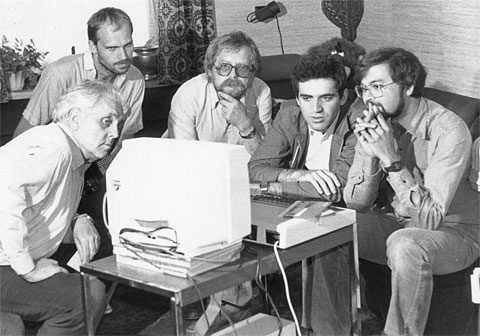
The first chess database is admired.
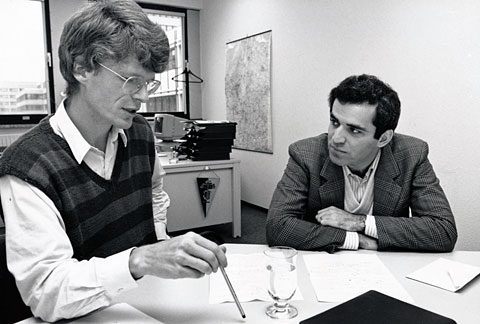
Matthias Wüllenweber and Garry Kasparov
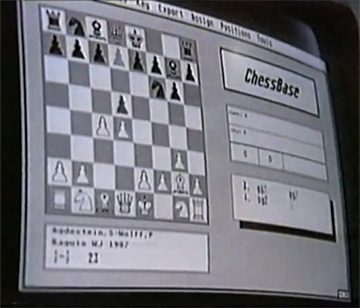
During his visit to Hamburg, Gisbert Jacoby, Frederic Friedel and Matthias Wüllenweber, a physicist from Bonn, presented Garry Kasparov with a new development—a chess database. The company ChessBase had just been founded. A few weeks later, Kasparov received a floppy disk containing the first version of the program, bearing serial number 1.
Your personal chess trainer. Your toughest opponent. Your strongest ally.
FRITZ 20 is more than just a chess engine – it is a training revolution for ambitious players and professionals. Whether you are taking your first steps into the world of serious chess training, or already playing at tournament level, FRITZ 20 will help you train more efficiently, intelligently and individually than ever before.
