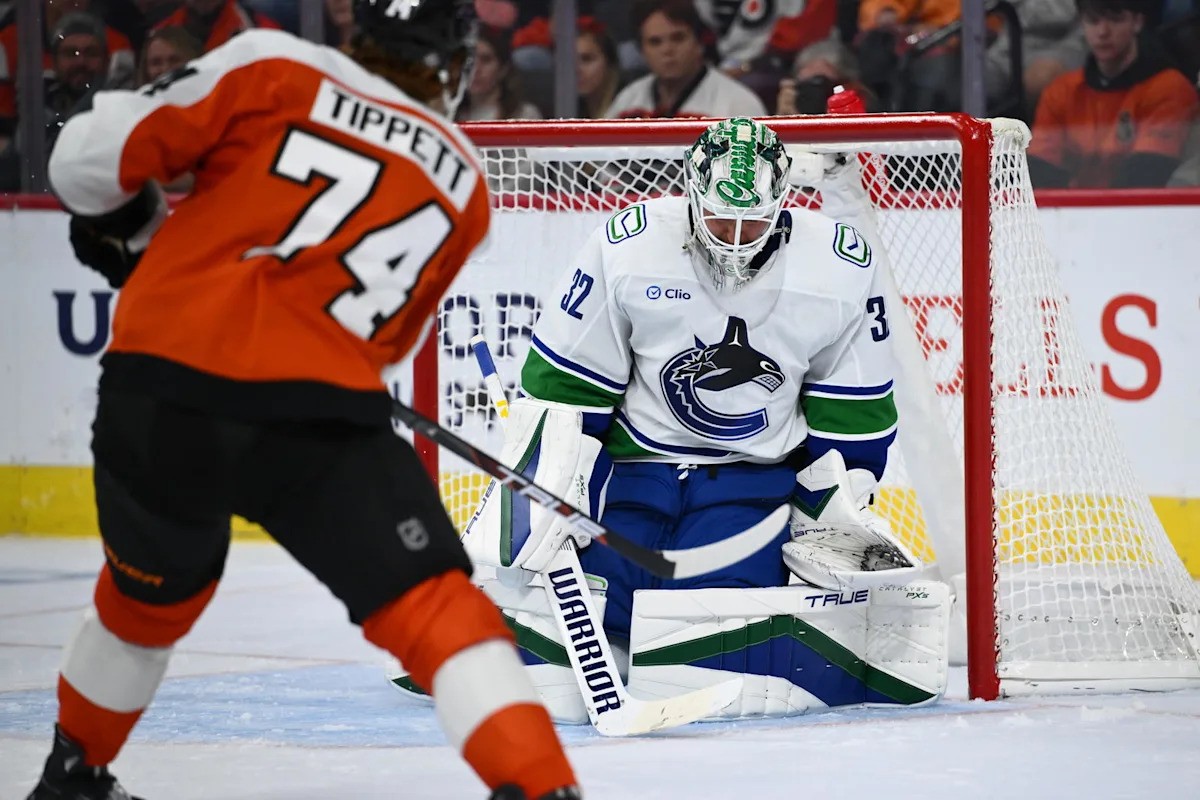
The Philadelphia Flyers return home with a chance to reset quickly after a frustrating but largely well-played shootout loss to the Rangers, welcoming the Vancouver Canucks to Philadelphia.
The result on Saturday didn’t fully reflect the performance, and the focus now shifts to whether the Flyers can carry over the parts of that game that worked—particularly at five-on-five and on the power play—against a Vancouver team that presents a very different set of problems.
Vladar Likely to Get the Crease.
Dan Vladar looks set to start in goal, though Rick Tocchet left the door slightly open by calling it a game-time decision. Vladar being the first goalie off the ice after morning skate, however, is usually a strong indicator of the plan.
Advertisement
With Sam Ersson having handled a heavy workload recently, the Flyers appear comfortable leaning on Vladar in a game that could hinge on early saves. Vancouver generates a lot of offense off the rush and second chances around the net, and Vladar’s ability to manage traffic and control rebounds will matter more than raw save totals. The Flyers have generally gotten steady, predictable goaltending from him, which fits the kind of structured game they’ll want to play at home.
Dan Vladar (80). (Megan DeRuchie-The Hockey News)
Building on Progress From the Rangers Game.
Calling the Rangers loss “disappointing” doesn’t mean it was unproductive. The Flyers skated well, pushed play for long stretches, and—importantly—saw tangible results on the power play with two goals. That’s been an inconsistent area, so any sign of cohesion is meaningful.
Advertisement
The challenge now is sustainability. Vancouver’s penalty kill isn’t passive, and their defense tends to close quickly on puck carriers at the blue line. Clean entries and quick decisions will matter more than volume. The Flyers don’t need to reinvent anything from the Rangers game, but they do need to be sharper in execution—especially if power-play chances are limited.
Denver Barkey’s Role Grows, Even If the Sample Size is Small.
Denver Barkey has only played one NHL game, but his impact was immediate enough that he stays in a prominent spot. Slotted alongside Sean Couturier and Owen Tippett, Barkey brings pace and a willingness to get involved in the middle of the ice—traits that can help stabilize a line that often draws tough matchups.
Tocchet was clear about what he’s seen so far.
Advertisement
“Unreal,” Tocchet said of Barkey’s energy. “I think it’s important to have guys every once in a while come up, whether they stick or not, they’re playing with energy. And I thought he was really, really good. He’s a hockey player.”
Barkey, who will be playing his first game on Flyers home ice isn’t being asked to spark the team emotionally or do anything flashy. He’s there to play, to move pucks, and to keep shifts alive. Against a Canucks team that rolls four lines and keeps pressure high, those details will determine how much ice time he earns again.
Christian Dvorak’s Return Settles the Top Six.
Christian Dvorak is back after missing the Rangers game with what Danny Briere jokingly described as a “boo-boo,” a minor lower-body issue that didn’t keep him out long.
Advertisement
His return stabilizes the top line with Trevor Zegras and Travis Konecny, a trio that relies on Dvorak’s positioning and defensive awareness to balance Zegras’ creativity and Konecny’s pace.
With Dvorak in the lineup, the Flyers’ forward group looks more properly slotted. It also allows Matvei Michkov to stay in a matchup-friendly role with Noah Cates and Bobby Brink, where that line has quietly been effective at tilting the ice without needing sheltered minutes.
How Philadelphia Matches Up With Vancouver.
Vancouver brings a mix of size, speed, and shooting, led up front by Brock Boeser and supported by a deep, physical middle six. Evander Kane’s presence adds an edge, while players like Conor Garland and Jake DeBrusk thrive in broken plays and around the net.
Advertisement
On the back end, Filip Hronek drives much of their transition game, and Marcus Pettersson provides defensive stability. Thatcher Demko is expected to start, and when he’s on, goals are difficult to come by without traffic and second efforts.
For the Flyers, the defensive pairings suggest a clear plan. The York–Sanheim pair will handle top matchups, while Andrae and Drysdale are tasked with clean puck movement and avoiding extended shifts in their own zone. Nick Seeler and Rasmus Ristolainen give the third pair a more direct, physical look against Vancouver’s depth lines.
Projected Lines
Philadelphia Flyers
Forwards:
Advertisement
Trevor Zegras – Christian Dvorak – Travis Konecny
Denver Barkey – Sean Couturier – Owen Tippett
Matvei Michkov – Noah Cates – Bobby Brink
Carl Grundstrom – Rodrigo Abols – Nikita Grebenkin
Defense:
Cam York – Travis Sanheim
Emil Andrae – Jamie Drysdale
Nick Seeler – Rasmus Ristolainen
Goalies:
Dan Vladar
Sam Ersson
Vancouver Canucks
Forwards:
Evander Kane – Marco Rossi – Brock Boeser
Jake DeBrusk – David Kampf – Conor Garland
Kiefer Sherwood – Aatu Raty – Drew O’Connor
Liam Ohgren – Max Sasson – Linus Karlsson
Defense:
Marcus Pettersson – Filip Hronek
Zeev Buium – Tyler Myers
Elias Pettersson – Tom Willander
Goalies:
Advertisement
Thatcher Demko
Kevin Lankinen
