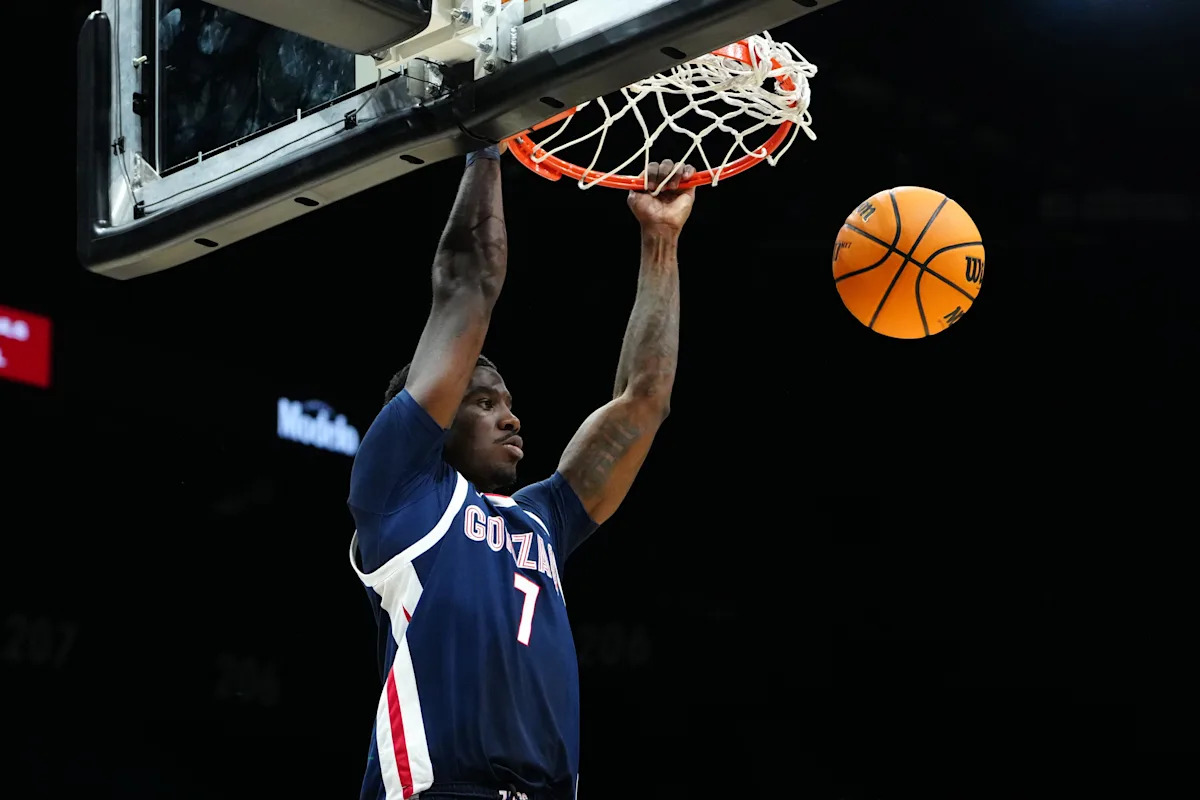
Gonzaga had its share of rough nights last season, but the Kentucky game sits in its own category. The Zags rolled into Climate Pledge Arena with the confidence of a group still buzzing from the season-opening win over Baylor, built an 18-point lead, and looked ready to put a top-five opponent in a headlock. Then the game turned into something else entirely.
Gonzaga lost its grip on the tempo. Kentucky kept stacking scoring punches. The lead shrank possession by possession until Kentucky’s Andrew Carr delivered the jumper that pushed the game into overtime. The Zags collapsed, coughed up an 18-point lead, and Kentucky closed out a 90-89 overtime win, snapping Gonzaga’s streak of 175 straight wins when leading by double digits at halftime. The dominance of the first 20 minutes only amplified the collapse of the following 25.
Advertisement
It became one of those early-season checkpoints fans kept circling back to, the moment where questions about identity, toughness, decision-making, late-game execution, and coaching adjustments all felt sharper than usual. And with the rematch back on the schedule, that night still hangs over this year’s meeting like the smell of John Calipari’s hair gel and cologne hangs in the rafters of Rupp Arena itself.
The Series So Far
Friday’s game marks the fourth installment of a six-game series that began in 2022. The agreement originally came together under Coach Calipari, who brought the Wildcats into a home-and-home with Gonzaga and then spent the next two seasons getting clipped by Few, first in the Spokane Arena in 2022, then again at Rupp in February 2024. Calipari left for Arkansas after that season, passing the program to Mark Pope, who arrived with years of experience facing Gonzaga during his tenure at BYU.
The last times these two teams met marked a signature early moment for Pope’s tenure and a season-defining collapse for Gonzaga. Calipari may be gone, and Pope may be building something new in his stead, but beating Kentucky still carries real weight in the college basketball world, even if there’s a good to fair chance the Wildcats wake up unranked come Monday. The blue-blood label hasn’t faded, the stakes for both teams remain high, and the memory of last year’s reversal adds even more tension to the latest chapter of the series.
Advertisement
The Zags know better than anyone: don’t count out Kentucky.
Meet the Wildcats
Kentucky enters this matchup ranked No. 18 nationally and No. 16 on KenPom with a profile that sits somewhere between “dangerous” and “hard to fully trust.” The Wildcats carry the 23rd-rated offense, the 13th-rated defense, and the second-weakest strength of schedule rating of any team in the top 20. Louisville owns the only weaker schedule, and Louisville already beat Kentucky 96-88 a few weeks ago. More recently, the Wildcats endured a frustrating home setback to North Carolina on Tuesday, when the Wildcats lost 67-64 and shot just 43% from the field and 8% from deep while getting out-rebounded 41-30.
For now, sophomore guard Denzel Aberdeen leads the team at 13.5 points per game and sets most of their pace. Wing Otega Oweh sits right behind him at 13.4 points per game and attacks with a downhill speed that forces perimeter defenders to respect every first step. Sophomore sharpshooter Collin Chandler adds scoring pop from the perimeter (currently an absurd 20-43 from deep on the season), and freshman 7-footer Malachi Moreno provides physicality inside while leading the Wildcats in rebounding.
The bench offers some length and energy through Jasper Johnson, Andrija Jelavić, and Brandon Garrison, but the team’s overall depth has been limited by injuries.
Jayden Quaintance, the elite rim-protector and probable lottery pick who transferred in from Arizona State, still hasn’t debuted after offseason knee surgery. Pitt transfer Jaland Lowe, expected to be one of the team’s primary point guards, has been sidelined by a lingering shoulder issue and is still “loosely practicing” without any five-on-five work. Kentucky’s core is talented, but the roster holes are impossible to ignore.
Advertisement
Even with the injuries and the soft schedule (did you know there was a Loyola in Maryland?), the Wildcats do a few things at a level Gonzaga must respect. They shoot from deep with a barely warranted confidence, they rebound with physicality on both ends, and they drag games into the kind of physical, half-court slugfest that works to their strengths. They haven’t beaten anybody of note yet, but the personnel still demands Gonzaga’s full attention, especially in Nashville.
Keys to the Game
1. Take away the three-point line
This is always the starting point with a Mark Pope team. His BYU teams lived behind the arc, and this Kentucky group follows the same blueprint. They attempt between 25-30 three-pointers per game, and their whole roster is willing to let it fly. Pope’s half-court actions rarely try to grind defenders down inside. Instead, he wants ball screens, drive-and-kick pressure, and multiple shooters touching the ball in quick succession.
Gonzaga’s guards will have to stay attached to their assignment through every screen, flare, and early-action drag in transition. Kentucky shot just 1-for-13 from deep against UNC, which usually signals regression in the other direction. The Zags cannot let this be the night Kentucky’s numbers “normalize.”
2. Win the possession battle
Kentucky’s offense runs hot and cold, but their possession advantages have kept them afloat. They’ve grabbed 354 boards in 8 games, including 97 offensive rebounds. They make rebounding a priority because they’ve been streaky from the field, and so far it’s kept them competitive in games they had no business hanging around in.
Advertisement
Gonzaga cannot let Kentucky string together second-chance possessions, especially when Pope’s offense gets settled in the half court. If Huff, Ike, Warley, and Grant-Foster control the glass and force Kentucky into one-shot trips, the Wildcats lose their safety net.
Bonus: Kentucky commits over 10 turnovers per game, many of them unforced. Mario Saint Supery, Braeden Smith, and Emmanuel Innocenti can flip the game with active hands in passing lanes and exploit Pope’s emphasis on ball movement around the perimeter; the ball is constantly in the air, and Gonzaga can turn those windows into runouts.
3. Let the Bigs Set the Tone
Kentucky has size inside but very little depth, especially if wing 6’7” wing Mo Dioubate (11.8 ppg, 5.8 rpg) remains sidelined. Malachi Moreno, a true 7-footer averaging 10 points and 8 boards on 60% shooting, anchors the middle but plays under 25 minutes per game. Behind him is 6’11” freshman Andrija Jelavić, a big body who can occupy space but offers limited scoring and rim protection. That thin rotation gives Gonzaga a clear path: play inside-out and make Kentucky defend the post all night.
Graham Ike should get the ball early and often. Every deep catch forces Pope to make rotation decisions he’d rather avoid, and once Kentucky starts collapsing, the floor opens. Huff stretches the matchup even further with his ability to pop, slip, and pass from the high post. If Gonzaga commits to running the offense through Ike’s power and Huff’s versatility, the Wildcats will be under pressure from the opening tip.
Advertisement
Final Thoughts
Gonzaga doesn’t get many chances to fix two different problems in the same week, but Friday sets the table for exactly that. Last week’s 40-point collapse against Michigan still lingers, and the memory of last year’s 18-point collapse to Kentucky hangs over this matchup whether anyone says it out loud or not. This game offers a straight path to clearing both from the system and resetting the trajectory heading into the new year.
Tipoff comes Friday, Dec. 5 at 4:00 p.m. PT from Bridgestone Arena in Nashville, with coverage on ESPN2, plus radio on 96.1 FM and the Varsity Sports App. Kentucky will bring talent, length, and a dedicated home crowd. Gonzaga brings urgency and a chance to take control of the series again.
