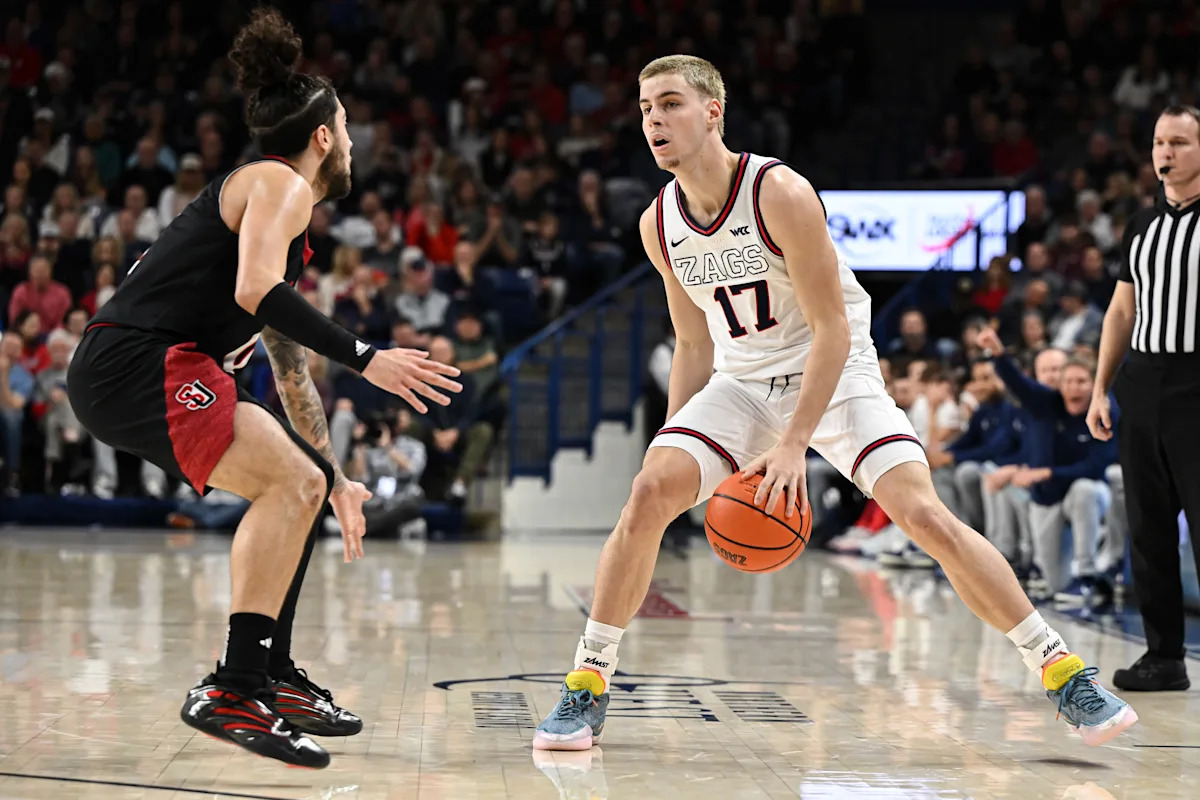
Gonzaga heads into Thursday’s tilt against the Pepperdine Waves with a very strange type of momentum. Saturday’s matchup against the Redhawks of Seattle U resulted in a 70-51 win for the Bulldogs, and, even more impressively, they pulled it off without either Braden Huff or Graham Ike in uniform. It was a statement game built on defense, physicality, and control, and it pushed Gonzaga up one spot to No. 8 in the latest AP poll despite the loss of one of the nation’s most efficient scorers.
Huff is out four to eight weeks, but the hope around Spokane is that Ike is healthy and ready to return against the Waves. Based on how Gonzaga handled Seattle, though, and how the first meeting with Pepperdine unfolded in a 96-56 blowout in Malibu, Mark Few certainly has the flexibility to be cautious with Ike’s minutes if needed. Gonzaga did not look like a team missing its two best interior scorers against Seattle U. It looked like a team that had found a whole new gear to play in.
Advertisement
Meet the Waves
It’s been a struggle all season for Pepperdine. Saint Mary’s held them to just 45 points total. San Francisco held them to just 60 on 31 percent shooting. Santa Clara turned the game into a perimeter shooting contest, went up by 20, and never looked back. The trend has held: once the Waves are forced to defend movement and spacing at pace, the game gets away from them, the fouls stack up, and the offense starts chasing points it struggles to generate cleanly.
What’s occasionally kept them afloat is the extremely courageous play of sophomore guard Styles Phipps. He plays nearly the entire game (35 minutes per game), leads the team in scoring (12.5 per game), rebounding (6.4), and assists (4.8). He carries the offense possession by possession by living in the middle of the floor and daring defenders to absorb contact in the lane. Expect Pepeprdine to keep forcing Phipps downhill, trying to collapse the defense and draw fouls at the rim. When the lane stays open, he can control tempo. When it closes, the turnovers creep in and the shot quality drops.
Aaron Clark is a perfect counterpart for Phipps in the backcourt. He’s been the guard most willing to take and make difficult shots, the one most likely to flip a game’s energy with a couple quick threes or a transition pull-up. He closes games, hunts steals, and takes the big shots even when the game script advises not to. He averages 12.3 per game and is fresh off an 18 point and eight rebound performance against the Pilots. He’s a microwave scorer and could really test the Zags’ perimeter defense if gets hot from outside.
Last time…
It wasn’t much of a game when these two teams last faced each other. Gonzaga jumped on Pepperdine early, controlled the tempo from the opening tip, and turned the night into a long stretch of one-way traffic that ended in a 40 point rout. The Zags shot 54 percent from the floor, buried 10 threes, won the rebounding battle by a margin of 13, and scored 50 points in the paint while Pepperdine struggled to generate anything resembling sustainable offense. The Zags held Phipps to just six points on 1-8 shooting that night, his other four points all coming from the free throw line.
That night in Malibu marked a breakout for Tyon Grant-Foster, who delivered his most complete performance of the season with 18 points and four blocks in just 20 minutes, pairing scoring punch with real defensive impact. It was also one of Davis Fogle’s best outings of the year, as the freshman poured in 15 points on 5-of-7 shooting in only 16 minutes. The Tyon-Fogle pairing is uncharted territory for a team that spent the first half of the season stockpiling wing depth, but the prospect of seeing both on the floor together now feels far more relevant with Braden Huff out of the lineup. With the Zags continuing to cycle through combinations at the three and four in search of the right mix, both figure to be central pieces again in the rematch..
What to watch out for…
Of course everyone wants Graham Ike back on the floor as soon as possible, but there is something genuinely enticing about the runway his and Huff’s absence creates for Gonzaga’s small-ball groups. The Seattle U game showed how much speed, spacing, and defensive chaos Gonzaga can generate when it plays fast and wide, and a matchup like Wednesday’s gives Mark Few the freedom to ease Ike back in slowly. If Ike goes, expect controlled minutes and deliberate stretches with Diagne on the block, because the coaching staff needs both versions of this team ready by March.
Advertisement
The next thing to watch is whether Mark Few goes back to the group that blew the doors off Seattle U. The combination of Emmanuel Innocenti, Mario Saint-Supery, Jalen Warley, Tyon Grant-Foster, and Davis Fogle gave Gonzaga the exact blend of speed, shot creation, defensive chaos, and positional versatility that turned what could have been a close game into an absolute rout. On paper, a frontcourt that tops out at 6’7″ with no true center feels like an invitation to anxiety, but in practice the positionless look was one of the most effective rotations they have found against anyone all season. Size barely registered as a factor once the pace picked up and the scoring started coming from everywhere. The assumption remains that Ike and Warley open the game together, yet the real intrigue lives with that second unit, a lineup that speaks to just how deep and flexible this roster has become.
The next thing to watch is the ongoing battle for point guard supremacy and what it means for the shape of Gonzaga’s offense going forward. Mario Saint-Supery was outstanding against Seattle U, finishing with 20 points on 7-of-10 shooting, drilling four of his six threes, and handing out four assists in a performance that finally looked like the version of Mario Gonzaga opened the season with.
What makes this especially interesting is how the guard dynamic may be forced to evolve with a thinner frontcourt rotation. Braeden Smith remains the engine of the offense and the connective tissue of every lineup, but with fewer true post touches available, the inside-out table setting he provides carries a little less weight than the shot creation and scoring gravity Saint-Supery brings. The most intriguing version of this backcourt may ultimately become Smith at the one and Mario at the two, freeing Saint-Supery to hunt threes, attack closeouts, and pressure the rim off the bounce. It could be the start of a climb toward the two-point-guard identity that has anchored Few’s best teams in the past.
The final thing to watch is how creative Few gets with the frontcourt. The default option if Ike’s minutes are limited is to keep cycling through combinations of Diagne, Warley, Grant-Foster, and Fogle and let speed, switching, and ball pressure carry the lineup. But there are other levers available. This could be a clean opportunity to burn Parker Jefferson’s redshirt and start bringing him along as a real rotation piece at the four or five. There also remains the option of pairing Ike and Diagne together, a look that would bring real rebounding and rim protection back to the floor but raises questions about spacing and offensive flow, since their skill sets overlap far more than they complement. However Few chooses to play it, this stretch without Huff feels like an audition window that could reshape the rotation completely heading towards March.
Advertisement
Final Thoughts
Under normal circumstances, this would be a comfortable home win. But without Huff or a fully healthy Ike, it becomes another experiment in managing depth and finding the right combination of dudes to put on the floor together. In most seasons, losing your leading scorer and watching your other leading scorer spend a game on the bench in a walking boot would feel catastrophic. This year, it feels like an opportunity.
It means more Davis Fogle. It means Tyon Grant-Foster with a longer leash. It means Jalen Warley growing into a foundational piece as a starter rather than a luxury asset off the bench. It means Mario Saint-Supery calling his own number from deep or being opportunistic off the bounce. It means Ismaila Diagne vacuuming up rebounds and flashing the kind of offensive upside that hints at where his ceiling might live. This game is also Gonzaga’s last chance for lower-stakes experimentation, recovery, and tinkering before the schedule gets brutal with San Francisco and Saint Mary’s waiting on deck. If everything goes how it should, the result should take care of itself. The real value in this one is everything the Zags get to learn along the way.
