You know all about the Power 6 conferences in college basketball. You hear about those more than any other, and those groups often dominate the March Madness conversation. There are 31 other conferences out there, however, and our goal is to get you up to speed on the teams, players and fights in the standings to know before the conference tournaments, Selection Sunday and the official start of March Madness.
It’s time for you to get to know a mid-major: this time, it’s the Coastal Athletic Association.
The Coastal Athletic Association has gone through a couple of name changes over the years. It was formed in 1979 as the ECAC South Conference for basketball schools located in the southern United States, but then was renamed the Colonial Athletic Association in 1985 as other championship sports began to be played in the conference, as well. It was then renamed a second time in 2023, as the Coastal Athletic Association, after a few teams outside of the south were added to its ranks. Now, the CAA spans the coast, from as south as South Carolina to as north as New England.
All 13 teams in the conference are eligible for the Coastal Conference Association tournament in March, but the last two teams in the standings face off in a play-in round. The top four teams receive a double bye to the quarterfinals, while teams seeded 5th through 11th head to the second round, with the fifth-seed getting to face the first-round winner. Similarly, the top seed faces the winner of 8 vs. 9. This is a newer system, since last season there were 14 teams in the conference, giving just 10 teams byes.
Leaders:
- Points Per Game: Cruz Davis, Hofstra, 21.0
- Rebounds Per Game: Xzavier Long, Hampton, 10.3
- Assists Per Game: Jack Collins, Monmouth, 5.5
- Steals Per Game: Jason Rivera-Torres, 2.2
- Blocks Per Game: Chol Machot, Charleston, 2.6 (9th in D-I)
There is no dominant power in the men’s portion of the Coastal Athletic Association. Through Feb. 10, UNC Wilmington — UNCW — is both the top team in the conference standings at 9-2 and the highest-ranked in the NCAA Evaluation Tool, or NET, at 99th. Hofstra is next in NET, at 105th, and third in the CAA at 7-5. College of Charleston is second in CAA — half-a-game back of UNCW — but 164th in NET. William & Mary has the opposite problem, with a 6-6 record and 119th showing in NET. None of the other Coastal Athletic Association teams are top-150 in NET: Stony Brook is 7-5 but 213th, Drexel is also 7-5 and 214th, Monmouth 6-5 and 204th, Campbell 6-6 and 210th, Hampton also 6-6 and 249th. Towson is ranked ahead of that whole bunch in NET — 179th — but is 5-7 in conference play, tied with Elon (195th). Northeastern and North Carolina A&T are 2-10, tied for last in the CAA, and 262nd and 269th in NET, respectively.
So, this isn’t a competitive conference on a national level, as no one is even approaching bubble territory and there will be, just like the last three years, an automatic bid to the NCAA Men’s Basketball Tournament and no at-large ones. However, look how closely clustered these teams are: there are teams that rate better in NET but have lost to opponents deemed inferior enough times to fall in the standings, and even the two teams at the top have just 2-3 more wins than seven of the other 11 teams. “There is no clear favorite” might be bad news for how things go in March Madness for whichever team gets a ticket there, but as far as the conference tournament goes, that’s exciting.
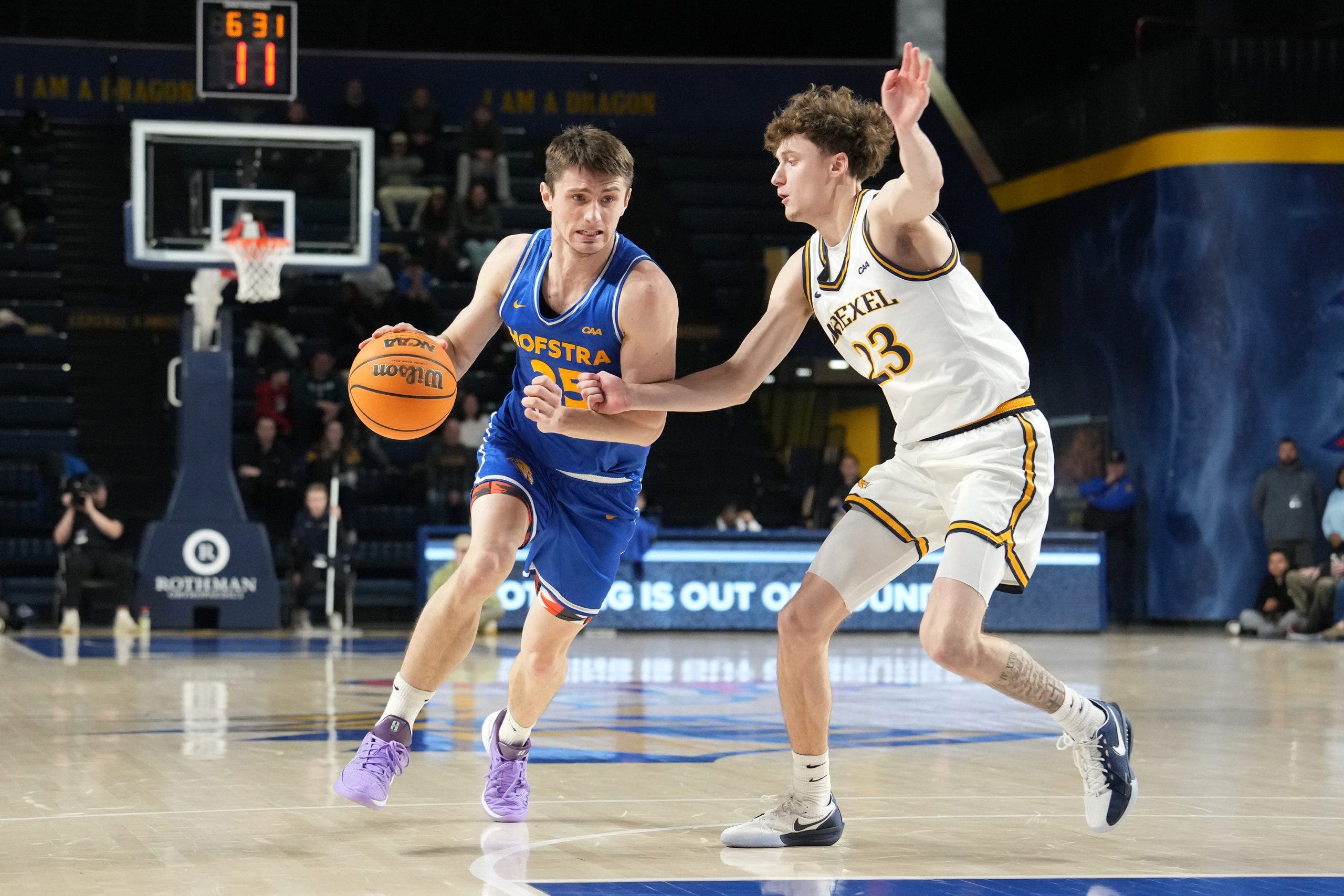
Hofstra’s offense could help it thrive in the CAA tournament. (Photo by Mitchell Layton/Getty Images)
Hofstra (89), Elon (92) and UNCW (97) have top-100 offenses by KenPom’s unadjusted Offensive Rating, while Towson (97) is the lone team with a top-100 defense. (When adjusting for the quality of competition, these rankings all look much worse — unsurprising, given the lack of high-quality teams to play against.) UNCW might not have a lights out offense, but it does rebound well — it’s fourth in the conference in offensive rebounds and second in defensive boards — and averages the most free throws both made and attempted per game, while limiting turnovers better than anyone else. UNCW doesn’t limit its own turnovers, though, and because the shooting is mid, the Seahawks have an average margin of victory in-conference of just under five points.
Hofstra has senior guard and conference scoring leader Cruz Davis averaging 21 points per game, as well as 3.9 rebounds and a team-leading 4.8 assists. He’s joined by freshman guard Preston Edmead, averaging 15.6 points, 3.4 rebounds and 4.7 assists. Hofstra is an even better rebounding team than UNCW, but not a good shooting one: it’s second in the CAA in field goal attempts and 10 of 13 in shooting percentage. It does excel from 3, however — the Pride are 2nd in made 3s (10.4), attempts (26.6) and lead the conference in 3-point percentage (39.2%) — allowing for them to make up for the overall shooting and put those boards to good use, too.
Leaders:
- Points Per Game: Amaris Baker, Drexel, 19.5
- Rebounds Per Game: Grace Ezebilo, Charleston, 12.1 (6th in D-I)
- Assists Per Game: Taylor Barbot, Charleston, 6.2 (T10th in D-I)
- Steals Per Game: Rori Cox, UNC Wilmington, 2.7
- Blocks Per Game: Kayla Morris, Towson, 2.4 (T8th in D-I)
College of Charleston is 11-0 in conference play, at the top of the Coastal Atheltic Association and also 101st in NET. The Cougars are the lone top-150 team in CAA by NET’s calculations.
Stony Brook is second in CAA at 8-2, followed by 8-3 Monmouth and Campbell. Drexel is 7-4 and in fifth, then Elon and Towson tied at 6-5. William & Mary is 5-6, NC A&T 4-7, Hampton 3-8, Northeastern and Hofstra both 2-9 and UNCW 1-10. Drexel (157th) and Monmouth (192nd) are the only other top-200 teams in NET in the conference.
Charleston is 88th in adjusted Offensive Rating, at 97.92 points per 100 possessions, and while much worse defensively than that — 92.22 points per 100 possessions — in-conference the Cougars’ average margin of victory is 15.9 points. Charleston is in the top five in basically every category in the conference besides free throw attempts (6th), defensive rebounds (7th) and blocks (12th). The Cougars are averaging 8.3 made 3s per game, best in the CAA, and are shooting 35.4% from beyond the arc, 2nd-best. They are also averaging a CAA-best 12.2 steals per game, and the significant gap in turnovers is part of how Charleston has succeeded despite the lack of rebounding.

Taylor Barbot (#0), one of a pair of twins on Charleston, has helped the Cougars to an 11-0 conference record. (Photo by Matthew Jonas/MediaNews Group/Boulder Daily Camera via Getty Images)
Twin junior guards Taryn Barbot and Taylor Barbot are the Cougars’ top leading scorers, at 19.0 and 12.5 points, while Taryn is also second on the team in both rebounds and assists — Taylor leads in dimes, at 6.2 per game, tied for the 10th-best in all of Division I women’s basketball. Then there is junior forward Grace Ezebilo, who averages just 6.1 points per game but leads the conference in rebounds while ranking sixth in D-I. That’s a fearsome trio, and the Cougars’ depth goes further, too: junior forward Tyja Beans is scoring 11.1 per game with 4.5 rebounds, while senior guard Sophia Tougas is averaging 9.2 points, and is second on Charleston in made 3s per game behind Taryn Barbot, while leading the conference in 3-point percentage at 36.8%.
Like with the men’s side, the automatic bid is the only way to get into March Madness. Charleston has the best chance of that, but consider that 8-10 William & Mary was the team that won last year’s conference title. Anything can happen when teams are this clustered together, even if the odds are in Charleston’s favor.
