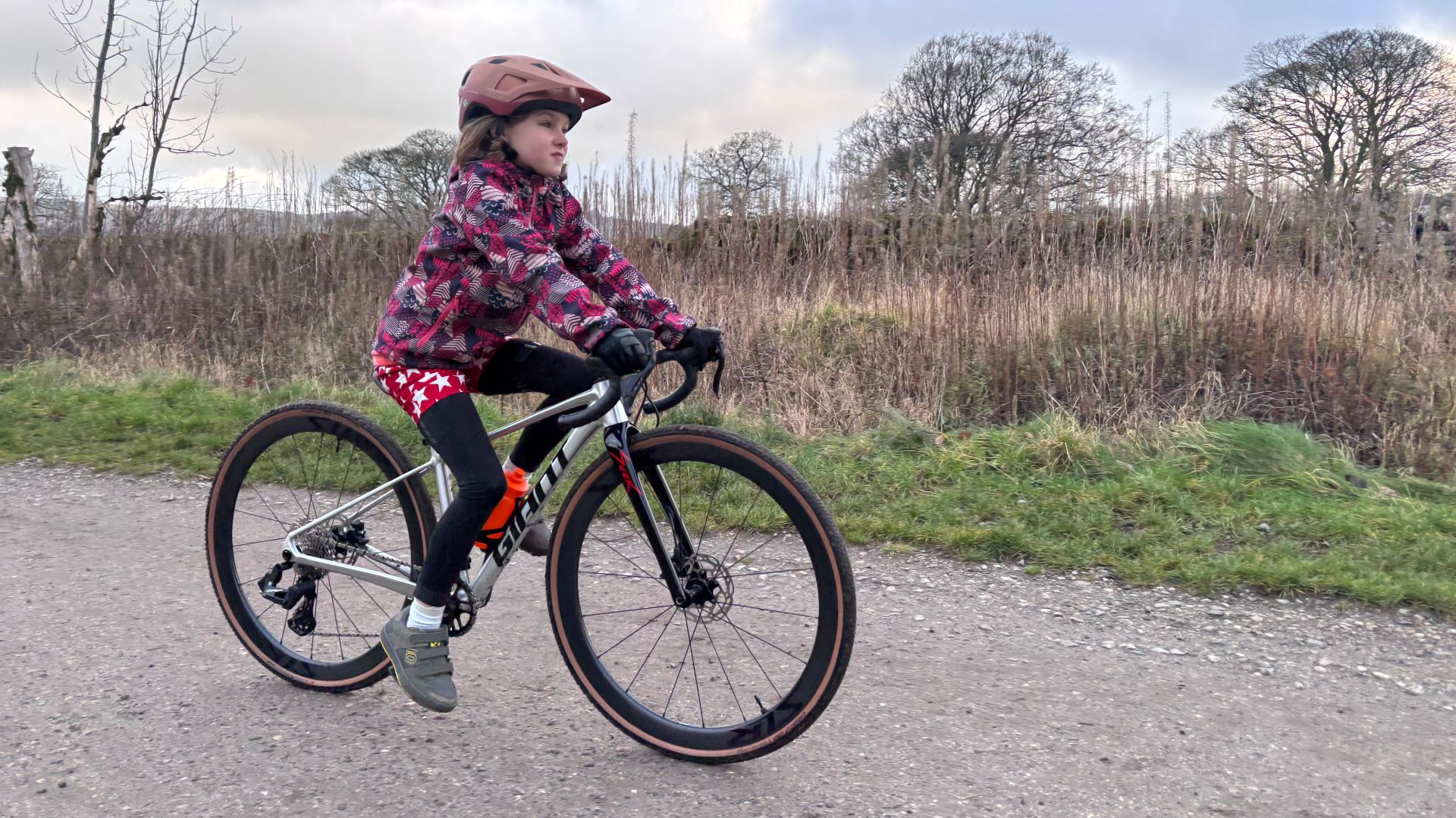
The Giant Seek is the Taiwanese company’s attempt to support younger riders into road riding. The company designed the bike, to in it’s words “transform the road riding experience for kids and give them the same feeling of speed, efficiency and control that adult road riders enjoy” and on paper, it certainly goes a long way further than almost anything else that’s come before it.
The frame uses slimmed down tubing in a specially considered frame design, paired with a composite fork, and a proprietary seat post designed to deliver good ride quality, for riders whose inputs are smaller. The thoughtful design continues into a specially designed cockpit, with controls designed for smaller hands; not unusual on a well thought out kids bike, but not many bikes come with grown-ups hydraulic brakes and electronic shifters too.

(Image credit: Future / Neal Hunt)
Design details
The Seek is pitched primarily as a road bike; in fact, you’d be hard pressed to tell it has any off-road capabilities at all by looking at their website, but it does, in fact, have plenty of clearance for wider tyres (up to 37mm) and even ships with a set of gravel tyres in a 35mm width, adding a heap of versatility.
The bike we’re testing is the Seek 1, the more expensive of the two bikes available. The top of the range model weighs a paltry 7.44 kg (without pedals and gravel tyres fitted), which is pretty light for a bike of this type. Vitally though, despite the low weight, it doesn’t feel fragile.

(Image credit: Future / Neal Hunt)
The frame comes in one size and is designed to fit riders 130 to 150cm tall. Stack and reach are 476.5mm and 325.5mm, respectively, with saddle height from 420mm from the centre of the bb to the top of the saddle at its lowest, up to 600mm at its maximum. My daughter is 135cm tall, which means it should fit for at least the next couple of growth spurts.
Giant is one of the largest producers of alloy frames in the world, so it’s no surprise to see that this one is packed with neat features and engineering know-how. Made using what it calls Aluxx tubing, a brand name for their aluminium alloy range, the tubes are hydroformed, meaning it looks every inch the high-end frameset. What sets it apart is that it is that the tube profiles are not ‘big bike’ tubes, cut shorter. They are made in specific profiles for this bike, to suit the needs of smaller riders.

(Image credit: Future / Neal Hunt)
The frame itself has a stout head tube and a heavily sculpted downtube, for strength and pedalling response, paired with a very slim top tube and seat stays, which presumably delivers some compliance. The seat tube is a ‘D-Fuse’ seat post shape common to Giant’s adult bikes, but even that is made in a smaller diameter to give some flex in the seatpost, with a smaller, lighter rider on board.
The frame is finished in a brushed alloy finish, paired with a smart gloss black carbon fork, which gives it a very classy, timeless look. As this bike is for kids, and colour can be all important, I’d be tempted to brighten it up with some coloured bar tape. Colour aside, it’s a great-looking bike, with premium looks befitting its premium price tag.
It’s worth noting if colour is all important, that the Liv women’s bike division at Giant does also offer a Seek range. The frame is black, with a pink fork, but otherwise the spec is the same.
For the purposes of the review, my daughter didn’t mind riding the Giant version. The specification and frame is exactly the same, regardless of which brand you might prefer.

(Image credit: Future / Neal Hunt)
Specifications
The Seek range, whether Liv or Giant branded, has been designed to suit smaller riders from the off, so every component has been designed through that lens. It’s therefore not a surprise to see narrow bars, and shorter cranks. What is surprising, and stands as one of the real highlights of this product is the TRP Vistar drivetrain. TRP will be familiar to people who have used Tektro products before, as TRP stands for Tektro Racing Products. Finding electronic gears on a childs bike, is really something special.

(Image credit: Future / Neal Hunt)
They aren’t just the grown-up versions however. Rather these are especially designed with kids’ hands in mind, with a reach that’s 35% shorter from the drops and 30% shorter from the hoods. The outer hood diameter is 20% smaller overall, and the lever’s flared shape further improves ergonomics for small hands. The lever itself is also adjustable for reach using a 2.5mm allen key.
In use, the shifter controls feel similar to those on a Shimano Di2 road shifting system, with two paddles located behind the brake lever. They are easy and intuitive to use.
Braking is handled via hydraulic discs, with 140mm rotors front and back. 140mm rotors are enough for a full size bike, so it’s good to see that they’ve gone for the smaller of the available ‘adult’ options here. Larger would be too much, but these strike a good balance between feel and control in use.

(Image credit: Future / Neal Hunt)
The bike runs a 1x set up, so doesn’t use a front mech, just the Vistar electronic rear mech out back, which is operated by the shifters, wirelessly. It uses a 30t chainring paired with a 12-speed 11-36 cassette. The cassette is from Shimano’s 105 range, so should be easy to replace come servicing time, as well as running a Shimano compatible 12-speed chain.
The chosen gearing makes sense, and gives a wide range, with smooth progression through the ratios and smooth jumps between gears. The Prowheel DMA cranks are also size-specific, with 130mm arms, perfect for smaller folk, and a seat tube-mounted chain guide is present to keep the chain in place over rough terrain and in the event of a mistimed back pedal.

(Image credit: Future / Neal Hunt)
The finishing kit, like the rest of the bike, has ergonomics designed for smaller riders. The alloy handlebars are just 320mm wide and flare to 340mm for added control in the drops, they also have a relative short reach of 62mm, and a shallow drop of 100mm. The stem is 60mm in length.
A version of the brand’s Grit saddle is made for this bike and mounts to the aforementioned D-Fuse seatpost. The finishing kit is all alloy and finished to the same high level you find on Giant’s adult road and gravel ranges.

(Image credit: Future / Neal Hunt)
The 650 B wheels on the Seek 1 are from Giant’s own SLR range and feature carbon rims with an internal width of 21mm and a depth of 40mm. They look like a miniature version of high-end race wheels, with 18 spokes front and back, svelte hubs and 12mm thru axles. The supplied road tyres are the Gavia Course 0, in a 28mm width, and the gravel tyre is the Giant Crosscut Grip 1, in a 35mm width; both are tubeless. If your child is racing cyclo-cross you’ll need to source a suitable pair of 33mm or narrower tyres if racing at a national level, though for more local events, I’m sure the supplied gravel tyres would be passable.
One other thing to bear in mind for UK readers looking to race is that, at the time of writing, under British Cycling regulations, anyone racing under the age of 14 can’t use the supplied wheels, as the maximum height or wheel depth allowed is 35mm.
The gearing supplied should fare better with the scrutineers however, as the gearing falls below the rollout figure of 6.34 metres quoted in the rules. It’s perhaps worth double-checking with your relevant governing body before buying the bike, and always check before you head off to a race, as local regulations can change.
Performance
My daughter’s first reaction to this bike was one of pure excitement; she sees both my wife and I on drop-bar bikes all the time, and after watching the Tour de France Femmes and meeting Olympic track rider Maggie Coles-Lyster this summer, she was keen to get out on ‘a proper road bike’ as soon as possible.
As a family, we ride all the time and she’s been on various Islabikes up to her current 24” wheeled one, so the Seek was a great next step – not too much of a jump, and a nice alternative to what she normally rides. She’s also a very competent rider, riding mountain bikes comfortably on blue trails, pump tracks and singletrack in and around Sheffield.

(Image credit: Future / Neal Hunt)
Setting the bike up for her was straightforward, though I opted not to use the plastic pedals that came with the bike. They are a cheap, one-sided plastic pedal designed for toe clips, the sort of thing you’d see with budget adult road bikes 10-15 years ago.
They seemed very out of place on an otherwise sorted spec, and I can only assume they’re provided so that there is some kind of pedal with the bike. I opted to fit her regular flat pedals.
The contact points use a standard bar and stem and an externally clamped seatpost, so set-up and getting her comfortable was very straightforward.
The bike ships with road tyres, which we swapped out for the gravel options after one ride, purely because she doesn’t enjoy riding on the roads yet. The sad truth is that the roads local to me just didn’t feel safe enough for an 8-year-old. Close passes are all too common, and the last thing I wanted to do was to scare her away from the simple pleasure of riding a bike.

(Image credit: Future / Neal Hunt)
If your child is keen to race, then there are plenty of British Cycling road race circuits around the UK where they can learn the required skills in complete safety from a young age. My daughter has yet to show interest in wanting to take part in the competitive side of bike riding, despite a keen interest in watching it. So for us, fitting gravel tyres was an obvious choice, as it opened up lots more safe and inviting riding options. Hats off to Giant for including a pair with the bike.
The tyres themselves, Giant’s own Crosscut Grips, offered plenty of traction in wet and muddy conditions in the 35mm width and didn’t appear to slow her down much on smoother sections, either. Though narrow compared to common adult gravel options, you can still run them pretty soft without any pinch flats or burping. We generally ran them at 22-25 psi through testing and had no punctures or issues at all.
She was a little hesitant at first, and once underway, described the bike as not being as easy to control as her current bike with flat bars. Watching her first ride, I’d say it was the move to a road-style bike that she was getting used to, with narrow road bars, narrower tyres, and quicker handling to adjust to. After a short time on the bike she adapted and was soon flying along very confidently. She was happily chatting as we cruised along, a sure sign she was comfortable and was enjoying the ride.
We live in a very hilly area of the UK and often head out into the Peak District together for rides, here she found the range of gears perfectly adequate, with no need to get off and walk at any time. The bike climbs well too, and looks very stable when she transitions from seated to standing on climbs. Cornering was also suitably controlled, without any visible wobbles, or complaints about wayward handling. I checked in on our cafe stop de-briefs to check, and she raised nothing that felt alarming or even of concern to me about the bike’s handling.

(Image credit: Future / Neal Hunt)
The narrow profiled lever body on the shifters and easy reach levers, meant she could hold on comfortably, and the smooth shifting and easy-to-reach paddles made it all feel easy. She’s used gripshift and trigger-style shifting before, but this was her first time using a drop-bar lever, and she took to it right away.
Though not nearly as versatile as a traditional flat-bar bike, the Giant Seek 1 is more than capable on smooth trails and rolls well. She was noticeably faster than she was on her usual bike, and with a bit of careful route planning, we had plenty of great days out together. There were a few grumbles about the saddle not being the comfiest early on, though this did vary depending on her choice of riding wear and chamois and it was a problem that was mentioned less and less as she got used to it.
Value
The Giant Seek 1 is priced at £2,499 / $3.600. For that, you get a tremendous spec, as Giant really has gone to town on the Seek. It feels very much like a passion project for the staff members I spoke to at Giant when discussing the bike, and it shows in the final product. The frame has some great detailing; the ergonomics of the smaller shifters and finishing kit are pretty much perfect; and, according to my daughter, it rides really well and is noticeably faster than other bikes she has ridden.
Having the option of road and gravel also makes it a versatile machine, especially if you have safer, more inviting infrastructure than we have where we live.
There is a lower-spec version available for £1,399 / $2,200, which utilises the same frame and forks but features alloy wheels and a cheaper Sword 10-speed groupset from Microshift. It still has electronic shifting and small, hand-specific ergonomics, but I would assume a less refined shifting experience with just ten sprockets on hand. The 12-speed TRP set-up on this Seek 1 is excellent.
Drop-bar kids’ bikes remain reasonably rare, but there are a few out there. However, a direct comparison with the Seek isn’t, as yet. The Cube NuRoad Rookie Pro is priced at a much more pocket money friendly £999, though it’s a much lower-end spec with alloy wheels and cable-actuated brakes.
There is also the Megamo Jakar, which has a similar spec to the Cube, and also retails at £999, but neither is dual-purpose or as highly specced as the Giant, which currently sits out on its own in the market.
Verdict
I was really torn when it came to summing up this bike. On the one hand, it’s a fantastically well-designed bike with some great features and genuinely thoughtful engineering touches, but on the other, she didn’t love riding it as much as I thought she would, and the price is high for a kids’ bike, whichever way you look at it.
For the road riding it’s designed for, and the gravel it also excels on, it’s excellent, and we had some brilliant daddy-daughter days out together, which are priceless. I’m certain the bike’s extra speed and efficiency made for better, longer rides. But it was more limiting in other ways, in the context we used it, which took the shine off a few rides for her, as she’s used to exploring and riding more varied terrain.
Because of its high ticket price, it’s never going to win the prize for value either. You therefore have to weigh up if your child really needs a bike this specific or of this high specification, but for those who conclude that you do, and who can justify the cost, it really is something special.
If you want to ride more varied trails, and surfaces, and need a versatile bike, you could forgo the fancy gears and opt for something like the Seek 2, or Cube, or stick with a flat bar. It really will depend on your child, and what they want to do.
Overall, it’s a brilliantly considered product, and an excellent start in road riding for an aspiring Tadej, or Ferrand, if you can afford it.
