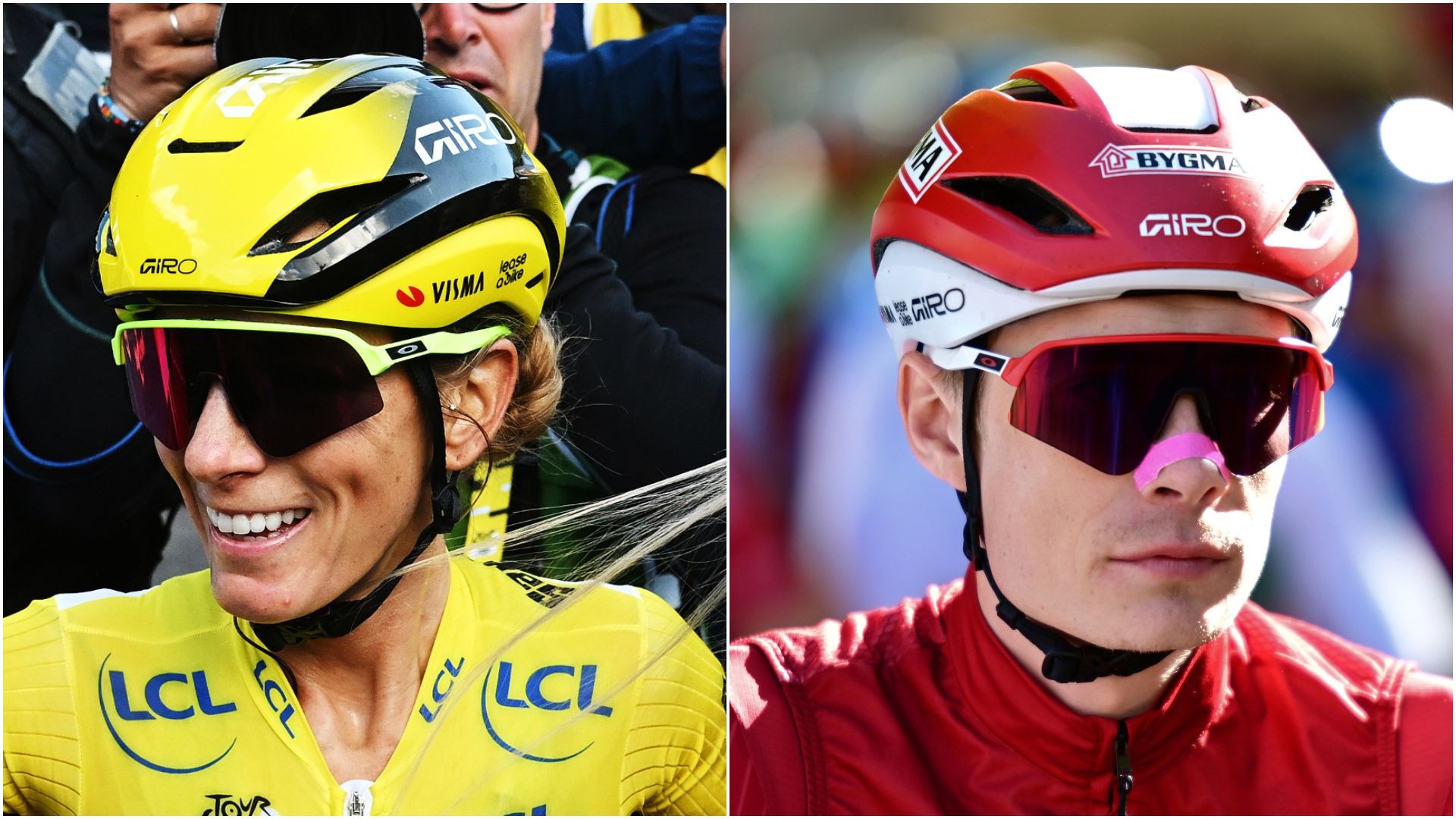
For the second half of the 2025 season, Giro’s newest aero road helmet has been hiding in plain sight. Seen regularly on the heads of Team Visma-Lease a Bike riders, it quietly logged victories at the Tour de France, Tour de France Femmes, and La Vuelta a España long before consumers had an official name or details to attach to it.
Today, Giro officially unveiled the helmet as the new Eclipse Pro Aero Road Helmet, confirming what many had already suspected. In brief, it is the brand’s fastest non–time trial helmet to date, claimed to be 17 per cent faster than the previous Eclipse model, while remaining ventilated and comfortable enough for all-day riding. The helmet incorporates MIPS Spherical technology for protection and the claimed weight is 280g for a size medium.
(Image credit: Giro)
With a new silhouette and Specialised Evade-like rear venting, the Eclipse Pro is more than just a refresh of the original Eclipse helmet; it’s an evolution. Giro says the final product was shaped through thousands of simulations and physical test iterations, including extensive computational fluid dynamics modelling, iterative clay shaping and full-scale wind-tunnel validation.
Up front, two prominent vents sit along the edges of the helmet and double as ports for storing sunglasses. Between them, a narrower central opening feeds into a large, smooth fairing that defines the Eclipse Pro’s sleek profile. Giro says the new centre vent is designed to split air to the forehead and over the brow for aerodynamic efficiency. All in all, this latest model is 17 per cent faster than its predecessor yet designed to be “exceptionally balanced” and suitable for all-day comfort.

(Image credit: Giro)
The helmet’s defining, uninterrupted, central section serves multiple purposes. In addition to streamlining airflow over the helmet and offering great branding real estate, it helps manage internal airflow and comfort. Temperature regulation is often a compromise with aero-focused helmets, but Giro says it addressed this by incorporating 15 vents and deep, structured intake ports that channel air across the rider’s scalp to help manage heat buildup during sustained efforts and in warmer conditions.
The Eclipse Pro carries over some of Giro’s established safety and fit technologies, including a polycarbonate roll cage, EPS foam, the MIPS Spherical technology for rotational impact protection, antimicrobial padding and the Roc Loc 5.5 Air fit system for micro-adjustability.
Impressively, the claimed weight of the Eclipse Pro is just 10g more than its breezy Aries model, at 280g in a size medium.
Giro plans to make the helmet available through its website and authorised retailers in mid-February 2026, with additional product information, including price and colourway options, to be rolled out between now and then.
A very brief first ride review

(Image credit: Future)
The Eclipse Pro showed up on my doorstep as a surprise. No official packaging, no branded helmet box; just a helmet wrapped in bubble wrap and paper inside a black box. But this helmet didn’t need much explaining; we’d seen it all over the pro peloton these past six months.
But with the helmet arriving just a day before the embargo lift, my time riding in it has been brief. Still, the first impressions are positive.
When it comes to cycling helmets, I’m very much a creature of habit. Once I find a model I like, I’ll wear it until it’s dented or worn out, then buy the exact same one again. That’s how I’ve ended up in Giro helmets for roughly the past 12 years. I wore various iterations of the Giro Synthe for close to eight years before eventually moving to the Aries Spherical, which I’ve now been riding for the past three seasons. Different colourways, sure, but always the same model.
The reason is simple: it’s lightweight, low-profile, well-rated for safety, and extremely well-ventilated. That last point is also why I’ve never really loved aero helmets. They tend to run hot, and with long hair, temperature management is already a challenge. Can this new Eclipse Pro finally convert me to riding in an aero helmet? Maybe!
The heart of winter isn’t ideal for testing cooling performance, but during my one ride, Eclipse Pro feels surprisingly close to the Aries. There are a decent number of vents, I noticed no pressure points, no sweaty brow and no hair snagging, which is something older MIPS systems were prone to.
And when I put both helmets on my Park Tool scale, I found a mere six-gram difference between the Eclipse Pro and the Aries.
I like that the Roc Loc® 5.5 Air fit system has been carried over as it’s easy to adjust and, for riders with long hair, it leaves enough room to pull a ponytail through. With that said, I’ve consistently found that sizing up in Giro helmets works better for ponytail wearers, and that remains true with the Eclipse Pro.
As for looks, the Eclipse Pro comes across as a slightly more streamlined Aries. It sits lower on the head than many helmets, which I prefer, and despite the all-white colourway, it avoids the dreaded mushroom look.
More to come.
