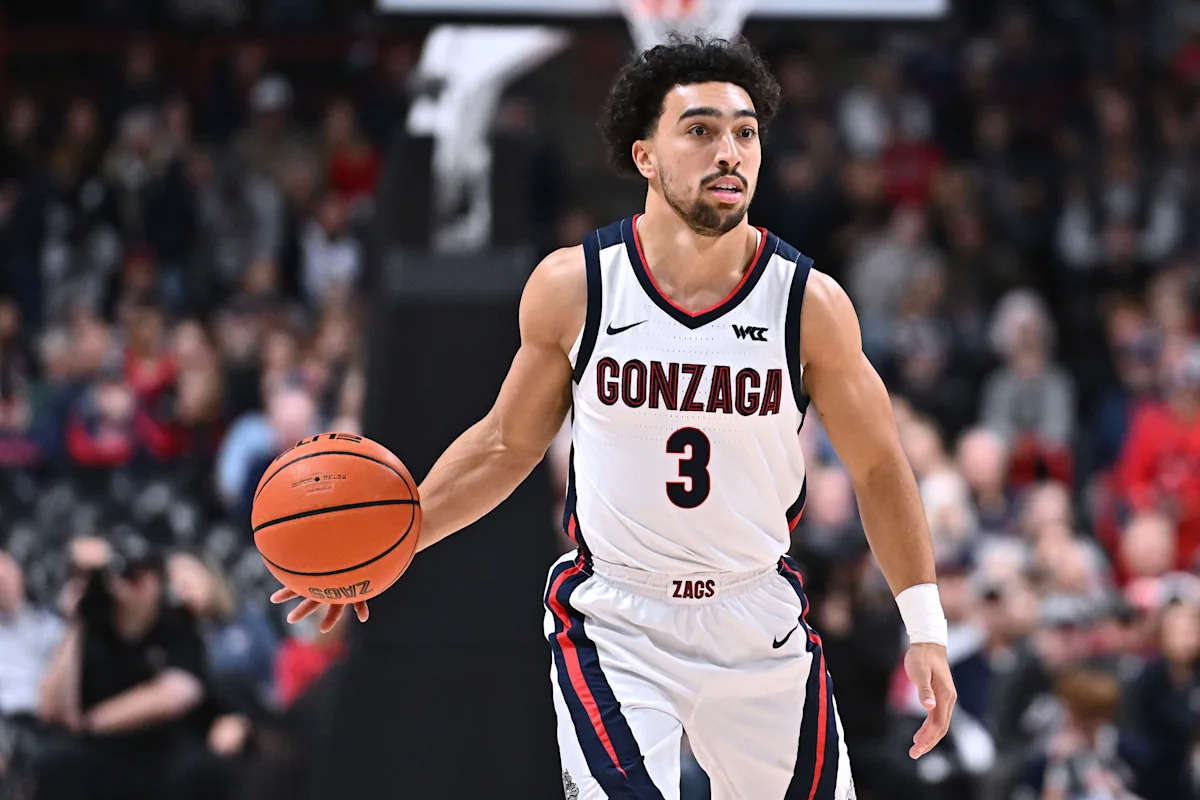
Gonzaga opened West Coast Conference play Sunday night in Malibu by blowing the game open early and never letting it narrow. The 96-56 win over Pepperdine moves the Zags to 13-1 on the season and extended one of the longest win streaks in college basketball to 50-0 as Pepperdine kept searching for its first win over the Zags since 2002. The night nudged Gonzaga up to No. 4 in KenPom and pushed its defensive efficiency to second nationally, trailing only Michigan. It was a one-sided affair from start to finish, despite some ugly, ugly performances by a few Zags looking to get back on track and some stellar performances from a few now hitting their stride.
Pepperdine spent most of the night searching for a workable offense while failing to even theorize about a workable defense. The Waves shot 34% from the field (26% from deep), struggled to find space inside, and were outscored 50-18 in the paint despite Graham Ike and Braden Huff combining for just 23 of Gonzaga’s total points.
Advertisement
There were still moments that wandered and stretches that lacked polish, and games this lopsided tend to blur rather than sharpen evaluation, but Gonzaga’s night in Malibu left far more to build on than to pick apart.
Defense Shines
Pepperdine struggled to create space against Gonzaga throughout the night, with most possessions ending in rushed decisions or heavily contested looks. Pepperdine’s Aaron Clark and Styles Phipps combined to go 3-22 on the night while the Waves finished 5-19 from three, a credit once again to the Emmanuel Innocenti / Jalen Warley combo that’s been locking everyone down from the perimeter. Similarly, turnovers piled up often enough to flip the floor, with Gonzaga converting 14 of them into 24 points. Much of the disruption came from activity around the rim, where Tyon Grant-Foster recorded a team-high four blocks, including a couple of recoveries that erased shots late in the possession after initial breakdowns. Throughout the game, there were moments where help arrived a beat late, particularly with Gonzaga cycling through unfamiliar lineups, but Pepperdine rarely capitalized, often settling for difficult jumpers rather than turning those openings into sustained offense. After going 4-10 from three in the first half, the Zags held the Waves to just 1-9 in the second.
Braeden Smith Starts, Scores, and Distributes
Braeden Smith was simply stellar against Pepperdine. Back in the starting lineup for the first time since the Arizona State game, he poured in 15 points in just 18 minutes, shooting 6-8 from the field while still stacking eight assists, grabbing five rebounds, and committing just one turnover. He opened the second half by scoring eight points in the first two and a half minutes, picking up right where he left off after dropping 22 against Oregon last week. Early in the season, Smith seemed a bit tentative moving the ball, managing pace, and trying to mirror the steadiness Ryan Nembhard brought to the position last year. Of late, however, he’s been playing his own game, the kind of game that made him Patriot League Player of the Year at Colgate. He’s been calling his own number without hesitation, turning the corner when lanes appeared, and forcing defenders to react to him rather than wait him out. That assertiveness pulled help higher, loosened coverages, and created space before the defense had a chance to settle, a dynamic that shifted the shape of Gonzaga’s offense possession by possession.
Super Mario Takes an Early Exit
As good as Braeden Smith was, Mario Saint Supery was… not. The Spanish freshman had one of those nights where nothing goes right. He still finished with four assists and four boards, but he also finished 1-7 from the field in 18 minutes off the bench, committed four turnovers, and somehow fouled out with roughly six minutes remaining in the second half. For reference, the new haircut probably cracked the top seven Mario Problems of the evening, but no higher. A week after seeing his name pop up on early 2026 draft boards, his stat line against Pepperdine is one he’d probably prefer to leave back in 2025.
Advertisement
All that being said, Mario is going to be fine. Saint Supery has been dealing with a rough flu bug, played only 13 minutes against Oregon last week, and is still feeling his way through the speed and physicality of college basketball in the U.S., a learning curve that rarely looks clean in the middle. The fouls came fast, a couple were extremely questionable, the turnovers snowballed, and the rhythm never arrived. It happens, especially to dudes who play with the kind of edge and urgency that Saint Supery has become known for. And Mario will bounce back.
Mario’s burst, creativity, and comfort playing through uptempo chaos still fit naturally into Gonzaga’s offense, even if the timing has gone sideways for the moment. If anything, we now have a Super Mario bounce-back game to look forward to. And I predict it’ll happen sooner rather than later.
“Quiet” Night
It was a quiet night from Gonzaga’s frontcourt, at least relative to the standard this group has set. The highest-scoring and most efficient big-man tandem in the country combined for 23 of Gonzaga’s 96 points, with Braden Huff finishing with 10 in 27 minutes and seeing his streak of 20-point games come to an end. Despite the decreased scoring load, the efficiency never wavered. Huff went 5-7 from the field and added four assists, and the usage felt deliberate, with Mark Few leaning into extended stretches of Huff going solo at the five while Graham Ike spent more time on the bench than he has been of late.
Ike also still filled the box score, posting another double-double with 13 points and 10 rebounds in 23 minutes while committing just a single foul. Even on a night where touches were limited and roles shifted, Gonzaga’s frontcourt stayed productive, efficient, and stable, which is about as much as you can ask from a group that has already carried such a heavy load this season.
Towards the middle of the second half, Ismaila Diagne got his first extended run of minutes in weeks. He’s still struggling to find the rim offensively, but it’s hard to complain about his seven rebounds (three offensive) in just 8 minutes.
Advertisement
Alive on the Wings
With a quieter scoring night from the bigs, Gonzaga spent the evening seeing where else they could generate some production. Braeden Smith accounted for a lot of it, but the wings also shone against Pepperdine. Davis Fogle continued to turn short runs into real production, finishing with 15 points in just 16 minutes. He went 5-7 from the field, knocked down 2-3 from three, and added two offensive rebounds, again translating limited minutes into outsized output. His approach remains score-first and occasionally skews overly aggressive, but the buckets keep him on the floor. Each appearance looks a little steadier, a little more composed within the offense, a little more patient on defense, and the question surrounding his role feels increasingly tied to roster depth rather than readiness.
Those minutes remain competitive because Tyon Grant-Foster delivered yet another full stat line against the Waves. He led Gonzaga with 18 points, missed just one shot all night, and added four blocks. There were defensive breakdowns and a few headlong drives towards the rim that ended in the muck, but the offensive possessions tended to resolve quickly when Grant-Foster had space to operate. The remaining challenge lies in fitting Grant-Foster’s style into the broader offensive structure while tightening the defensive reads, though Grant-Foster’s athleticism and versatility are impossible to keep on the bench when he’s producing at a high rate.
After a few uneven outings, the Pepperdine game felt like the closest Tyon’s come to channeling his explosiveness and athleticism into the offense instead of asking them to carry it.
Final Thoughts
This was a good win, even if it never felt especially clean. Gonzaga rarely looks fully formed in late December, and this time of year tends to bring uneven stretches no matter who’s on the other side. The larger factor, though, was the opponent. Pepperdine’s offensive limitations made it strangely difficult to look sharp while winning by 40.
Foul trouble and dead-ball stretches pushed Gonzaga into a handful of unfamiliar lineup combinations (Adam Miller playing point guard? Davis Fogle at the four?), rhythm never really settled, and pace came and went in short waves rather than building across long stretches. Coming off a non-conference slate that demanded something close to full attention every night, it also looked like a group carrying some fatigue, both physical and mental, even as the margin kept expanding.
Advertisement
And still, the numbers stacked up. Another blowout, another pile of efficient stat lines, another night where the flaws were visible without ever threatening the outcome. That combination has become familiar. Gonzaga keeps winning big while leaving room for improvement, dominating games that feel loose in real time and then look like bloodbaths when you check the box score. The fact that this team can do that, and still feel unfinished, remains one of the more thrilling parts of where the season sits right now.
The Zags now head to San Diego to take on the Toreros on Tuesday, December 30. Tip-off scheduled for 6:30 PST, coverage provided by KHQ locally and ESPN+ nationally.
