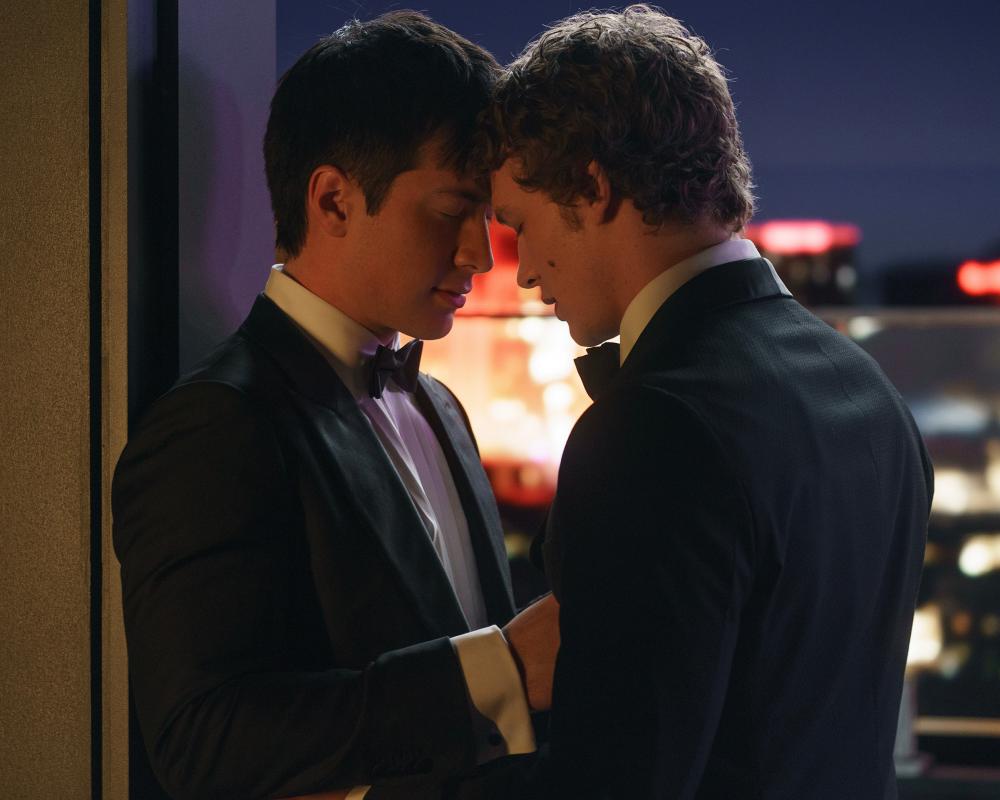
At around the midpoint of the first episode of Heated Rivalry, just after Shane Hollander and Ilya Rozanov – one Canadian, the other Russian, both hockey’s top prospects – have had their first tryst, Hollander sits at the side of his hotel bed and says: “So. You’re not going to tell anyone about this, are you?” Rozanov, lying naked beside him, replies sarcastically: “Me? Yes, Hollander, I’m going to tell everyone.” Hollander reinforces the point: “Because no one can know,” he says. Rozanov utters something under his breath in Russian, then: “Hollander. Look, I’m not going to tell anyone, OK?” Hollander replies: “OK.”
No one can know. If hockey were to have an unofficial slogan, this might be it. Heated Rivalry, the surprise 2025 hit series from Crave and HBO, is layered drama, prompting timely questions about the barriers to acceptance that persist within sport even as they are lowered elsewhere across society. But it may be that hockey’s existential battle with its culture of silence is the show’s deepest target.
Related: Minnesota Wild go all-in with blockbuster trade for Norris winner Quinn Hughes
Hockey culture presents a paradox, simultaneously welcoming yet exclusive. When the NHL launched its Hockey Is For Everyone initiative in 2017, the league was making a point about attracting new fans from groups that did not typically see themselves reflected on the ice, including members of the LGBTQ+ community. It was a savvy business move, if nothing else. “Diverse representation within inclusive environments is proven to advance innovation, creativity, and decision-making – all of which are important to the growth of the sport and our business,” NHL commissioner Gary Bettman wrote in his introduction to the league’s first report on diversity and inclusion in 2022. Inclusion, Bettman wrote, is a “driver for performance … individuals and organizations grow stronger from uniting across differences”. Times were changing, lessons were being learned. Briefly, anyway. The 2022 “annual” report has since been scrubbed from the NHL’s website (it remains available elsewhere). And while the league continues to work on inclusivity initiatives and claims it is attracting more women fans, there has not been another report since.
Just a few months after that diversity report’s release, in January 2023, Ivan Provorov, then a defenseman for the Philadelphia Flyers, refused to wear a Pride-themed jersey during a pre-game warm-up, saying it conflicted with his religious beliefs. The jerseys had been introduced as part of the Hockey Is For Everyone initiative and were typically auctioned afterwards to raise money for local charities. In the weeks that followed, more players refused to wear their team’s Pride jersey. Rather than push back or make the jerseys a requirement like any other aspect of a team’s uniform, the NHL officially walked away from it all, eliminating the jerseys. The whole thing had “just become more of a distraction from really the essence of what the purpose of these nights are,” Bettman said that summer.
In hockey, nobody wants to be a distraction. “[The players told me] it doesn’t matter if you’re gay, or concussed, or you’ve been sexually abused or have mental health issues, none of those are OK because you are a distraction,” Cheryl MacDonald, former co-chair of the western Canadian board of You Can Play, said of her interviews with a handful of gay hockey players in 2019. MacDonald had wondered why more gay players did not choose to come out. “You don’t want to risk it not being OK, because the perception is someone who is just as good at your job but isn’t gay is going to take your spot,” she said at the time. Better to say nothing at all.”
In the penultimate episode of Heated Rivalry, another gay player unexpectedly invites his boyfriend on to the ice to help celebrate a championship win. They kiss in front of tens of thousands of fans and, presumably, millions of viewers at home. It is a public coming out. The show pivots immediately to how this impacts Hollander and Rozanov and offers very little sense of how the kiss was received more broadly, but amid the on-ice embrace, the crowd appears enraptured, not appalled. The TV announcer simply says: “You don’t see that every day.” Well, no. But if we did?
In the same 2019 study, MacDonald also found that once gay players did come out, their teammates generally reacted positively – and the typical homophobic jibes that persist in hockey locker rooms were muted. Moreover, the banter eventually incorporated their orientation, with straight players more respectfully making light of the gay players’ sexuality. “The gay players said the acknowledgement was nice … it seems there is room for consensual humor,” MacDonald noted. Likely, few in the hockey world would find that surprising either; just part of the frustrating paradox at the heart of its culture.
Heated Rivalry’s popularity has prompted plenty of speculation about whether it will attract new fans to hockey and to the NHL. But they are already here – watching, spending, supporting. Playing. And learning, often from a young age, what part of themselves they should keep quiet because, y’know, no one can know. As for the NHL, in December, a spokesperson told the Hollywood Reporter that “there are so many ways to get hooked on hockey and, in the NHL’s 108-year history, this might be the most unique driver for creating new fans. See you at the rink.” The line is cheerful, harmless and, in typical fashion, empty. Even when the conversation is unavoidable, the NHL still has little to say. It seems that for the league, this is not about hockey. It is still just a distraction.
