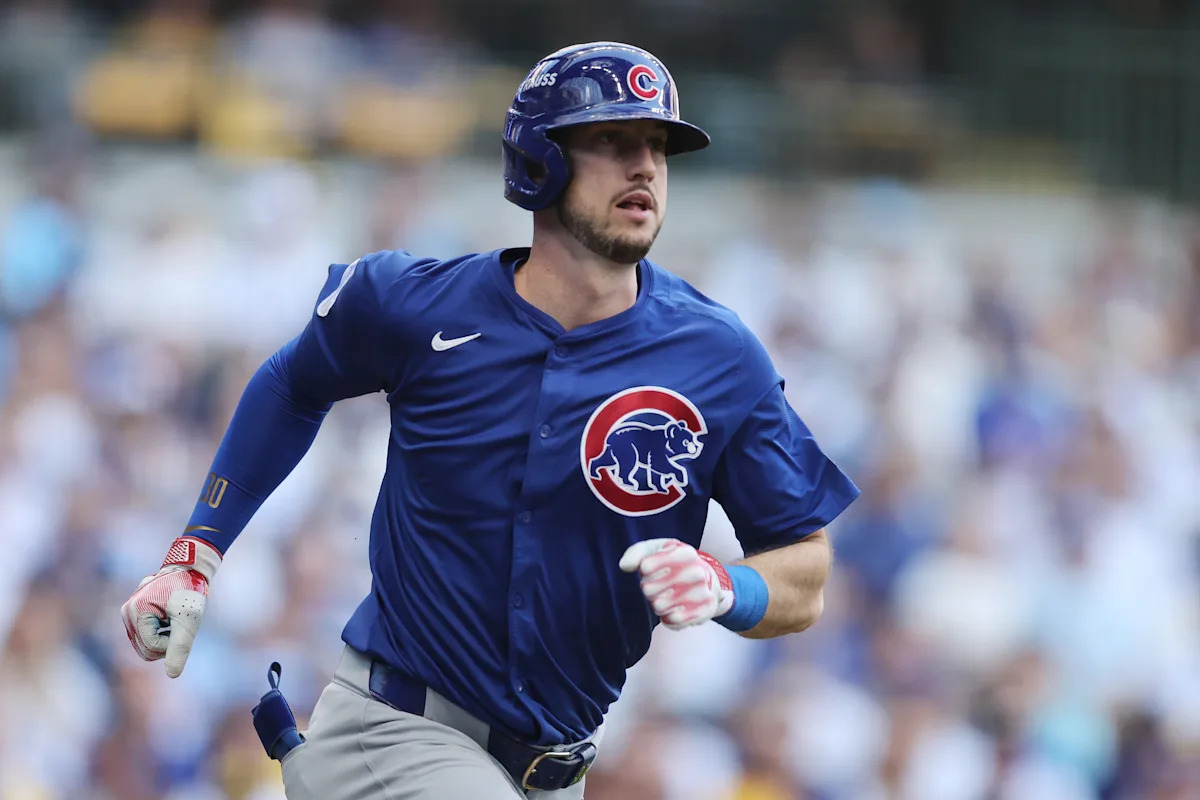
The Los Angeles Dodgers were the two-time defending World Series champions and the most expensive team in MLB history. And then they landed Kyle Tucker.
More specifically, they reportedly got the former Chicago Cubs star to agree to a four-year, $240 million contract, which is effectively the most expensive deal in MLB history on a per-year basis, when taking into account the deferrals in Shohei Ohtani’s $70 million-per-year deal.
Advertisement
It is an outrageous development. The Dodgers needed outfield help, yes, but teams with a record payroll aren’t supposed to go out and grab the most expensive guy on the market on a deal even larger than expected. MLB has tried over the past several years to discourage its biggest spenders from making the game appear even more unfair, and the Dodgers are laughing at them through a megaphone purchased with Ohtani bucks.
How big does this make the Dodgers’ payroll, which was the largest in MLB last season at $416.7 million per Spotrac? It’s now reportedly down to approximately $413.5 million, according to Spotrac.
That might feel counterintuitive because, y’know, $60 million-per-year outfielder. Here’s why that’s the case.
Advertisement
The Dodgers entered this offseason with plenty of room to spend
The Dodgers had an enormous payroll and just added another big contract, but they saw a considerable number of contracts move off the books after 2025. And none of those contracts were for their biggest stars.
Michael Conforto ($17 million), Kirby Yates ($13 million), Chris Taylor ($13 million), Clayton Kershaw ($7.5 million), Kiké Hernández ($6.5 million), Michael Kopech ($5.2 million), Evan Phillips ($6.1 million), Tony Gonsolin ($5.4 million) and Austin Barnes ($3.5 million) made a combined $77.2 million last year and are now off the team via free agency, trades, non-tenders or retirement.
Hernández was the only one of those players who made a significant contribution to the Dodgers’ World Series run. Using Baseball Reference’s calculation of Wins Above Replacement, that nine-man group combined for 0.3 WAR in the regular season.
Advertisement
The Dodgers had also been spending modestly — by their standards — until the Tucker deal. Since the start of free agency, they had signed three players to major-league contracts: closer Edwin Díaz (three years, $69 million), infielder/World Series hero Miguel Rojas (one year, $5.5 million) and infielder Andy Ibañez (one year, $1.2 million).
Los Angeles was on track for a less expensive team in 2026 prior to the Tucker deal. Then the team opted to go moderately more expensive in order to add Yahoo Sports’ No. 1 MLB free agent.
The Dodgers have more big contracts than any team in baseball
Let’s go ahead and list them. Here is every Dodgers contract larger than $50 million total, without factoring in deferrals:
Advertisement
-
Shohei Ohtani: 10 years, $700 million
-
Mookie Betts: 12 years, $365 million
-
Yoshinobu Yamamoto: 12 years, $325 million
-
Kyle Tucker: four years, $240 million
-
Blake Snell: five years, $182 million
-
Freddie Freeman: six years, $162 million
-
Will Smith: 10 years, $140 million
-
Tyler Glasnow: five years, $136.5 million
-
Tommy Edman: five years, $74 million
-
Tanner Scott: four years, $72 million
-
Edwin Díaz: three years, $69 million
-
Teoscar Hernández: three years, $66 million
Every contract except for Betts and Freeman has been signed since the end of the 2023 season. As for deferred money, let’s get into that.
How much deferred money do the Dodgers have?
Here is that same list, with the money the Dodgers will reportedly be paying after those contracts are over.
-
Shohei Ohtani: $680 million
-
Mookie Betts: $115 million
-
Freddie Freeman: $57 million
-
Tanner Scott: $21 million
-
Edwin Díaz: $13.5 million
-
Teoscar Hernández: $23.5 million
That adds up to $1.081 billion, and that’s not every Dodgers contract on the books. Obviously, Ohtani is doing most of the work there.
By Spotrac’s calculations, the Dodgers are now on the hook for $2.11 billion in guaranteed salary when including deferrals.
[Get more Dodgers news: L.A. team feed]
We should also make a quick note about deferrals. The popular thinking is that teams that sign players to contracts with deferred money are kicking the can down the line and will someday have to come up with an enormous amount of cash. After all, we celebrate Bobby Bonilla Day for a reason.
Kyle Tucker is going to cost the Dodgers a lot of money. They can afford it. (Photo by Michael Reaves/Getty Images)
(Michael Reaves via Getty Images)
However, the reality is more complicated than that. Under collective bargaining agreement rules, teams do have to put up “deferred money,” but that cash goes to escrow accounts instead of the players. Once it’s in those accounts, teams are under strict regulations for what they can do with it, but they are allowed to invest the cash in low-risk vehicles.
Advertisement
So that $680 million the Dodgers will owe Ohtani after 2033? They’ll have already put that money up while enjoying interest and modest returns. That’s not nothing when the total sum working for you is more than $1 billion.
How much luxury tax will the Dodgers have to pay?
Remember that $413 million mark above? It’s not the best representation of what the 2026 roster, as currently constructed, will cost the Dodgers.
Last year, the Dodgers’ CBT number was $417 million. For that, the Dodgers had to pay a $169 million luxury tax bill, which was larger than the 2025 payrolls of 12 MLB teams. In total, the Dodgers paid $586.7 million for their championship roster. For 2026, Spotrac projects that tax bill to go down to $161.9 million, making the total cost around $610 million.
Advertisement
What’s ridiculous is their tax bill would have been around $99.1 million without the Tucker deal, which is rated at $57.1 million per year in CBT calculations due to the deferred money. Because overages are taxed at 110% at the Dodgers’ level, Tucker alone will make the Dodgers responsible for $62.8 million in tax money in 2026.
So the Dodgers are basically paying $119.9 million to put Tucker in right field. Which is more than the current CBT payrolls of the Cleveland Guardians, Tampa Bay Rays and Miami Marlins.
This is happening because of Shohei Ohtani
You might be wondering, how did we get here? How is there a team making the George Steinbrenner Yankees look like a scrappy underdog?
Advertisement
It’s Ohtani.
The Dodgers have a lot going for them structurally. They are the dominant team in MLB’s second-largest market. They have the largest stadium by capacity in MLB. They have the largest TV deal in the sport. They have a fan base with considerable spending power.
That’s why the Dodgers were spending big and winning 100 games per season under their current ownership group. But this level of financial bombardment, which has now yielded back-to-back titles?
It’s Ohtani.
It is not hyperbole to say that Ohtani’s contract is the biggest bargain in all of sports, especially when considering the deferrals. The Dodgers don’t make much money from his jersey sales or the broadcast of their games in Japan (MLB divides both of those revenue streams among the 30 teams, so the Cincinnati Reds will make as much money from an Ohtani jersey as the Dodgers), but Ohtani has given them the one international star in baseball, combined with a premium brand and seemingly inevitable winning.
Advertisement
In the way some call Harvard a hedge fund with a university attached, the Dodgers are a Japanese advertising firm with a baseball team attached. The team has so much cultural cachet in Japan it can name its price for on-field advertisements and will be enjoying popularity in the world’s third-richest country for generations.
Combine that with the usual outlay of winning a World Series, which the Dodgers have accomplished twice in as many seasons with Ohtani, and there’s nothing comparable in the landscape of MLB.
Is a salary cap coming to MLB?
The Tucker contract is going to make a lot of fans angry. It’s going to make some team owners angry. And so, we come to the salary cap question.
Advertisement
With MLB’s CBA up after 2026, many observers believe a labor stoppage is inevitable. MLB has already made it clear it wants a salary cap, which has been a non-starter with the MLB Players Association for decades.
The Dodgers’ dominance has been treated as an endorsement for the salary cap to level the playing field of an unfair game. However, MLB quite likes it when the Dodgers are good. And the Yankees. And all of its biggest teams. The league has seen great ratings over the past two years, and the Dodgers are a major reason for that.
It’s fun for some to imagine the Dodgers being forced to sell their team off if MLB gets its way with a salary cap. However, the reality will probably be less than satisfying for the biggest Dodgers haters, at least in the short term. MLB commissioner Rob Manfred wants to keep labor costs down, but he also wants the Dodgers to keep winning, to a reasonable degree.
So what does the Tucker deal mean for the bigger picture? Maybe not much, especially when he only brought their payroll up to 2025 levels. And it’s hard to imagine the Dodgers haven’t already thought up some plans, depending on how the CBA negotiations go.
