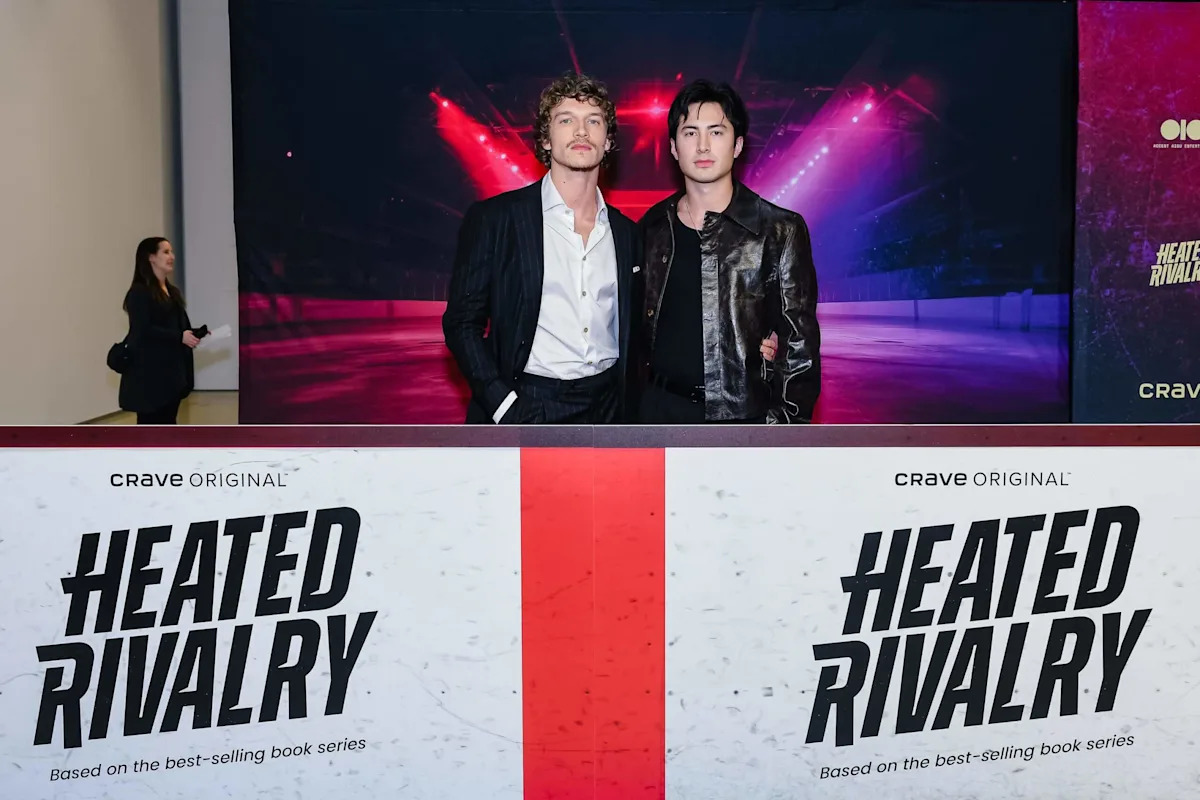
When Harrison Browne landed a minor role in the Canadian TV show “Heated Rivalry,” he was excited to take part in a project that would get people talking. A show about gay hockey players, “Heated Rivalry” tackles a complex topic in the fabric of male hockey culture, which, as Browne sees it, is due for a “reckoning.”
But even Browne, now working as an actor after being the first pro hockey player to come out as transgender, couldn’t fathom how popular the show would become.
Advertisement
“I don’t think anybody expected this,” Browne told The Athletic. “It’s a pop culture phenomenon right now.”
“Heated Rivalry,” shown on HBO Max and Canadian television streaming platform Crave, follows two fictional male hockey players, Japanese-Canadian Shane Hollander (played by Hudson Williams) and Russian Ilya Rozanov (played by Connor Storrie), who develop a secret romance while fostering a public rivalry throughout their hockey careers. Browne has a cameo appearance in the fourth episode as Rozanov’s teammate. In real life, Browne underwent a medical transition after playing three seasons in the National Women’s Hockey League.
Little by little, the show has entered mainstream hockey culture. It raises questions and criticisms about the sport’s failures when it comes to the inclusion of the LGBTQ+ community. But could the rising popularity of “Heated Rivalry” lead to a change in male hockey culture? It has at least opened the door for conversations to be had.
Advertisement
Montrealer Jacob Tierney, a writer and director known for his work on the popular Canadian program “Letterkenny” and its spinoff series “Shoresy,” adapted the first two books for the television series. There’s limited hockey action in the show, which focuses more on the relationship, banter and love-making between its main characters.
“This show is for the girls, the gays and theys,” former pro hockey goalie and LGBTQ+ advocate Brock McGillis said.
“Heated Rivalry” is now Crave’s most successful original debut series of all time, and it has already been renewed for a second season. Fans clamored for Emmy consideration, but the program is ineligible because it is fully financed in Canada. (Crave is owned by Canadian telecommunications conglomerate Bell Canada.) Two of the series’ episodes are ranked among IMDb’s highest-rated television episodes of all time, surpassing installments from shows such as “Game of Thrones,” “Better Call Saul” and “The Mandalorian,” among others. Mega pop star Miley Cyrus wants to make music for the show’s next season.
Although current NHL players have been quiet about the show, the Boston Bruins referenced the show in a social media post during a game against the Montreal Canadiens — the main characters play for fictional Boston- and Montreal-based teams in the show. The Canadiens played a trailer for the show during the intermission of their Pride Night game in early December.
Advertisement
Fans are wearing shirts referencing the show at NHL games. And in an interview with the Hollywood Reporter published late last month, an NHL representative called the show “the most unique driver for creating new fans.”
Actor François Arnaud, who plays Scott Hunter, a veteran hockey player at the end of his career who pursues a relationship with a male barista, was interviewed by RDS during an intermission of the Canadiens Pride Night game.
“If you asked me what the demographic was going to be for this show, I wasn’t even sure,” said Arnaud, who spoke to Variety on the red carpet of this year’s Critics Choice Awards. “I was like, definitely people like women who love the books. Maybe LGBT people. But the fact that hockey players are watching the show? The fact that the failing NHL is using us to bring people in?
“I just hope that it brings on actual change in the league and that it has a real influence on how they treat their own players and the possibility of that. Because it’s not, historically, the most open association.”
Despite the limited on-ice hockey scenes, the sport is clearly the show’s backdrop. It showcases dressing room dynamics among players, the pressures of being a professional hockey player, and elements of their high-profile lifestyles, all as multiple characters navigate same-sex relationships and the sport’s complicated history with their acceptance — mirroring elements of real life.
Advertisement
The NHL banned Pride Night jerseys and rainbow-colored tape in October 2023, months after some players opted out of their team’s Pride Night festivities. After then-Arizona Coyotes defenseman Travis Dermott defied the ban by covering his stick in rainbow tape during a game, the NHL reversed its tape ban. But special jerseys still can’t be worn in commemoration of specialty nights, including Pride Night.
There have never been any openly gay players in the NHL. Bakersfield Condors defenseman Luke Prokop, who came out as gay in July 2021, was under contract with the NHL’s Nashville Predators until 2024-25.
The Edmonton native said his experiences with every pro hockey team he’s played with have been “positive,” with teams being “accommodating” and “welcoming” at every turn. But Prokop is mindful of when to use his platform and status to call out homophobia, while hoping players and teams can see him for the hockey player he is without ruffling “too many feathers.”
“I want to make sure I’m doing everything in my power to make sure that I get, hopefully, an opportunity to get in the NHL one day,” Prokop said. “With hockey and the LGBTQ community, it’s tricky. You don’t want to do too much to draw attention to it, where some teams might say, ‘Oh, we view that as a distraction. So, we don’t want them on our team.’ There’s been instances where that’s come up.”
Advertisement
What doesn’t help players such as Prokop is hockey’s conservative nature, which restricts individuality in the name of conformity. McGillis regularly speaks to high school students across Canada about how to make hockey environments more inclusive spaces.
“They can’t even share things about themselves that they like or don’t like without fear of being completely ripped apart and chirped by their teammates,” McGillis said. “So, if the straight, White bro who is assumed to make up 90 to 95 percent of the demo has to adhere to these extreme norms, what hope is there for a queer person?”
Ironically, the sport’s culture of sameness could help NHL teams when it comes to accommodating openly gay teammates if it ever happens, said McGillis.
“I think the insularity of the culture leads to this notion of family, more so than probably ever for any other sport,” McGillis said. “And that family aspect is: You’re going to fight for your family. And once somebody is embedded in that family, they’re not going to be pushed out.”
It’s not as if players in the NHL have never expressed support before for LGBTQ+ issues, or for people in the sport.
Advertisement
NHL player agent Bayne Pettinger came out in 2020 and was immediately greeted by warm texts of support from two NHL superstars: Connor McDavid and Sidney Crosby. McDavid said it was “disappointing” to see the NHL ban Pride Night-themed jerseys and tape and had no problem donning a jersey or rocking Pride tape on his stick blade. Organizations such as “You Can Play,” co-founded by former NHL executive Brian Burke following the death of his son, Brendan, who came out as gay, have also worked to end homophobia in sports.
However, the NHL still isn’t considered a particularly friendly space for the LGBTQ+ community, unlike the Professional Women’s Hockey League, which features many LGBTQ+ players and fans.
“Whether you’re lesbian, bisexual, transgender, non-binary,” Browne said. “We’re seeing those (people) within those spaces. So, I think it allows people to feel more safe to express themselves and know that they’re not going to be excluded.
“I think that a show like ‘Heated Rivalry’ is really putting into question masculinity, and toxic masculinity is quite pervasive in hockey,” Browne said. “I think it’s just creating new avenues for visibility of somebody that you might not think stereotypically represents that community. And just knowing that somebody in the locker room can identify a certain way … I just think it sends a different message on what masculinity can be.”
Advertisement
The show’s popularity has presented the NHL with an opportunity to attract new fans, which the league itself has recognized. The onus is now on the NHL to retain them.
“Because if they don’t feel welcomed and safe,” McGillis said, “why would they stay?”
This article originally appeared in The Athletic.
NHL, Sports Business, Culture, Women’s Hockey
2026 The Athletic Media Company
