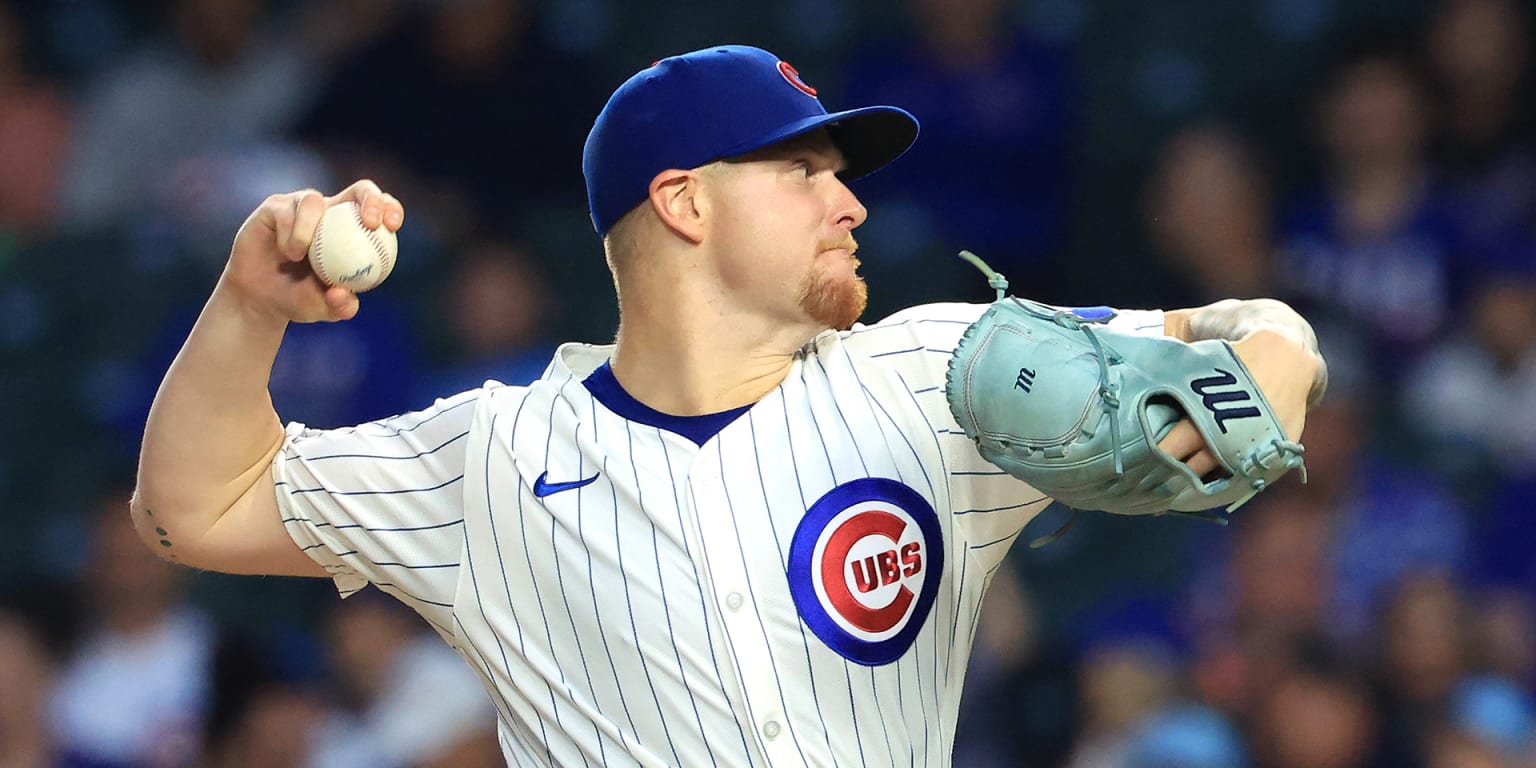
If Horton shows improvement and things continue to break right, he could find himself contending for the 2026 NL Cy Young Award. That’s a high bar — and with starters like Paul Skenes, Cristopher Sánchez and Yoshinobu Yamamoto in the NL, the competition will be fierce — but Horton’s 1.03 ERA across his 12 starts after the All-Star break show he at least has a chance.
Here are three improvements Horton could make in 2026 to become a Cy Young contender.
1) Get more whiffs on his four-seam fastball
Elite pitchers are able to miss bats with just about any offering in their repertoire. While Horton did admirably with most of his arsenal as a rookie, he struggled to get swings and misses against his most-used pitch.
Horton threw his four-seam fastball more than half the time in 2025, but the pitch had just a 14.7% whiff rate. That ranked 138th among the 152 hurlers to throw the pitch at least 500 times in 2025. While Horton still had decent results on the heater (including a .258 batting average and .355 slugging percentage), Statcast quality-of-contact metrics indicate he benefited from some batted-ball luck. Horton’s expected batting average on his four-seamer was .286, with a .481 expected slugging percentage.
How could Horton get the most out of his fastball? Giving it some horizontal break might help: The pitch had just 0.1 inches of arm-side run in 2025, toward the bottom of qualifying pitchers in terms of horizontal movement. Horton’s heater already has plus velocity at an average of 95.7 mph, so ramping up its movement could go a long way.
Being able to get more K’s in general would be huge for Horton. The right-hander had only 97 strikeouts in 118 innings of work last season, so he’ll need a much higher strikeout rate to compete for a potential Cy Young. Aside from the shortened 2020 campaign, the last NL Cy Young winner to finish with fewer than 200 strikeouts was Brandon Webb with 178 in 2006.
2) Keep the ball on the ground
“Pulled airballs” have been crucial to the success of many of MLB’s top hitters, including three star Cubs in 2025. Consequently, inducing ground balls and/or less pulled contact is essential — and that’s something Horton can work on.
By no means was Horton’s 18.3% pulled-air rate as a rookie a huge red flag, but he was a shade worse than the MLB average (16.7%). That didn’t come from giving up a ton of either pulled contact or airballs (fly balls, line drives and popups) but rather from allowing each at slightly above-average rates. Horton did give up fly balls at a much higher rate (29.0%) than line drives (20.7%), even though both occur at roughly the same rate across MLB.
Not all pitchers need a minuscule pulled-air rate to succeed — Skenes, the NL Cy Young honoree in 2025, posted a 17.7% pulled-air rate — but Horton certainly has room for improvement. All five of his principal pitches had an average launch angle of 8 degrees or higher, with his sweeper (24 degrees) the only one above 15. If Horton can find a way to induce a few more soft ground balls rather than potentially dangerous flies, he can get hitters out a lot more efficiently.
3) Continue to hone his secondary pitches
While his four-seam fastball and especially his sinker (.400 BA, .733 SLG) were hit a bit harder in 2025, Horton found tremendous success with his changeup, sweeper and curveball. If he can take those secondary offerings to the next level in 2026, it could go a long way in increasing his Cy Young chances.
Opposing right-handed hitters batted just .184 (38-for-206) against Horton in 2025, largely thanks to a sweeper he deployed primarily against righties. Horton’s second-most used pitch, the breaking ball had a .171 batting average and a .343 slugging percentage. With a 37.6% whiff rate, it was hard to touch, but hitters did manage to square it up sometimes: Horton allowed five home runs on his sweeper, the most he gave up on any pitch type.
Against lefties, Horton’s main secondary offering was his changeup, one of the nastiest in MLB and the best tool in his arsenal. Opponents went just 6-for-52 (.115) against the pitch with only two extra-base hits, both doubles. Horton’s changeup had a remarkable 47.8% whiff rate, the third highest among changeups (min. 200 pitches) in 2025.
Horton’s curveball also baffled lefties (.207 BA, .273 SLG), although its 24.7% whiff rate didn’t quite measure up to his other two offerings. If Horton can get a few more swings and misses on his curve, keep his sweepers from leaving the yard and run it back with his elite changeup, he’ll have all the weapons to complement his fastball in 2026.
