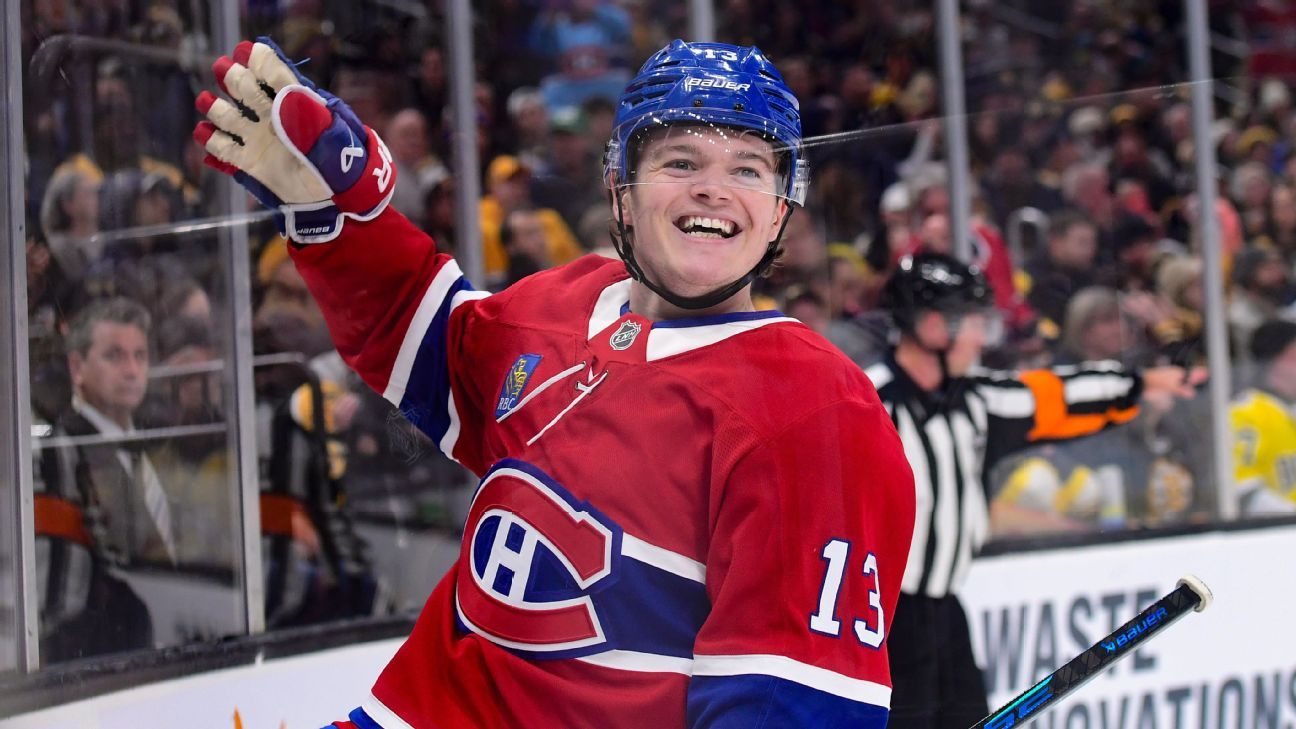
The topic of “Olympic snubs” will continue until we get to Milan for the 2026 Winter Olympics and the puck is dropped. But right now, many are scoreboard watching, analyzing the top performers among those not picked, as if to build a case why they should have been selected to their national team.
Elite athletes are human. But they are also “built different.” How they process the highs and lows of their careers is different from me and you. Part of it is because they have so many peaks and valleys, but it’s also because they are constantly under a microscope. That can make or break you.
I wanted to unpack the concept of the “snub.” Is it motivation? Does it wilt?
Coming into Saturday, since the Team USA Olympic announcement was made (Jan 2), Cole Caufield is tied for second among American players in goals with 10 (all statistics here are through Jan. 30). Alex DeBrincat and Charlie Coyle are one behind with nine apiece. Matty Beniers has eight. A lot has been said about Jason Robertson, whose 30 goals this season are tied with fellow snubs DeBrincat and Caulfield for third in the NHL and trail two Canadian Olympians Connor McDavid and Nathan MacKinnon. But since the Olympic announcement, Robertson has netted six goals and 15 points in 15 games — ninth among Americans in points in that span.
Since Canada announced its roster, Mark Scheifele is fourth in points among Canadians with 37. (McDavid, MacKinnon and Celebrini, the three Hart Trophy finalist favorites, are top three.) Evan Bouchard is tops among Canadian defensemen in points (22, fourth overall) and goals (eight, 9th overall). Zach Hyman leads with 11 goals. Jared McCann and Travis Konecny have nine (T-4th). Scheifele and Steven Stamkos have eight. Connor Bedard has three goals and eight points in 11 games since not making the cut.
I dug deeper. How do these big announcements affect athletes? I asked that question to world-renowned sports psychologist Dr. Alicia Naser, who has worked with several NHL players and professional athletes throughout her career.
“An omission like this almost always lands harder than players let on,” Naser said. “At the elite level, selection isn’t just about ice time or accolades; it’s about identity. For many NHL players, representing their country is woven into how they measure their worth, progress and legitimacy among peers. When that opportunity is taken away, even temporarily, it can trigger a quiet but powerful psychological response: ‘What does this say about me?’
“From a behavioral science perspective, this is a classic threat to self-concept. The brain interprets exclusion, especially public exclusion, as a form of social rejection. That can initially produce frustration, resentment, or doubt, even in highly resilient athletes. What’s important is that these emotions aren’t signs of weakness; they’re a natural human response to perceived loss of status. The difference at the NHL level isn’t whether players feel it, it’s how quickly they can regulate it and redirect their attention back to controllable behaviors on the ice.”
So what motivates the player after the announcement and they aren’t on the team? Are they salty? Are they looking to prove a point? Is there even a sense of relief involved?
“Interestingly, when we see players climb into the top 10 in scoring after an omission, it’s rarely because they’re playing angry,” Naser said. “It’s usually because the external noise is stripped away.
“There’s no Olympic preparation, no role ambiguity, no divided attention, just NHL games and execution. Combine that with a renewed clarity of purpose, and performance often sharpens. It’s difficult to say any one player’s motivation because each human experience is so unique. Sure, some players may play harder as a form of revenge because they’re ‘salty’ … others don’t chase revenge, they double down on precision, timing and consistency. It’s player and personality specific.”
Naser also noted that elite performance, especially in the NHL, is not sustainable when fueled by bitterness.
“In reality, sustained excellence comes from emotional regulation, not emotional intensity. Short bursts of anger might spike effort, but they rarely improve decision-making, anticipation, or scoring touch,” Naser said.
Jump ahead:
Games of the week
What I loved this weekend
Hart Trophy candidates
Social post of the week
Stick taps

Biggest games of the week
The team I’m watching most this week is the New York Islanders.
They just came off a season sweep of the rival Rangers (remember when Matthew Schaefer said they’d never lose to the Blueshirts? Well …)
The Islanders are third in the Metro and meet the Washington Capitals on Monday, Pittsburgh Penguins on Tuesday and New Jersey Devils, who recently sent Ondrej Palat to the Isles, on Thursday before the Olympic break.
These three Metro Division matchups can help the Islanders pad points before Milan.
What I loved this weekend
GOATS meeting GOATS. Alex Ovechkin took his sons to a Lakers game and traded jerseys with LeBron James.
ALL-TIME LINKUP 🐐
Alexander Ovechkin and LeBron James after Lakers-Wizards 🔥#ALLCAPS | #LakerNation pic.twitter.com/J4U4fZQRFg
— Stadium Live (@StadiumLiveApp) January 31, 2026
Ovi also lent Luka Doncic a hand during the game.
NHL star Alex Ovechkin had Luka Dončić’s back when he was going out of bounds 😅
37p, 11r, and 13a for Luka in LAL’s road W! pic.twitter.com/ZJji8eEdYg
— NBA (@NBA) January 31, 2026
Hart Trophy candidates if the season ended today
No secret here, it has been a three-headed Hart Hydra that has been all but locked in.
McDavid leads the Art Ross race with 94 points. He has nine points in his past five games, including a five-point performance Jan. 24 against Washington.
MacKinnon has 91 points and he has already built enough padding that he will contend with McDavid for the rest of the season.
Macklin Celebrini has 79 … wait a second, he’s in fourth now. A new challenger has emerged!
Nikita Kucherov tornado-kicked his way into the top three in points! Sixteen points in his past six games! He might push the kid out of this list next week!
It’s still Celebrini as the third finalist by a hair due to season-long performance, but Kucherov is making a compelling case and coming in hot.
Social media post of the weekend
During the “snowmageddon” that recently hit the Northeast, we got another installment of “hockey players as regular people giving weather reports.” This time, it was Rochester Americans goalie Devon Levi, aka “Rochester resident.”
Here’s what Rochester resident Devon Levi had to say on @News_8 about the storm. pic.twitter.com/MAKSsQvkJX
— Let’s Go Amerks! (@LGA585) January 26, 2026
The Amerks even announced him as such at their next game.
Devon Levi was announced as Rochester resident. pic.twitter.com/WzQTyqbby4
— Let’s Go Amerks! (@LGA585) January 29, 2026
Levi now joins a wonderful list that includes Roberto Luongo and Jarome Iginla
Stick taps
Brandon Bussi has been tearing it up in his first season in the NHL, setting rookie records, but it’s too bad that, because of his age, he’s ineligible for the Calder Trophy because he’d be giving Matthew Schaefer a run for his money. Twenty-five starts, 21 wins, one shutout, .906 save percentage.
He is also very public about causes he supports, particularly on his goalie mask.
Bussi has some cool artwork on his mask, including a jigsaw puzzle piece motif, a tribute to his younger brother Dylan, who is autistic. Rainbow colored butterflies also envelop the mask, another symbol connected with autism. He unveiled the mask design in November
Hurricanes goalie Brandon Bussi has a new mask with a tribute to autism awareness.
Painted by @daveartofficial pic.twitter.com/p7yzxj7j5Y
— Jesse Granger (@JesseGranger_) November 25, 2025
Bussi has been no stranger to Autism awareness, going back to his college hockey days.
Autism is something very near and dear to my family and me, and I applaud Brandon for his show of support and care. Good vibes, Bus Stop!
