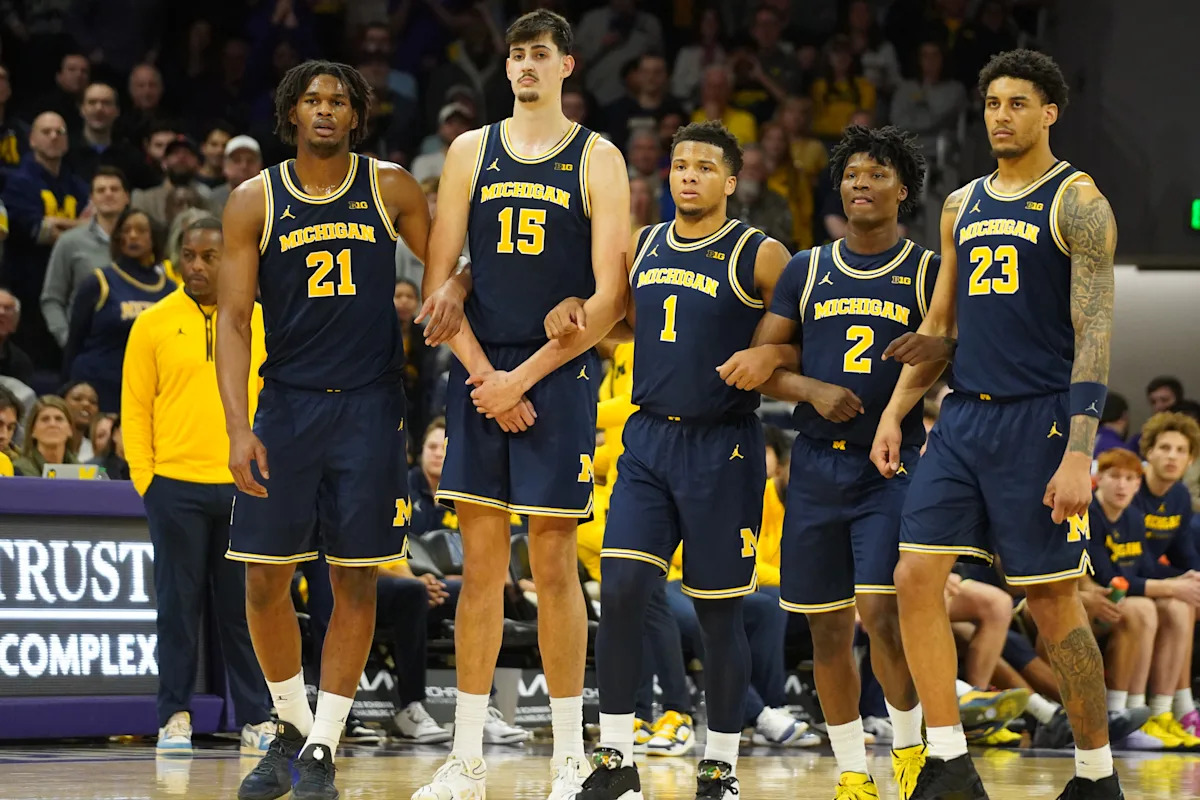
As we draw closer to the month of March, the Michigan men’s basketball team is in the final stretch of what’s been arguably the best season in program history. Even after a loss against the Duke Blue Devils on Saturday, the Wolverines rebounded with a win over Minnesota on Tuesday night – putting them at 26-2 overall and at No. 3 in the AP Poll.
Dusty May has had his squad clicking on all cylinders all season, rolling by even some of its strongest opponents with relative ease. Currently, the Wolverines are averaging a whopping 23.8-point margin of victory and have topped 100 points in eight games this year.
Advertisement
If you’ve been following Michigan’s men’s basketball this century, you’d be no stranger to teams being dominant in the Big Ten and making runs in the NCAA Tournament. This team very much has aspirations to do the same, but what fans might not realize is how much better this year’s iteration of the Wolverines is from some of the other “great” teams Michigan has put on the floor recently.
Today, we’ll take a look back at a few of them and see how they stack up with one another.
2024-25 (27-10, made Sweet Sixteen)
The Wolverines roared back to prominence in Year 1 under Dusty May, being well ahead of the program rebuild schedule. Michigan ended up winning the Big Ten Tournament and made it into the second weekend of the NCAA Tournament before losing to Final Four-bound Auburn Tigers in the Sweet Sixteen.
Advertisement
Much like this year’s team, Michigan was led by big men in Danny Wolf and Vlad Goldin. Trey Donaldson led the backcourt, but the group lacked the depth and perimeter shooting that this year’s team has. In 2024-25, Michigan shot 33.2 percent from three-point range on 24.2 attempts, while this year’s team is shooting 36.1 percent on 26.0 attempts per game from deep thanks to further development from L.J. Cason and the additions of Trey McKenney and Elliott Cadeau. Both teams were strong defensively, but this year’s group has the extra offensive punch and bench depth last year’s team lacked.
2020-21 (23-5, made Elite Eight)
The COVID season looked to be the outlier in Juwan Howard’s tenure, as the Wolverines won the Big Ten regular season title before losing in the Elite Eight to UCLA. It compares to this year’s team in a few ways, but both teams were notably deep with guys like Chaundee Brown, Brandon Johns and Austin Davis giving meaningful minutes off the bench. Furthermore, this team had a star freshman in the paint with Hunter Dickinson, logging 14.1 points and 7.4 rebounds per game.
The 2020-21 team was defensively dominant, holding opponents to 65.1 points per game and it was loaded with three-point shooting (38.1 percent from deep), but was perhaps a bit one-dimensional in its offensive attack. If the shots weren’t falling, other scoring options were slim, while the 2025-26 team is able to attack the interior (with Aday Mara, Morez Johnson Jr. and Yaxel Lendeborg) in addition to catching fire from deep.
Advertisement
2018-19 (30-7, made Sweet Sixteen)
Like the many John Beilein teams we’re about to look at, the 2018-19 team was suffocating on the defensive end while not being all that prolific offensively. This was the year Jordan Poole and Ignas Brazdeikis led the way, while the veteran Charles Matthews put together the most productive season of his Michigan tenure. Meanwhile, Jon Teske stepped in admirably as the new starting center in place of Moritz Wagner.
The problem was Teske proved to be the only reliable big man for the Wolverines that season, a big departure from the three-headed monster Michigan currently features. And while the backcourt was top-heavy, it was light on experience, with Brazdeikis, Poole and Zavier Simpson having to shoulder too much of the load. Although it turned out to be a great season, things fizzled out against Texas Tech in the Sweet Sixteen with a season-low 44 points scored. This year’s team features much more depth, shooting, and experience, meaning it’d be hard for it to face a similar fate come tournament time.
2017-18 (33-8, made National Championship)
Thirty-three wins in 2017-18 represents the highest total in program history, and it looks like this year’s team could surpass that number. Once again, Michigan rode its defense and a late-season surge all the way to the National Championship before ultimately being outmatched by a highly-talented Villanova team.
Advertisement
Moritz Wagner was the star here, scoring 14.6 points per game while Charles Matthews, Muhammad-Ali Abdur-Rahkman and Zavier Simpson were impact players as well. Similar to the 2018-19 team, the lack of depth and experience ultimately proved to be weaknesses, something the 2025-26 team has in spades. The team was impressive from the outside (35.7 percent from deep), but was perhaps over-reliant on the three-pointer with limited options for interior scoring.
2013-14 (28-9, made Elite Eight)
Coming off a trip to the National Championship, the Wolverines were still extremely impressive in 2013-14 despite losing Trey Burke, Tim Hardaway Jr. and not having Mitch McGary for most of the season. Nik Stauskas was the man on this team, averaging 17.5 points per game while shooting a blistering 44.2 percent from beyond the arc. Beside him were Glenn Robinson III, Caris LeVert, Derrick Walton Jr. and Jordan Morgan.
Where this team falls short compared to the 2025-26 roster is once again on the interior. With McGary’s lingering back issues causing him to miss so much time, Morgan and Jon Horford shouldered the load. And while the backcourt was highly productive on a nightly basis, it wasn’t enough as the Wolverines bowed out against a talented Kentucky team in the Elite Eight.
Advertisement
2012-13 (31-8, made National Championship)
Perhaps one of the most favorably remembered Michigan teams of all time, Burke led the 2012-13 team all the way to the National Championship before losing in heartbreaking fashion to Louisville. Another strong defensive team under Beilein, the Wolverines held opponents to just 63.8 points per game while boasting the third-best offensive rating in the country that season at 116.1.
This group compares pretty favorably actually to the 2025-26 bunch, with a group of bigs led by McGary and solid guards and depth across the board. Obviously with Burke leading the way, the 2012-13 team is better in the backcourt than this year’s team, and was more prolific shooting the ball from deep (38.5 percent as a team), but this year’s group is a bit better in the paint, particularly on defense.
As you can see with many of Michigan’s “great” teams from recent history, they’ve boasted great depth and the ability to shoot the three-pointer well. Michigan’s 2025-26 guard depth, perimeter shooting and perimeter defense slot it in well with the great teams of the past, but it also has the offensive and defensive ability of its big men that can carry the group further than other teams have been able to go. Even with a crushing late-season loss last Saturday against Duke, all this team’s lofty goals are still in front of them.
